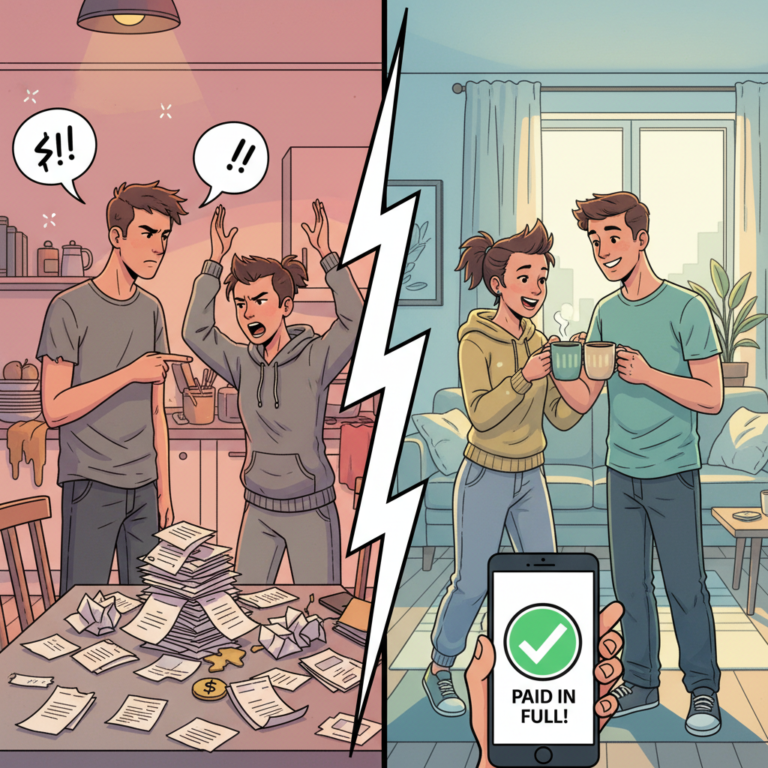


Listen up, frugal hackers and side hustlers. We need to have a real talk about love and money. You’ve found your person, you’re spending every night at each other’s places anyway, and moving in together seems like the ultimate life hack. You split the rent, you split the utilities, and boom—instant savings, right? Wrong. Moving in together without having a hardcore, no-BS financial conversation is the fastest way to wreck your credit score, drain your savings, and ruin your relationship.
When you sign a lease together, you are entering a legally binding financial contract. If your partner loses their job, blows their paycheck, or decides to bounce, the landlord doesn’t care about your broken heart—they want their $2,000 on the first of the month. Before you start picking out matching throw pillows, you need to dig into the financial skeletons in the closet.
Let’s look at the real math of moving in together. It’s not always the fairy tale savings you think it is.
| The Expense | Living Alone (Your Cost) | Moving In Together (The Expectation) | Moving In Together (The Reality if Unprepared) |
|---|---|---|---|
| Rent | $1,500 | $1,000 (Upgrading to a $2,000 place) | $2,000 (Partner loses job, you pay it all) |
| Utilities | $150 | $100 (Split 50/50) | $250 (Partner leaves AC running 24/7) |
| Groceries | $300 | $250 (Bulk buying) | $600 (Partner refuses to eat leftovers) |
| Furniture | $0 (Already own) | $0 (Combine stuff) | $1,500 (Financing a new couch together) |
Don’t play yourself. To protect your hard-earned cash and your sanity, you must ask these 20 awkward money questions. Grab a drink, order a pizza, and let’s get into it.
The Debt & Credit Confessional

This is where the rubber meets the road. You cannot build a solid financial house on a foundation of hidden debt. You need to know exactly what you are attaching your name to.
1. What is your exact credit score?
Don’t accept “Oh, it’s pretty good.” You need a number. If you are applying for an apartment together, the landlord will pull both scores. If your partner has a 520 credit score, you might get denied, or you might have to sign as the sole leaseholder—meaning you carry 100% of the legal risk.
2. How much total debt do you have?
Are we talking about $5,000 in student loans, or $45,000 in high-interest credit card debt? Debt isn’t a dealbreaker, but lying about it is. You need to know what their monthly minimum payments are.
3. Are you currently in collections or facing wage garnishment?
If their wages get garnished, their income drops overnight. Guess who has to make up the difference for the rent? You.
4. Do you pay off your credit cards in full every month?
This reveals their daily financial habits. If they are carrying a balance and paying 25% APR just to fund a lifestyle they can’t afford, that’s a massive red flag for your shared future.
5. Have you ever filed for bankruptcy or been evicted?
An eviction on their record will make getting a decent apartment nearly impossible. You need to know this before you waste money on application fees.
The Frugal Hacker Rule: Never co-sign a loan or an auto lease for a boyfriend or girlfriend. Ever. If a bank, whose literal job is to calculate risk, won’t lend them money, you shouldn’t either.
The Daily Grind & Bill Splitting

Once you know the past, you need to plan the present. How is the day-to-day cash going to flow? If you don’t set strict rules now, resentment will build faster than dirty dishes in the sink.
6. How exactly are we splitting the rent?
Will it be 50/50? Or will it be proportional to income? If you make $80,000 and your partner makes $40,000, forcing a 50/50 split on a luxury apartment will bankrupt them. Consider an income-based split.
| Split Method | Person A (Makes $80k) | Person B (Makes $40k) | Total Rent |
|---|---|---|---|
| 50/50 Split | $1,000 | $1,000 (Struggling) | $2,000 |
| Proportional (66% / 33%) | $1,333 | $667 (Comfortable) | $2,000 |
7. Who is physically pushing the ‘Pay’ button?
Whose bank account is the rent coming out of? Who is logging into the electric company portal? Decide who the “Household CFO” is, and set a strict deadline for when the other person transfers their share (e.g., three days before the 1st of the month).
8. What is our grocery budget, and what are we eating?
If you are a frugal meal-prepper who lives on rice, beans, and chicken for $50 a week, and they want organic takeout every night, you will fight. Set a firm weekly grocery budget.
9. How do we handle ‘fun money’ and shared dates?
Just because you live together doesn’t mean you stop dating. But who pays for Friday night pizza now? Establish boundaries on what is a “shared expense” versus an “individual expense.”
10. Are we opening a joint bank account?
For unmarried couples, the safest bet is “Yours, Mine, and Ours.” Keep your paychecks in your personal accounts, and transfer your share of the bills into a joint checking account used strictly for rent and utilities.
Scam Warning: Never deposit your entire paycheck into a joint account with someone you are not legally married to. If things go south, they can legally drain the account and walk away, leaving you with zero recourse.
The “Oh Crap” Scenarios

Life happens. Cars break down, companies do layoffs, and sometimes, love fades. A street-smart side hustler plans for the worst while hoping for the best.
11. Do you have an emergency fund?
If they don’t have at least $1,000 (preferably 3-6 months of expenses) saved, you are their emergency fund. Ask them how they plan to build one.
12. What happens if one of us loses our job?
Will the employed partner cover 100% of the bills? For how long? Three months? Six months? Set a timeline and an expectation for the unemployed partner to treat job hunting like a 9-to-5.
13. If we break up, who keeps the apartment?
It’s morbid, but necessary. Breaking a lease can cost upwards of $3,000. Decide right now: who moves out, who keeps the couch, and how do you handle the security deposit?
14. How do we handle unexpected pet or car expenses?
If their dog swallows a sock and needs a $2,000 surgery, are you expected to chip in? Clarify what belongs to whom.
15. Will you help me pay my debt, or are we keeping it separate?
If you are hustling to pay off your student loans, does your partner expect you to fund lavish vacations while you’re grinding? Make sure your financial priorities align.
The Long-Term Vision

Moving in together is usually a stepping stone to a permanent future. You need to make sure you are walking on the same path, or you’re just wasting each other’s time.
16. Do you want to buy a house eventually?
If you are aggressively saving $500 a month for a down payment, and they want to rent and travel the world forever, you have a massive compatibility issue.
17. What are your retirement goals?
Are they investing in a 401(k) or Roth IRA? Or is their retirement plan “winning the lottery”? You don’t want to be 65 and working double shifts because your partner never saved a dime.
18. Are we having kids, and how does that affect our income?
Kids are expensive. If you plan to have them, will one of you stay home? How will you survive on one income? It’s never too early to discuss the financial impact of expanding your family.
19. Do you financially support any family members?
If your partner sends $400 a month to their parents or siblings, that is money leaving your household. You need to know if this is a temporary situation or a lifelong commitment.
20. What is your absolute biggest financial dealbreaker?
Is it hidden debt? Gambling? Refusing to work? Put your absolute hard lines in the sand today.
The Master Script: How to Bring This Up

Reading these questions is easy. Asking them to your partner’s face without sounding like an IRS auditor is the hard part. Here is your step-by-step action plan to have this conversation peacefully.
- Set a Date: Do not spring this on them after a long day of work. Schedule it. Say, “Hey, I’m so excited about us moving in together. I want to make sure we’re a bulletproof team. Can we do pizza and a money date this Sunday?”
- Bring Your Own Numbers: Be vulnerable first. Bring your own credit score, your debt numbers, and your income. Show them you have nothing to hide.
- Keep it Blame-Free: If they reveal a massive amount of debt, do not panic or shame them. Ask them what their action plan is to tackle it.
- Write it Down: Create a shared Google Doc with your agreed-upon budget, rent split, and rules. Memory is fickle; written agreements are facts.
The Conversation Script: “I love you, and I want this to work long-term. Because I value our relationship so much, I want to make sure money never becomes a reason we fight. Let’s lay everything on the table today so we can build our future together without any surprises.”
Conclusion
Moving in together should be an exciting milestone, not a financial death trap. By having the guts to ask these 20 awkward money questions, you are taking control of your future. You are acting like a true frugal hacker—protecting your downside while optimizing for success. Remember, a partner who gets angry or defensive when you try to discuss budgeting is waving a massive red flag. A true partner will sit down, crunch the numbers with you, and build an empire.
Now get out there, have the hard conversations, and start building a life that is both romantically and financially wealthy!
Disclaimer: I am an empowering frugal hacker, not a certified financial planner, lawyer, or CPA. The information provided in this article is for educational and entertainment purposes only. Always consult with a professional before making major financial or legal decisions.


Makenzie is the founder and lead writer at MoneyHackTips.com — a personal finance blog dedicated to delivering street-smart financial wisdom for real people on real budgets. With 300+ published articles covering everything from debt management to investing fundamentals, Makenzie’s mission is to make every dollar work harder. When not writing about money hacks, Makenzie is testing frugal living strategies, optimizing side hustles, and helping readers build financial freedom from scratch.