

This Simple 50/30/20 Budget Trick Will Save You Thousands This Year
Let’s be real: most budgeting advice is garbage. It’s either a 100-tab spreadsheet that requires a finance degree or a guilt-trip guide that tells you to stop buying lattes if you ever want to own a home. It’s complicated, restrictive, and frankly, it sucks the joy out of life. You work hard for your money; you should be able to enjoy it without feeling like you’re one purchase away from financial ruin.
What if there was a way to get your money right without the headache? A system so simple you can map it out on a napkin, but so powerful it can change your financial future? Enter the 50/30/20 rule. This isn’t your grandma’s envelope system. This is a street-smart framework for the modern hustler. It’s about balance, not deprivation. It’s about building wealth while still living a life you actually enjoy. Forget the financial jargon and the penny-pinching misery. We’re about to break down a strategy that puts you back in the driver’s seat, automates your savings, and can literally put thousands of dollars back in your pocket this year. Ready to take control? Let’s get into it.
What is the 50/30/20 Rule and Why It Crushes Other Budgets

So what’s the secret sauce? The 50/30/20 rule is a simple framework for dividing your after-tax income into three buckets. No complex categories, no tracking every single stick of gum. It’s a high-level game plan that gives every single one of your dollars a job.
The Golden Rule of 50/30/20: 50% of your income goes to Needs, 30% goes to Wants, and a powerful 20% goes to Savings & Debt Repayment.
That’s it. That’s the whole system. The beauty is in its simplicity. Think about the last time you tried to budget. You probably had categories for ‘gas,’ ‘groceries,’ ‘utilities,’ ‘subscriptions,’ ‘entertainment’… the list goes on. If you overspent on groceries, you felt like you failed. The 50/30/20 rule doesn’t care if you spent more on fancy cheese this month and less on gas. It just cares that you kept your total ‘Needs’ spending at or below 50%.
This method crushes traditional, line-item budgets because it’s flexible. It adapts to your life. It understands that some months you’ll have a higher heating bill, and other months you’ll want to splurge on concert tickets. As long as you stay within your three main buckets, you’re winning. It shifts the focus from ‘Can I afford this coffee?’ to ‘Does this purchase fit into my 30% Wants bucket this month?’ It’s a mindset shift from restriction to conscious spending. You’re not cutting things out; you’re just making sure your spending aligns with your goals. It’s the difference between a financial prison and financial freedom.
The Breakdown: How to Carve Up Your Paycheck Like a Pro

Alright, let’s get into the nitty-gritty. Knowing the percentages is one thing, but knowing what actually goes into each bucket is where the magic happens. Get this part right, and you’re golden.
The 50% ‘Needs’ Slice: Your Survival Fund
These are the absolute must-haves. The non-negotiables. If you stopped paying for these, you’d be in serious trouble. This bucket is the foundation of your financial house. Be ruthless here—distinguish a true ‘need’ from a ‘want’ in disguise.
- Housing: Rent or mortgage payment (principal and interest).
- Utilities: Electricity, water, gas, internet (yes, internet is a need in 2023).
- Transportation: Car payment, insurance, gas, public transit pass. The basic cost to get you to your job.
- Groceries: The food you buy to cook and eat at home. Not your Friday night takeout habit.
- Insurance: Health, renters, or homeowners insurance.
- Minimum Debt Payments: The absolute minimum you have to pay on your student loans, credit cards, etc., to not go into default. Anything extra comes later.
The 30% ‘Wants’ Slice: Your ‘Live a Little’ Fund
This is where the fun is. This bucket is crucial because it’s what makes the whole budget sustainable. A budget that doesn’t allow for any fun is a budget you’ll quit in a week. This is your permission slip to spend on things that make you happy, guilt-free.
- Entertainment: Concert tickets, movies, streaming services (Netflix, Spotify).
- Dining Out: Restaurants, bars, that daily coffee you love.
- Hobbies: Gym membership, art supplies, video games, your side hustle supplies.
- Shopping: New clothes, gadgets, home decor—anything that isn’t a replacement for a broken essential.
- Travel: Weekend getaways, vacation flights, and hotels.
The 20% ‘Goals’ Slice: Your Future-Building Engine
This is the most important bucket. This is your ticket to financial freedom. The 20% slice is where you pay yourself first and build a future where you’re not living paycheck to paycheck. This is your wealth-building machine.
- Aggressive Debt Repayment: Paying anything above the minimum on your credit cards, student loans, or car loans. This is a guaranteed return on your investment.
- Emergency Fund: Building up 3-6 months of living expenses in a high-yield savings account. This is your shield against life’s curveballs.
- Retirement Savings: Contributions to your 401(k), Roth IRA, or other retirement accounts.
- Other Savings Goals: Saving for a down payment on a house, a new car, or a big trip.
Putting It on Autopilot: The Set-It-and-Forget-It Savings System

A plan is useless without action. The key to making the 50/30/20 rule stick is to take the willpower out of the equation. You’re going to automate your success so your money goes where it needs to without you lifting a finger after the initial setup. Here’s your step-by-step action plan:
- Calculate Your Real Income: First, find your net income—that’s your paycheck after taxes, health insurance, and any other deductions are taken out. This is the number you’ll base everything on. If you get paid $2,000 twice a month, your monthly net income is $4,000.
- Do the Math: Using your net income, calculate your 50/30/20 targets. For a $4,000 monthly income:
- Needs (50%): $2,000
- Wants (30%): $1,200
- Goals (20%): $800
- Track Your Spending (The Reality Check): For 30 days, just track where your money is going. Don’t change anything yet. Use an app like Mint, YNAB, or even just a notebook. The goal is to get a brutally honest picture of your current habits. You might be shocked to see how much you’re spending on ‘Wants’. This isn’t to make you feel bad; it’s to give you a starting point.
- AUTOMATE YOUR 20%: This is the most critical step. Set up an automatic transfer from your checking account to your savings accounts for the day after you get paid. Before you can spend it, before you even see it, that $800 (or whatever your 20% is) gets whisked away. Send part to your high-yield savings for your emergency fund, and part to your retirement accounts. Pay yourself first, always.
- Separate Your Funds: Open up separate bank accounts for your main buckets. Have your paycheck direct-deposited into your ‘Needs’ checking account. This account is for rent, bills, and groceries. Then, set up an automatic transfer of your ‘Wants’ money (e.g., $1,200) to a different checking account with its own debit card. This is your ‘fun money’ card. When it’s empty, you’re done with ‘Wants’ spending for the month. This simple trick prevents you from accidentally spending your rent money on a new pair of sneakers.
The Math That Doesn’t Lie: Real-World Scenarios & Big Savings
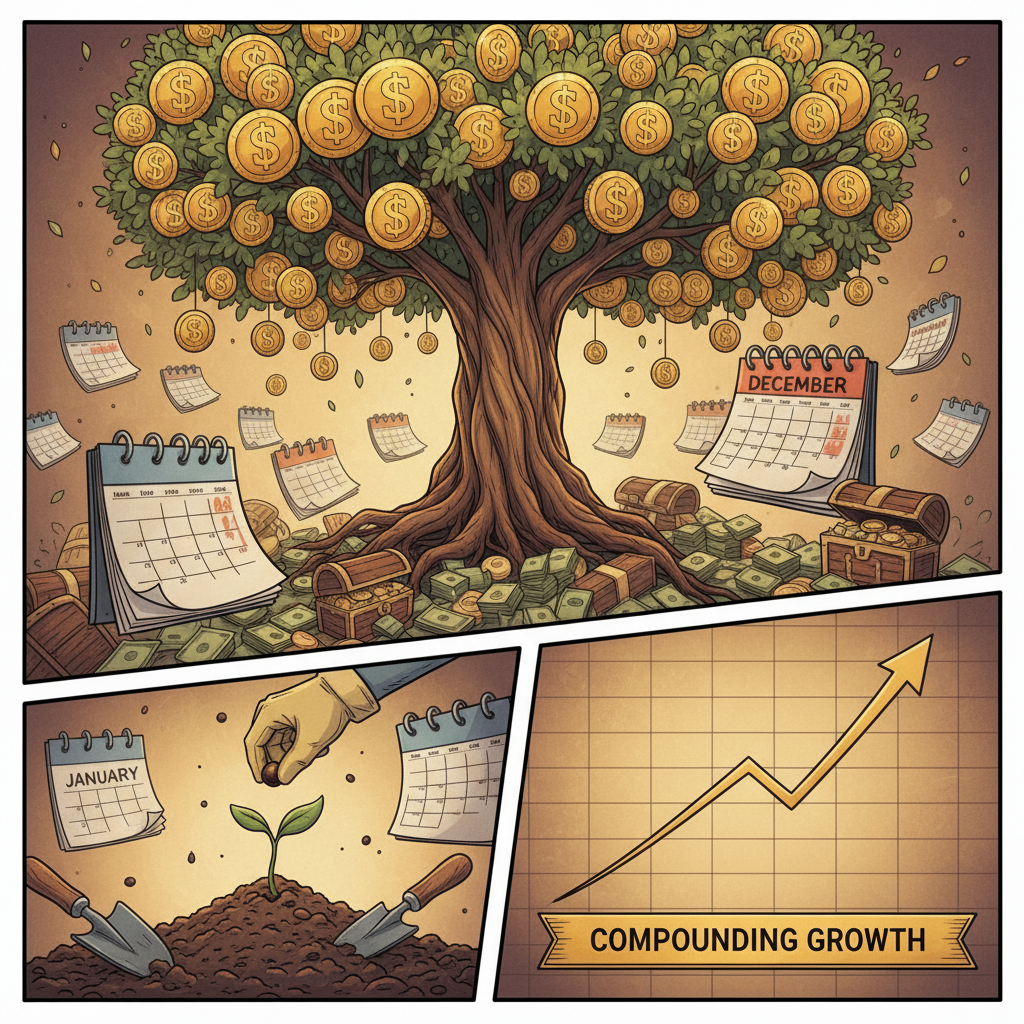
Talk is cheap. Let’s look at the hard numbers to see how this simple trick can radically change your financial picture. We’re not talking about finding a few extra bucks; we’re talking about stacking thousands of dollars per year that you didn’t think you had.
Below are two common scenarios. Find the one that’s closest to you and see the potential. This is what happens when you give your money a clear plan.
| Income Profile | Monthly After-Tax Income | 50% Needs (Per Month) | 30% Wants (Per Month) | 20% Goals (Per Month) | Total Annual Savings |
|---|---|---|---|---|---|
| Side Hustler / Entry-Level | $3,000 | $1,500 | $900 | $600 | $7,200 |
| Budget-Conscious Individual | $4,500 | $2,250 | $1,350 | $900 | $10,800 |
| Frugal Couple (Combined) | $6,500 | $3,250 | $1,950 | $1,300 | $15,600 |
Look at those numbers. An extra $7,200 a year can fully fund a Roth IRA and build a healthy emergency fund. For the couple, $15,600 is a serious down payment on a house in just a couple of years. This isn’t fantasy math; it’s a direct result of automating your 20% ‘Goals’ slice. This is money that was likely getting absorbed by random, unfulfilling ‘Wants’ before. By simply creating a structure and automating the process, you uncover a massive potential for wealth building that was hiding in your paycheck all along.
Troubleshooting Your 50/30/20: Common Pitfalls and How to Dodge Them

Starting a new system isn’t always a smooth ride. You might hit a few bumps. Don’t panic—it’s normal. Here’s how to handle the most common issues without throwing in the towel.
“My ‘Needs’ are way over 50%!”
This is the most common problem, especially if you live in a high-cost-of-living area. If your rent alone eats up 40% of your income, it can feel impossible. First, double-check your ‘Needs’ list. Is that daily Uber ride a need, or can you switch to cheaper public transport? Is your unlimited phone plan a need, or can you find a budget carrier? If you’ve cut everything and you’re still over, you have two main levers to pull: reduce your biggest expenses (can you get a roommate? move to a cheaper neighborhood?) or increase your income with a side hustle. The 50/30/20 rule is a diagnostic tool—if your numbers don’t fit, it’s telling you something bigger needs to change.
“I have a mountain of high-interest debt. What about the 20%?”
High-interest debt, like credit card debt, is a financial emergency. In this case, your 20% ‘Goals’ slice becomes a debt-killing machine. You still save a small emergency fund first (say, $1,000) so you don’t have to rely on credit for the next crisis. After that, every single penny of your 20% should go towards destroying that high-interest debt, starting with the card with the highest APR. Paying off a 22% interest credit card is like getting a guaranteed 22% return on your money. No investment can promise that. Annihilate the debt first, then pivot your 20% back to savings and investments.
“My income is irregular. How does this work for me?”
This is for all the freelancers, gig workers, and side hustlers. The key is to budget based on your lowest-earning month from the past year. Calculate your 50/30/20 based on that ‘worst-case’ number. This ensures your essential ‘Needs’ are always covered. Then, in the months where you earn more than that baseline, the entire surplus goes DIRECTLY to your 20% ‘Goals’ bucket. Don’t let lifestyle creep set in. A great month means you can supercharge your debt repayment or fill up your emergency fund in record time. This strategy turns unpredictable income into a powerful wealth-building tool.
Conclusion
The 50/30/20 rule isn’t just another budget. It’s a blueprint for a better financial life. It’s built on a foundation of empowerment, not restriction. It gives you a clear path to follow, automates the heavy lifting, and most importantly, it gives you the freedom to spend on the things you love without a shred of guilt. You don’t have to be a financial wizard to build wealth. You just need a solid game plan and the discipline to stick with it.
This is your chance to stop living in a state of financial anxiety, wondering where your money went at the end of the month. This is how you start building a buffer, paying down debt, and investing in your future self. Stop letting your money manage you. It’s time to take the wheel. Calculate your numbers, automate your savings, and watch how this simple trick puts thousands of dollars back into your control, year after year.