
The “In Case of Emergency” Binder Every Family Needs to Build Right Now
Picture this: a sudden medical emergency. You’re at the hospital, stressed and scared, and the front desk asks for insurance information you can’t find. Or worse, a natural disaster forces you to evacuate, and all your critical documents are scattered around the house. In that moment of panic, hunting for a birth certificate or a bank account number is the last thing you need. That chaos isn’t just stressful—it’s expensive. It leads to missed bill payments, lost opportunities, and hours of your life wasted on hold with customer service.
This isn’t about being paranoid; it’s about being powerful. It’s time to stop reacting and start preparing. The ‘In Case of Emergency’ (ICE) Binder is your ultimate power move. It’s your family’s playbook, your financial fortress, and your command center all rolled into one. Building it isn’t a depressing chore; it’s one of the most empowering, money-smart things you can do for your family’s security and your own peace of mind. Let’s get it done.
The Real Cost of Chaos: Why You Need This Binder Yesterday

Let’s be real. Nobody likes thinking about emergencies. But ignoring the possibility is a luxury most of us can’t afford. The true cost of being unprepared isn’t just the headache; it’s cold, hard cash drained from your pocket when you’re most vulnerable.
Think about the financial fallout of a simple crisis. If a primary bill-payer is hospitalized, how do you access the online banking to pay the mortgage on time? A missed payment doesn’t just mean a $50 late fee; it can ding your credit score, making future loans more expensive for years. That’s a multi-thousand-dollar mistake born from disorganization. What if your wallet is stolen? Having copies of your IDs and credit cards in one place can mean the difference between canceling them in 15 minutes versus spending an entire day on the phone while a thief goes on a shopping spree.
Let’s do some street-smart math. Imagine you spend just 10 hours tracking down documents, making calls, and resetting passwords during a family crisis. If you value your time at a conservative $25/hour, that’s $250 of your life force completely wasted. And that’s a low-ball estimate. An ICE binder gives you that time back. It’s an insurance policy against chaos, and the premium is just a few hours of your time now to save you untold amounts of stress and money later.
The Blueprint: Building Your Binder Section by Section

Alright, let’s get to work. Your binder is your fortress, and every fortress needs a solid blueprint. We’re going to build this thing section by section, so it’s organized, easy to navigate, and ready for action. Grab a sturdy 2- or 3-inch binder, a set of dividers with tabs, and let’s fill it with power.
Section 1: The Quick-Grab Essentials
This is your ‘fire drill’ section. If you have to leave your house in five minutes, these are the copies you’ll be glad you have. Keep the originals in a fireproof safe or safe deposit box.
- Copies of Government IDs (Driver’s licenses, state IDs)
- Copies of Birth Certificates for everyone in the family
- Copies of Social Security Cards
- Copies of Passports
- Copies of Marriage Certificate, Divorce Decrees, or other vital records
Section 2: The Money Map
This is the command center for your finances. In an emergency, this section allows you or a trusted person to keep your financial life running smoothly. No late fees, no missed payments, no locked accounts.
- Bank Accounts: List all checking, savings, and money market accounts with bank names, account numbers, and customer service phone numbers.
- Credit & Debit Cards: A list of all cards, account numbers, and the phone numbers on the back to report them lost or stolen.
- Loans & Debts: Information on your mortgage, car loans, student loans, and any other personal loans, including the lender, account number, and payment information.
- Retirement & Investments: Details for all 401(k)s, IRAs, brokerage accounts, and other investments.
- Monthly Bills: A master list of all your recurring bills (utilities, phone, internet, etc.), including how they are paid (auto-pay, check) and account login info.
| Service / Account | Website / Login Page | Username | Password Hint (NOT the password!) |
|---|---|---|---|
| Main Checking – Capital One | capitalone.com | FrugalHacker22 | First pet + childhood street |
| Verizon Wireless | verizon.com/my-verizon | MyHustlePhone | Favorite 90s band |
| Mortgage – Rocket | rocketmortgage.com | HomeownerHero | City we met in |
Section 3: The Health & Medical Hub
When health is on the line, fumbling for information is not an option. This section ensures medical professionals have what they need, fast.
- Copies of Health, Dental, and Vision Insurance Cards (front and back).
- A list of all doctors, their specialties, and phone numbers.
- A detailed list of medications for each family member, including dosage and frequency.
- A list of known allergies and medical conditions.
- Copies of Medical Power of Attorney and Living Wills.
Section 4: The Legal & Legacy Layer
This section is about protecting your family and ensuring your wishes are honored. It’s the ultimate act of looking out for the ones you love.
- Key Documents: Include copies of Wills, Trusts, and Power of Attorney documents. Crucially, add a note stating where the signed originals are located (e.g., ‘Original Will located in fireproof safe’ or ‘with attorney Jane Doe’).
- Life Insurance: Policy numbers, company names, and contact information for any life insurance policies.
- Property Deeds: Copies of deeds for your home, vehicles, and any other significant property.
Section 5: The Household Command Center
This section covers the nuts and bolts of running your home—invaluable if someone else needs to step in.
- Copies of car titles and registrations.
- Homeowner’s or Renter’s Insurance policy information.
- A list of trusted repair contacts (plumber, electrician, HVAC).
- Login information for all utilities (gas, electric, water, internet).
- A spare set of house and car keys (in a secure pocket of the binder).
The Game Plan: How to Build It Without the Overwhelm

Looking at that list can feel like staring up at a mountain. But you don’t climb a mountain in one leap. You do it one step at a time. Here’s how to build your binder without losing your mind.
- Schedule It, Don’t Wing It. Pull out your calendar right now and block off 30-60 minutes this week. Label it ‘Project Freedom’ or ‘Fortress Construction.’ Treat it like an unbreakable appointment. One focused hour is better than 10 hours of worrying about it.
- Start with the Easy Wins. Don’t try to tackle the whole ‘Money Map’ section at once. Start small. Your first mission? Just gather last month’s bank statements. That’s it. Put them in the binder. Next session, find your car titles. Tackling one small task at a time builds momentum and makes the process feel manageable.
- Go Digital & Physical (The Belt-and-Suspenders Approach). A physical binder is king in a power outage. But a digital backup is a lifesaver if the binder is lost or destroyed. Scan every document as you add it to the binder. Save the files to an encrypted, password-protected USB flash drive. Keep this drive in a separate, secure location, like a safe deposit box or at a trusted family member’s home. You’re not paranoid; you’re prepared for anything.
- The ‘Tell Someone’ Rule. A secret fortress is useless. At least one trusted person—your spouse, your partner, your executor, or a very reliable adult child—needs to know that this binder exists and where to find it. You don’t have to give them a key to the safe today, but they need to know the location for when it’s truly needed.
- Set a ‘Review & Update’ Date. Life changes. You’ll get a new credit card, change doctors, or pay off a loan. Schedule a quick 30-minute review every six months or once a year to update your binder. A quick tune-up keeps your fortress impenetrable.
Level Up: Fortifying Your Binder for the Digital Age
You’ve got the physical foundation. Now, let’s bring your fortress into the 21st century. In today’s world, our lives are run by passwords and digital accounts. Leaving your loved ones locked out of your digital life is the modern equivalent of leaving them without a key to the house.
Master Your Passwords
Writing all your passwords down on a piece of paper is a rookie move and a huge security risk. The pro move is using a password manager. Services like LastPass, 1Password, or Bitwarden create and store complex, unique passwords for all your accounts. You only need to remember one thing: the master password.
The Key Rule: Do NOT write your master password in the binder. Instead, create a sealed envelope within your binder labeled “Digital Access.” Inside, include clear instructions on how to access your password manager. You can also entrust the master password to your designated executor or tech-savvy loved one in a separate, secure manner.
Create a Digital Legacy Plan
What happens to your email, your social media, your cloud storage full of family photos? Create a ‘Digital Legacy’ sheet for your binder. List your most important digital accounts (Email, Facebook, iCloud/Google Photos, etc.) and your wishes for each one. Do you want your social media memorialized or deleted? This document gives your family a clear roadmap.
Secure Your Physical Fortress
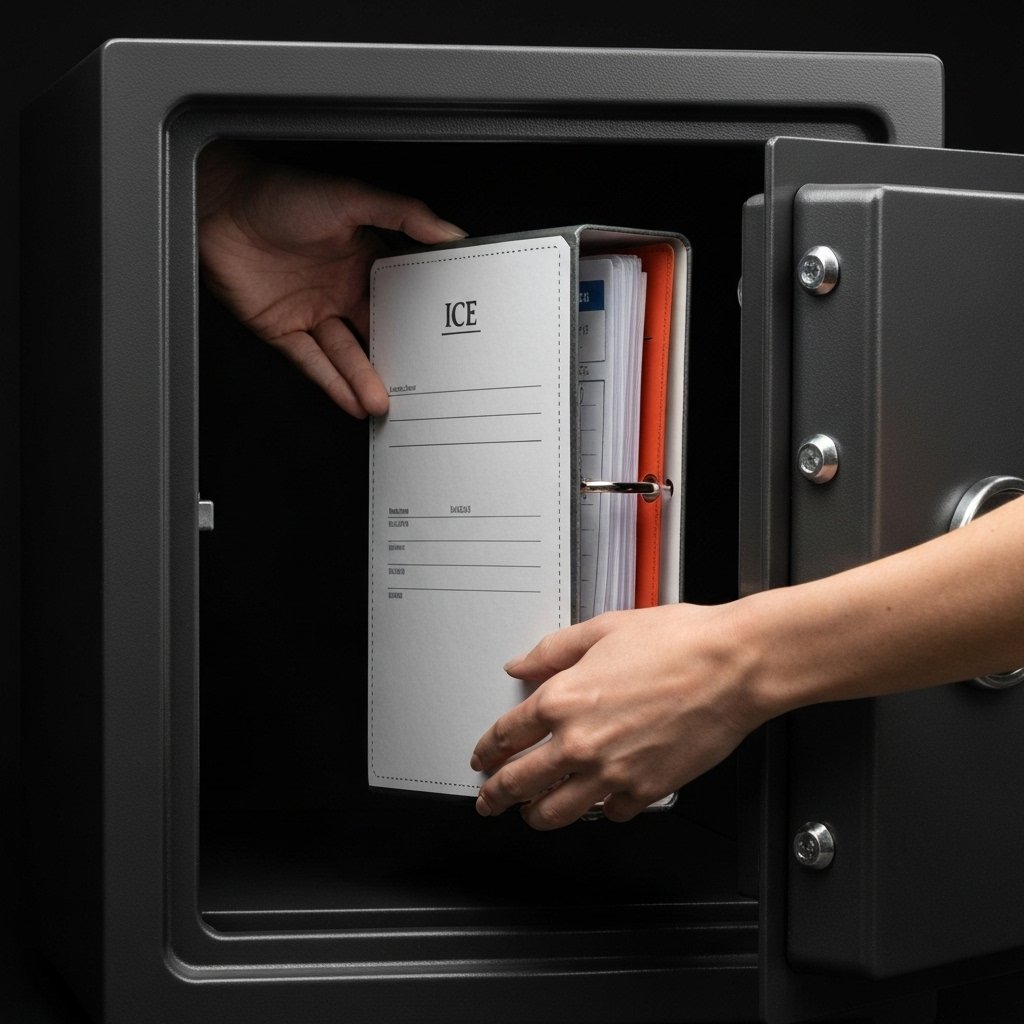
Your binder contains a treasure trove of sensitive information. It’s not something to leave on the coffee table. Invest in a small, durable, fireproof and waterproof safe. These can be purchased for under $100 and are one of the best investments you’ll ever make. Store your ICE binder, your digital backup USB drive, and your original documents (passports, birth certificates, deeds) in this safe. This is the final layer of armor for your family’s security plan.
Conclusion
Building your ‘In Case of Emergency’ Binder is more than just an organizational project. It’s an act of profound responsibility and empowerment. It’s the process of looking chaos in the eye and saying, ‘Not today.’ Every document you copy, every account number you log, is a brick in the fortress you’re building around your family.
The peace of mind that comes from knowing you’re prepared is priceless. You’re no longer at the mercy of sudden events; you have a playbook to navigate them with confidence and control. Don’t put it off. Start with one section, one document, one 15-minute task this week. You’ve got the blueprint. Now go build your fortress. You got this.