

The “High-5” Banking Method: Why You Need 5 Bank Accounts
Let’s be real. You hustle hard for your money. You clip coupons, you drive for DoorDash on the weekends, you find the deals. So why does it feel like your bank account is a black hole where your cash just disappears? You look at your balance, see a decent number, and think you’re doing okay. A week later, after a few bills, groceries, and one impulse buy, you’re wondering where it all went. That’s not a personal failing; it’s a system failure. The traditional “one-account-fits-all” method is broken. It’s designed to keep you confused and spending.
It’s time to stop playing their game and start playing your own. The High-5 Banking Method is your new playbook. It’s a dead-simple, powerful strategy that puts you in the driver’s seat of your finances. By creating five distinct accounts, you give every dollar a mission. You’ll know exactly what you have for bills, what’s saved for a crisis, and—most importantly—what you can spend guilt-free. Forget complicated spreadsheets and budgeting apps that just track your past mistakes. We’re building a forward-looking system that automates your success and makes financial control effortless.
Why Your Single Bank Account is Sabotaging Your Wealth

Think of your single checking account as a junk drawer. Your paycheck, your rent money, your savings for a vacation, and your coffee fund are all tossed in there together. When you need to pay a bill, you just reach in and grab some cash. When you want to buy something fun, you do the same. The problem? You never actually know how much is in the drawer for each specific purpose. This creates a dangerous illusion called ‘The Balance Mirage’.
You see $3,000 in your account and your brain translates that to “I have $3,000 to spend!” But that’s a lie. In reality, $1,500 of that is for rent, $400 is for utilities and car insurance, and you were supposed to save $300. That means you only have $800 of truly ‘spendable’ money for the rest of the month. But because it’s all lumped together, it’s incredibly easy to overspend on wants and find yourself scrambling when the needs come due. This is how ‘money leaks’ happen. A $10 lunch here, a $30 subscription there—it all seems insignificant against the big balance, but it drains your resources for what truly matters. Your one account is encouraging you to be reactive with your money, not proactive.
The High-5 Breakdown: Assigning a Job to Every Dollar
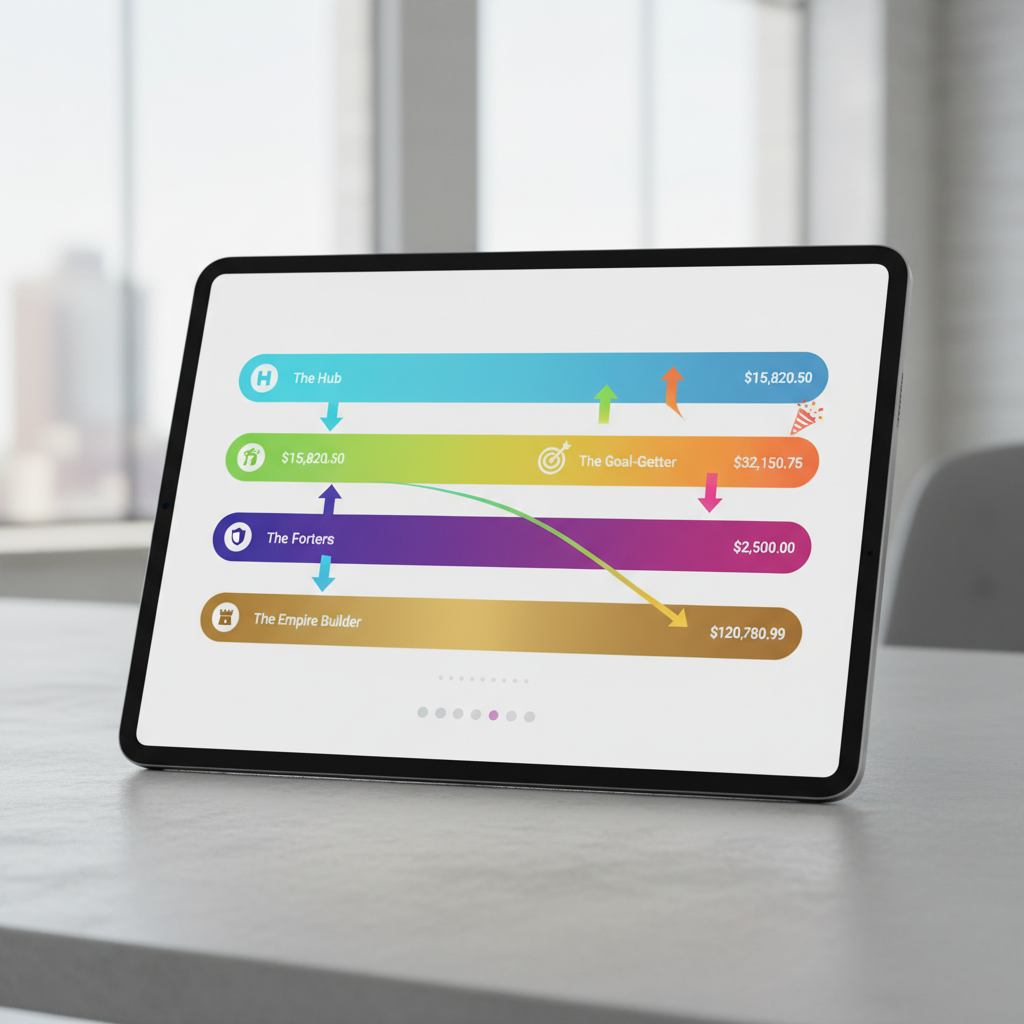
The High-5 Method is about creating clarity through separation. By setting up five dedicated accounts, you build a financial command center where you are the boss. Each account has one specific job, and automation does the heavy lifting. Here’s the lineup:
-
Account #1: The Hub (Your Primary Checking Account)
This is your financial air traffic control. All your income—from your 9-to-5, your side hustles, your eBay sales—lands here first. Its only other job is to pay your predictable, fixed monthly bills: rent/mortgage, utilities, car payment, insurance, phone bill. You should set up auto-pay for these bills directly from this account. Nothing else happens here. No debit card swipes at the grocery store, no random ATM withdrawals. It’s purely for income in, fixed costs out.
-
Account #2: The Fortress (High-Yield Savings for Emergencies)
This is your ‘life happens’ fund. It’s for the unexpected job loss, the blown car transmission, the emergency root canal. Your goal is to stock this account with 3-6 months of essential living expenses. The key is to keep it at a separate, preferably online, bank in a High-Yield Savings Account (HYSA). Why? First, the higher interest rate means your money is actually working for you. Second, the slight inconvenience of it being at another bank makes you less likely to raid it for a non-emergency. Putting just $75 a week here builds to $3,900 in a year, not even counting the compound interest you’ll earn.
-
Account #3: The Goal-Getter (Sinking Funds for Big Goals)
This is where your dreams take shape. Want a $5,000 down payment for a car in 10 months? That’s $500 a month. Planning a $2,400 vacation next year? That’s $200 a month. This account is for large, predictable expenses that aren’t part of your monthly bills. You break down the cost by the number of months you have to save and automate the transfer. Many online banks let you create digital ‘buckets’ or ‘envelopes’ within a single savings account to track multiple goals at once.
-
Account #4: The Fun Fund (Your Guilt-Free Spending Account)
This is the game-changer. This is a second checking account with a debit card that you use for all your variable, everyday spending: groceries, gas, dining out, coffee, clothes, entertainment. Every pay period, a fixed amount is automatically transferred from The Hub into this account. If you give yourself $400 every two weeks, that’s your budget. When the money is gone, it’s gone until the next transfer. This completely eliminates the guilt and anxiety of spending. You know the bills are covered and your savings are growing, so every dollar in this account is yours to enjoy, 100% stress-free.
-
Account #5: The Empire Builder (Investing & Wealth Growth)
This is your long-term wealth machine. A small, automated transfer from The Hub goes directly into this account every single payday. The sole purpose of this account is to feed your investment accounts, whether that’s a Roth IRA, a brokerage account for index funds, or another wealth-building vehicle. Even if you start with just $25 a week, you’re building the most critical habit for financial independence: paying yourself first and consistently.
The Setup: Automate Your High-5 System in Under an Hour
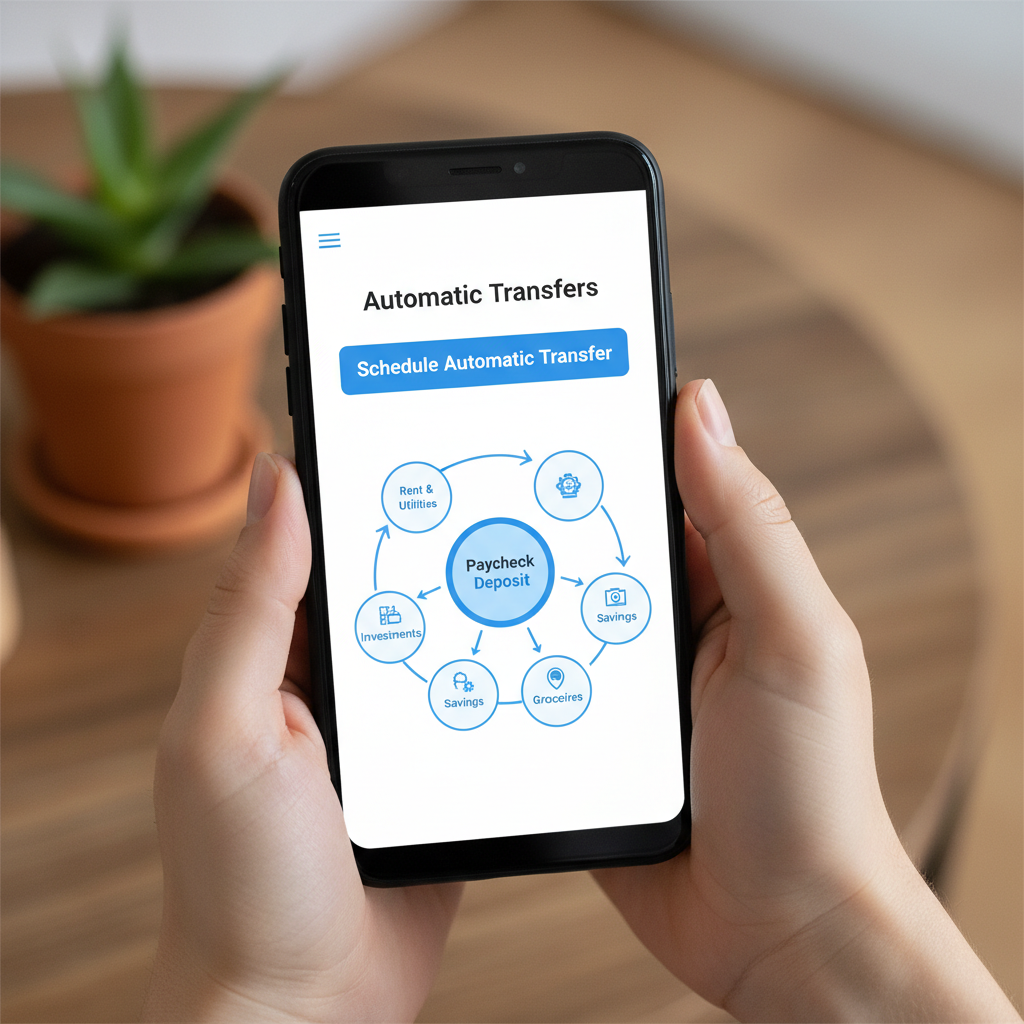
This sounds complicated, but you can set up the entire foundation in less time than it takes to watch a movie. The key is automation. You set it up once, and the system runs itself. Here’s the step-by-step plan:
- Choose Your Banks: You don’t need five different banks, but it helps to have at least two. Use a traditional brick-and-mortar or a good online bank for your two checking accounts (Hub & Fun Fund). For your savings (Fortress & Goal-Getter), absolutely go with a High-Yield Savings Account (HYSA) from an online bank like Ally, Marcus, or Capital One. The interest rates are typically 10x higher than traditional savings accounts, and they rarely have fees.
- Open the Accounts: Open the accounts you need. Most applications take 5-10 minutes online. Don’t worry about funding them immediately. Just get them open. Label them with nicknames in your banking app (e.g., “HUB – BILLS ONLY,” “FUN FUND,” “EMERGENCY FORTRESS”).
- Map Your Money: Calculate your numbers. Add up all your fixed monthly bills (rent, insurance, subscriptions, etc.). This is the amount that needs to stay in The Hub. Then decide on your savings goals for the other accounts. How much can you realistically send to your Fortress, Goal-Getter, and Empire Builder each paycheck? Finally, determine your Fun Fund amount.
- Set Up Your Direct Deposit: Change your employer direct deposit to go 100% into Account #1: The Hub. This is your central collection point.
- Automate the Magic: This is the most important step. Log in to your Hub account and set up recurring automatic transfers. On the day after your paycheck hits, schedule transfers for the amounts you decided on to go to your other four accounts. For example: Payday is Friday. On Saturday, automatically transfer $250 to The Fortress, $100 to The Goal-Getter, $400 to The Fun Fund, and $50 to The Empire Builder.
Once this is done, you don’t touch it. The system now works for you. Your only job is to spend from your Fun Fund debit card and watch your other accounts grow without lifting a finger.
The Math That Matters: From Financial Chaos to Clarity
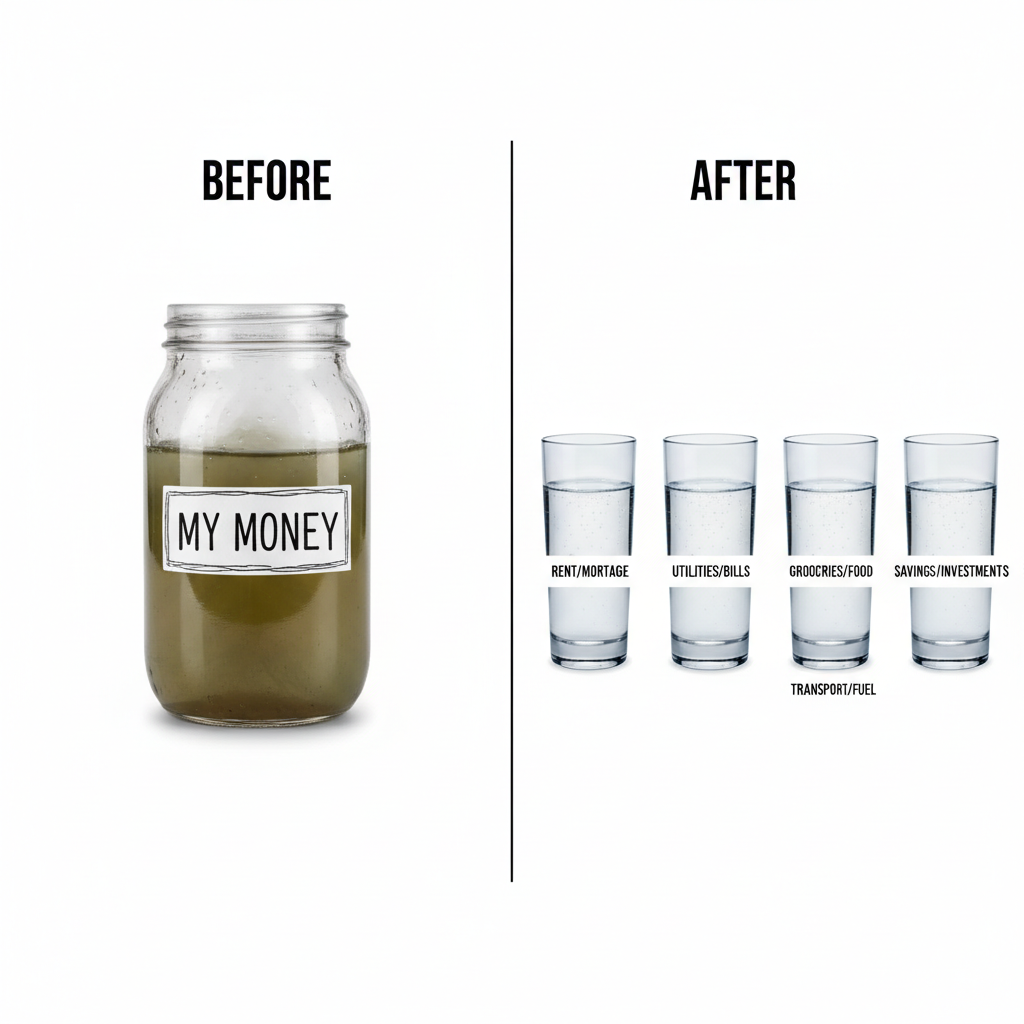
Let’s look at a real-world example of how this transforms your financial picture. Imagine someone named Alex who takes home $4,000 per month.
Before: The One-Account Method
Alex’s $4,000 paycheck lands in one checking account. Rent is $1,500, bills are $500. Alex tries to save “what’s left over” at the end of the month. Throughout the month, Alex uses that one debit card for everything: $450 on groceries, $150 on gas, $300 on dinners out, $200 on random shopping. By the end of the month, there’s only $900 left, which feels tight with the next rent payment looming. So, Alex only manages to save maybe $100, feeling broke and stressed despite a decent income.
After: The High-5 Method
Alex sets up the system. The $4,000 paycheck lands in The Hub. The next day, the automations kick in. Here’s how the money flows and what the result is:
| Account | Action/Purpose | Monthly Amount | Outcome |
|---|---|---|---|
| The Hub (Checking #1) | Income In / Fixed Bills Out | $2,000 remains after transfers | Rent ($1,500) and Bills ($500) are paid automatically. Zero stress. |
| The Fortress (HYSA) | Automatic Transfer for Emergencies | $400 transferred | Emergency fund grows by $4,800/year + interest. Peace of mind. |
| The Goal-Getter (HYSA) | Automatic Transfer for Vacation | $200 transferred | Vacation is fully funded at $2,400 after one year. No credit card debt. |
| The Fun Fund (Checking #2) | Automatic Transfer for Variable Spending | $1,200 transferred ($300/week) | Alex spends this $1,200 on groceries, gas, and fun without guilt. If it runs out, Alex waits for the next transfer. |
| The Empire Builder (Savings) | Automatic Transfer for Investing | $200 transferred | Wealth-building becomes an automatic habit, growing consistently over time. |
Look at the difference. With the High-5 Method, Alex has intentionally saved $800 ($400 Emergency + $200 Goal + $200 Investing) before spending a dime on variable costs. The $1,200 in the Fun Fund is a clear budget, not a vague guess. There is no more end-of-month panic or wondering where the money went. There is only clarity, control, and progress.
Street Smarts: Dodging Fees and Staying on Track

A system is only as good as your ability to stick with it. Here are some street-smart tips to make the High-5 Method bulletproof and avoid common traps.
Hunt for Fee-Free Accounts
The biggest enemy of this system is bank fees. Minimum balance fees or monthly maintenance fees can eat away at your progress. The good news? They are almost entirely avoidable. Most online banks (for your savings) have zero fees. For your checking accounts, look for free options at local credit unions or online banks. If your current bank charges fees, call them and ask to be moved to a free account type. If they say no, it’s time to walk. You are the customer; you have the power.
The ‘Buffer’ is Your Best Friend
In your Hub account, after you’ve paid your bills, you should be left with a zero balance, right? Wrong. That’s cutting it too close. A bill might come in a day early or a transfer might be a day late, triggering a nasty overdraft fee. Keep a small buffer in your Hub account—say, $100 to $200—at all times. Think of it as a permanent cushion that never gets spent. It’s your insurance policy against expensive mistakes.
Adjust Your Sails
Your income and expenses will change. You’ll get a raise, your rent will go up, or you’ll pay off your car. Every six months, do a quick review. Do you need to adjust your transfer amounts? Can you send more to your Empire Builder account now? The system is flexible. A quick 15-minute check-in twice a year keeps it perfectly tuned to your life.
The most important rule is to protect your system’s integrity. Never ‘borrow’ from your Fortress for a non-emergency. Never pay a fixed bill from your Fun Fund. Each account has one job. Respect the jobs, and the system will work for you forever.
Conclusion
The High-5 Banking Method isn’t just another budgeting hack; it’s a fundamental shift in how you interact with your money. It’s about moving from a place of passive hope to a position of active command. You work too hard to let your money just drift away into a financial fog. By giving every dollar a name, a purpose, and a destination, you eliminate financial anxiety and replace it with clarity and confidence.
You’ll know at a glance how much you have for fun. You’ll see your emergency fund growing automatically, creating a safety net that lets you sleep at night. You’ll watch your vacation fund fill up, knowing you’ll pay for it in cash, not debt. This is what financial control feels like. It’s not about restriction; it’s about freedom. The freedom to spend without guilt and save without effort. So stop letting one big, confusing account dictate your financial life. Get out there, open a few fee-free accounts, set up your automations, and give your money the high-five it deserves.