
Stop Losing Money! Why Your Bank Account is Costing You (And Where to Move It)
You work hard for your money. You hustle, you budget, you skip the expensive lattes. So why does it feel like your bank account balance is stuck in quicksand? You’re not imagining things. That comfortable, familiar bank account from that big-name institution is likely a financial parasite, quietly siphoning off your wealth while you’re not looking. They’re making a fortune using your money, and what are they giving you in return? Practically nothing.
This isn’t just about saving a few bucks; it’s about reclaiming what’s rightfully yours. We’re talking about hundreds, even thousands of dollars a year lost to what I call ‘lazy money’—cash that’s just sitting there instead of working for you. It’s time for a wake-up call. This guide is your action plan to stop the bleeding, expose the hidden ways your bank is picking your pocket, and show you exactly where to move your money so it starts paying you for a change.
The Silent Killers: How Your Bank is Picking Your Pocket

You might think your money is safe and sound, but the reality is that most traditional bank accounts are designed to benefit the bank, not you. They chip away at your balance with a series of perfectly legal, but totally outrageous, charges and missed opportunities. Let’s pull back the curtain on these financial vampires.
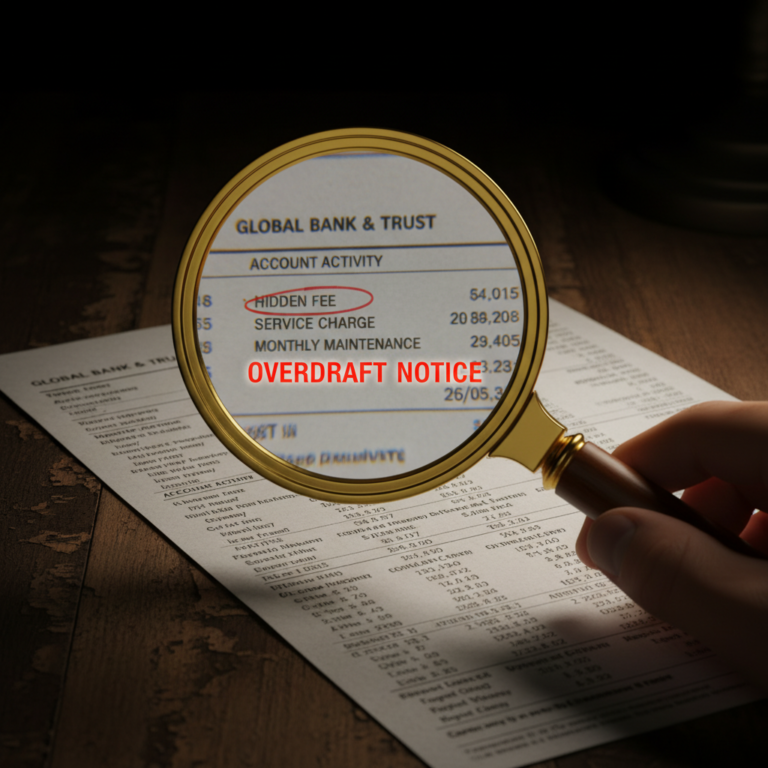
Monthly Maintenance Fees: The Price of ‘Free’ Checking
Remember when checking accounts were actually free? Now, many big banks charge you a ‘maintenance’ or ‘service’ fee just for the privilege of holding your money. They’ll often waive it if you meet certain criteria, like maintaining a high minimum balance—which is just another way they force you to keep more of your lazy money with them.
The Street-Smart Math: That ‘small’ $12 monthly fee doesn’t sound like much, but it adds up. That’s $144 sucked out of your account every single year. Think about it: that’s a full tank of gas, a week’s worth of groceries, or a couple of nice meals out. You’re paying them to hold the money they’re using to make profits. It’s insane.
Overdraft Fees: The Predator’s Price Tag
This is one of the most predatory practices in banking. You accidentally spend $3 more than you have, and the bank ‘graciously’ covers it, then slaps you with a $35 penalty. You just paid a 1,000%+ interest rate on a cup of coffee. These fees are a multi-billion dollar industry built on small mistakes. It’s a trap designed to keep people in a cycle of debt and fees.
The Real Thief: Pathetic Interest Rates
This is the biggest ripoff of all, but it’s the one most people overlook. The national average interest rate for a traditional savings account is a joke—something like 0.01% APY. Meanwhile, inflation is often 3% or more. This means your money isn’t just sitting still; it’s actively losing purchasing power every single day it stays in that account. Your $1,000 today will buy less next year. You’re literally paying to save.
Let’s put this in perspective. Here’s how your bank is costing you compared to a smart alternative.
| Feature | Your Big-Name Bank | High-Yield Savings Account (HYSA) |
|---|---|---|
| Average APY (Annual Percentage Yield) | ~0.01% | 4.00% – 5.00%+ |
| Interest Earned on $10,000 (1 Year) | $1.00 (Yes, one dollar) | $400 – $500+ |
| Typical Monthly Fees | $5 – $15 | $0 |
| Net Gain/Loss on $10,000 | A LOSS of over $100 | A GAIN of $400+ |
The numbers don’t lie. By keeping your money in a traditional bank, you are actively choosing to lose money every year. It’s time to stop.
The Power Plays: Where to Move Your Money for Real Growth
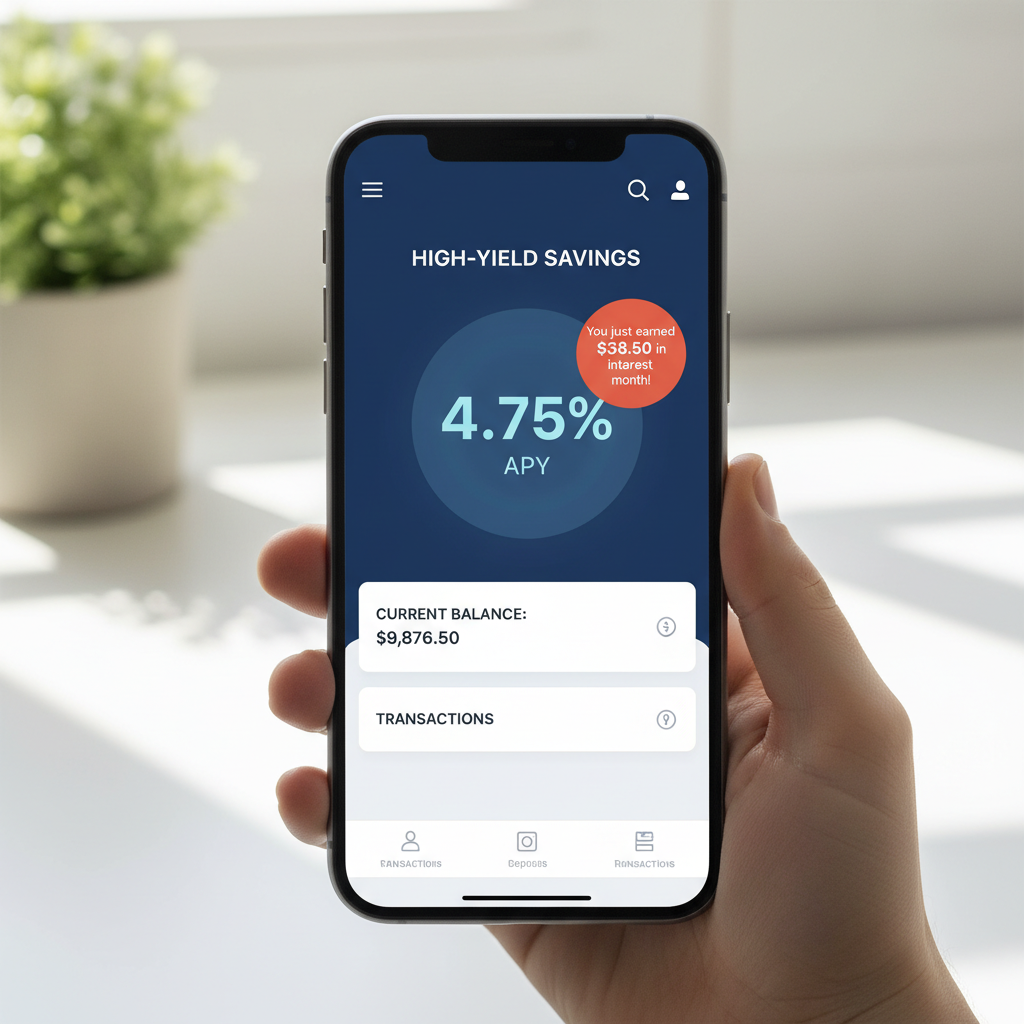
Okay, enough with the problem. Let’s get to the solution. The good news is you have powerful, safe, and easy-to-use alternatives that will turn your savings from a lazy freeloader into a money-making machine. These aren’t complicated investment schemes; they are straightforward, FDIC-insured accounts designed for the 21st century.
The #1 Choice: High-Yield Savings Accounts (HYSAs)
This is your new best friend. An HYSA is exactly what it sounds like: a savings account that pays a much higher interest rate than a traditional one. We’re talking 40 to 50 times more.
- Why do they pay so much? Most HYSAs are offered by online-only banks. They don’t have the massive overhead of physical branches, so they pass those savings on to you in the form of higher rates.
- Are they safe? Absolutely. As long as you choose a reputable bank, your money is FDIC-insured up to $250,000, just like at your old brick-and-mortar bank. There is no catch.
- Who are they for? Everyone. This is the perfect place to park your emergency fund, savings for a down payment, a vacation fund, or any cash you need to keep safe but want to grow.
The Contender: Money Market Accounts (MMAs)
Money Market Accounts are another solid option, often confused with HYSAs. They are also FDIC-insured savings vehicles that offer competitive interest rates. The main difference is they sometimes come with more checking-like features, such as a debit card or the ability to write checks. The rates can be slightly lower or higher than an HYSA, so it pays to compare. They can be a great hybrid option for an emergency fund you might need to access quickly.
The Ultimate Rule of Cash: Your emergency fund and short-term savings should be making you money, not costing you money. The bare minimum requirement is that your money is in an FDIC-insured account that is actively fighting inflation with a high interest rate. No excuses.
Finding these accounts is easy. A quick search for ‘best high-yield savings accounts’ will give you a list of top contenders like Ally Bank, Marcus by Goldman Sachs, SoFi, and Capital One 360. Spend 20 minutes comparing rates and features, and you’re ready for the next step.
The Math That Matters: The Real-World Impact of Switching
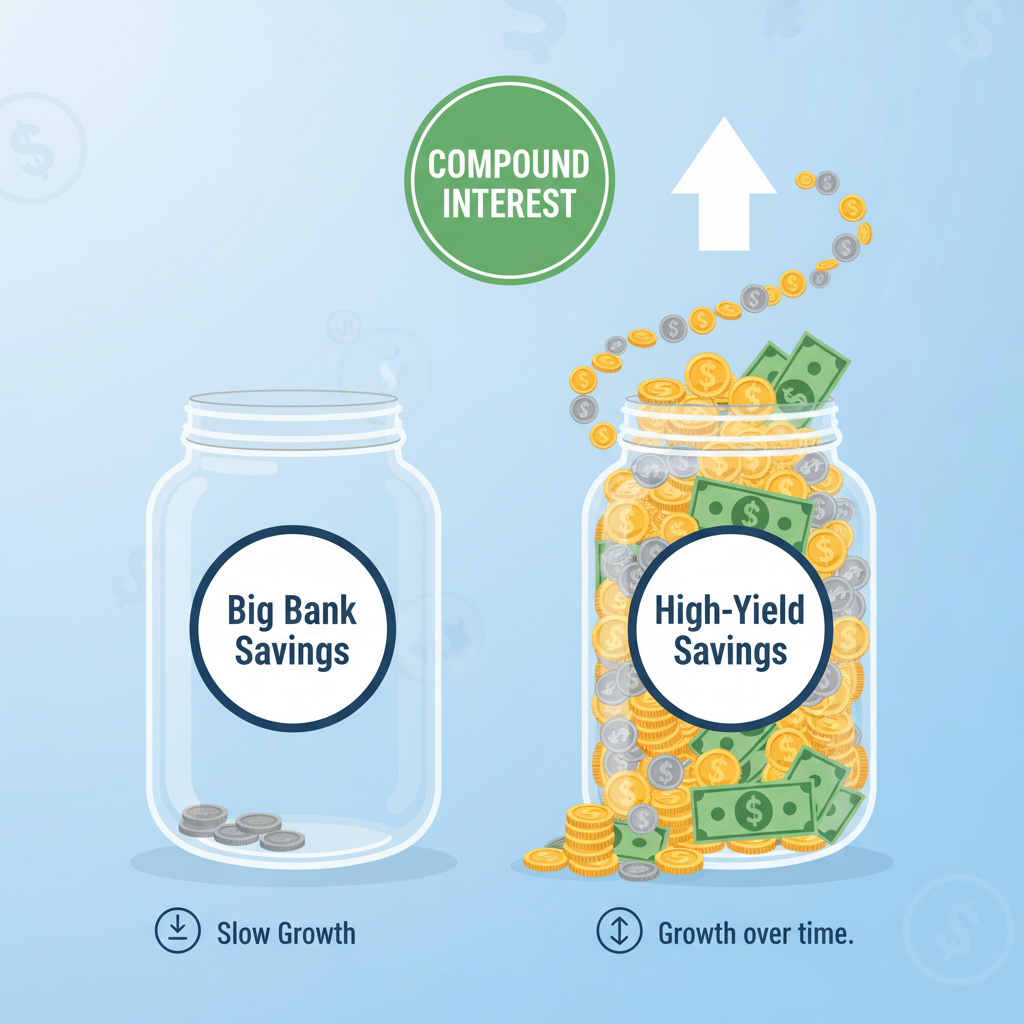
Talk is cheap. Let’s look at the cold, hard numbers. This is where the true cost of inaction becomes painfully clear, and the benefit of making a simple switch becomes a no-brainer. This isn’t just about a few extra dollars; it’s about changing your financial trajectory through the power of compound interest.
The One-Year Turnaround
Let’s start with a common emergency fund goal: $5,000. See what happens to it in one year in two different places.
- In a Big-Name Bank earning a pathetic 0.01% APY, after one year your $5,000 will have earned you… $0.50. Fifty cents. You can’t even buy a candy bar with that.
- In a High-Yield Savings Account earning a conservative 4.5% APY, after one year your $5,000 will have earned you $225. That’s a free utility bill, a fancy dinner, or a significant boost to your savings goal, all for doing absolutely nothing but choosing the right account.
The Long Game: The 10-Year Cost of a Bad Bank Account
This is where it gets really powerful. Compounding interest is like a snowball rolling downhill—the longer it rolls, the bigger it gets. By leaving your money in a low-yield account, you’re leaving that snowball at the top of a very small hill.
Let’s see what happens to a $10,000 savings fund over a decade. We’ll even ignore any monthly fees from the bad bank to make it a ‘best case’ scenario for them.
| Timeframe | Balance in Traditional Bank (0.01% APY) | Balance in HYSA (4.5% APY) | The Difference (Your Lost Money) |
|---|---|---|---|
| Start | $10,000.00 | $10,000.00 | $0 |
| End of Year 1 | $10,001.00 | $10,450.00 | $449.00 |
| End of Year 5 | $10,005.00 | $12,461.82 | $2,456.82 |
| End of Year 10 | $10,010.00 | $15,529.69 | $5,519.69 |
Look at that last number. After ten years, by making one simple change that takes less than an hour, you would be over $5,500 richer. That’s the cost of inaction. That’s the money the bank is keeping from you. This isn’t magic; it’s just math. Your math. It’s time to make it work for you, not against you.
The Game Plan: How to Ditch Your Old Bank, Hassle-Free

Knowing you need to switch is one thing; actually doing it is another. Many people stick with bad banks out of inertia, fearing a complicated process. Forget that. We’re going to break this down into a simple, step-by-step plan you can knock out in under an hour.
Your Step-by-Step Breakup Guide
- Step 1: Pick Your New Champion. Spend 20 minutes online comparing top HYSAs. Look for a competitive APY, no monthly fees, and good customer reviews. Don’t overthink it—choosing any reputable HYSA is a massive upgrade.
- Step 2: Open the New Account. This is all done online and usually takes about 10 minutes. You’ll need your basic personal information and Social Security number. It’s as easy as signing up for a new streaming service.
- Step 3: Make the First Move. Link your old bank account to your new one and make a small initial transfer (like $25) to establish the connection and get your new account funded. This usually takes 1-3 business days to process.
- Step 4: The Great Migration. This is the most crucial step. Make a list of all your financial connections to the old account. Systematically move them to the new one.
- Direct Deposits: Give your employer your new account and routing number.
- Automatic Bill Payments: Log into your utility, credit card, and subscription services and update your payment information.
- Linked Apps: Update any payment apps like Venmo or PayPal.
Keep a small buffer of cash in the old account for a month to catch any straggler payments you might have missed.
- Step 5: The Final Goodbye. Once you’re certain all your automatic transactions have cleared and your direct deposit is hitting the new account, it’s time to officially break up. Transfer the remaining balance to your new HYSA and then contact your old bank to formally close the account. Get confirmation in writing or via email. This prevents ‘zombie fees’ from reactivating on a zero-balance account.
Scam Warning: Be smart. Stick to well-known, FDIC-insured institutions. If you see an ad for a bank you’ve never heard of offering a 15% APY on a savings account, it’s a scam. High-yield is great; ‘too-good-to-be-true’ is a red flag. Protect your hustle.
That’s it. By following these steps, you can seamlessly transition to a bank that actually values your business and pays you for it. The temporary hassle is a tiny price to pay for years of financial gain.
Conclusion
For too long, we’ve been conditioned to think of a bank as just a place to store money. That mindset is costing you a fortune. Your bank should be an active tool in your wealth-building arsenal, not a leaky bucket. The difference between earning $1 and earning $450 on your savings isn’t a small detail; it’s the foundation of a stronger financial future.
You have the knowledge. You have the game plan. The only thing standing between you and hundreds of dollars in free money is about 30 minutes of action. Don’t let billion-dollar banks profit from your inertia for one more day. Take control, make the switch, and put your money to work. Your future self will thank you for it.
Disclaimer: I am not a financial advisor, and this is not financial advice. This article is for informational and educational purposes only. Always do your own research and consult with a qualified professional for advice tailored to your specific financial situation.