
Live for Free? The Beginner’s Guide to House Hacking Your First Home
Let’s get real. Your biggest monthly bill is probably your rent or mortgage. It’s a massive financial anchor, dragging you down month after month. What if you could just… eliminate it? Not by moving into your parents’ basement, but by turning that massive expense into an income-generating machine. That’s not a pipe dream; it’s a strategy called house hacking, and it’s the most powerful financial move you can make, especially when you’re just starting out.
Forget what the so-called gurus are selling you. You don’t need a mountain of cash or a fancy real estate license to pull this off. What you need is a game plan and the guts to execute it. This guide is your street-smart playbook. We’re cutting through the jargon and the BS to give you the raw, actionable steps to buy your first property and have other people pay for it. Get ready to stop paying for your home and start having your home pay you.
What the Heck is House Hacking (And Why It’s Your Ticket Out)
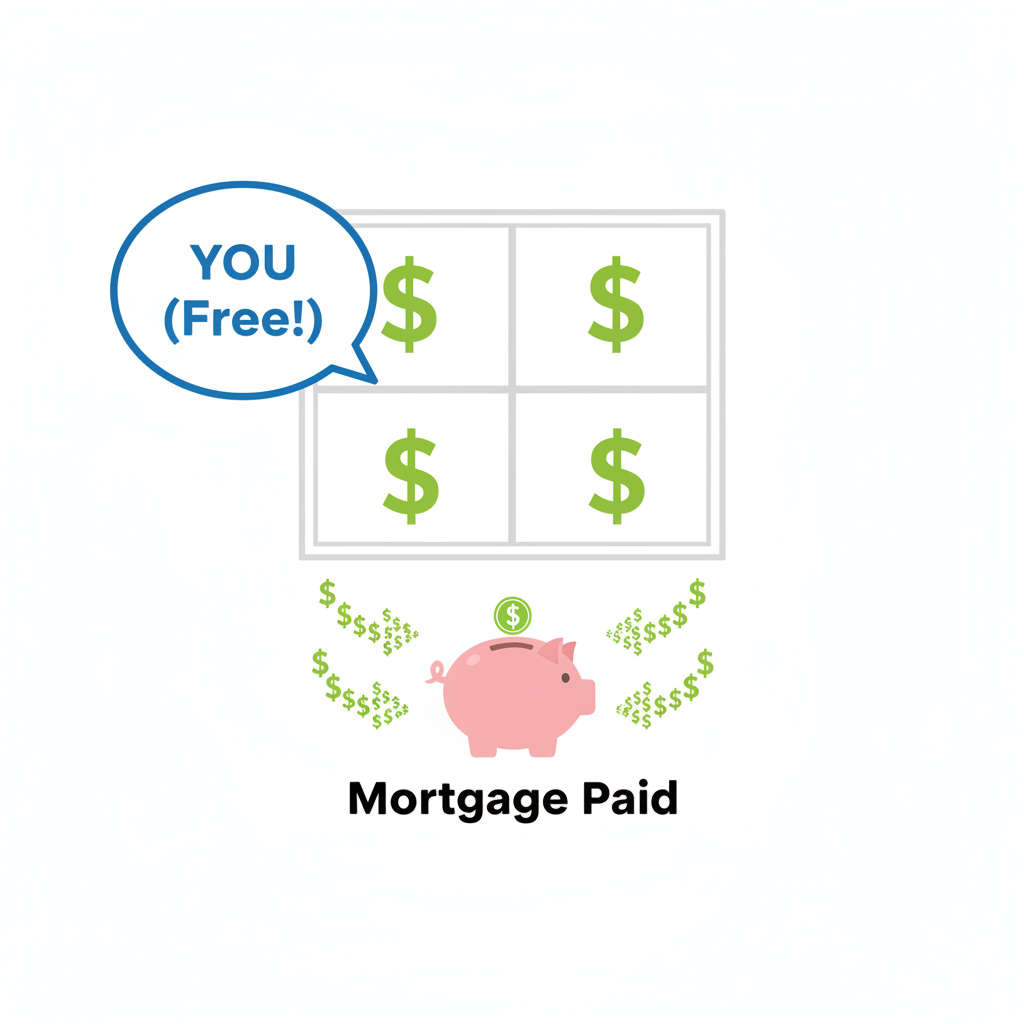
Alright, let’s break it down. House hacking is simple: you buy a property with multiple units (think a duplex, triplex, or even a single-family home with a rentable basement or spare rooms), live in one unit, and rent out the others. The rent you collect from your tenants covers most, if not all, of your monthly mortgage payment. In the best-case scenario, you’re living for free. In a grand-slam scenario, you’re getting paid to live in your own home (this is called positive cash flow).
This isn’t some landlord fantasy; it’s a strategic wealth-building play. Here’s why it’s a game-changer:
- Eliminates Your Biggest Expense: By offloading your housing cost onto your tenants, you free up a massive chunk of your income. That money can now be used to pay off debt, invest, or save for your next property.
- Low Barrier to Entry: Because you’ll be living in the property (owner-occupied), you can access loans with ridiculously low down payments. We’re talking FHA loans at 3.5% down or VA loans at 0% down for qualified veterans. Try getting that on a pure investment property—it’s not happening.
- Builds Equity on Autopilot: Your tenants aren’t just paying your mortgage interest; they’re paying down your principal. Every month, their rent checks are buying you a bigger piece of a valuable asset. You’re building wealth while you sleep.
- Forced Savings Account: Real estate appreciates over time. While the market has its ups and downs, property is a tangible asset that historically trends upward. You’re parking your money in something that grows.
Think about it: instead of giving $2,000 a month to a landlord, you’re redirecting that cash flow to build your own net worth. It’s the ultimate financial judo move—using the system’s biggest expense to your own advantage.
The Numbers Game: Running a No-BS Analysis

Talk is cheap. Let’s run the numbers on a real-world example. This is where you separate the dreamers from the doers. You have to be ruthless and conservative with your math. Never, ever fall in love with a property; fall in love with the numbers.
Your goal is to have the total rent collected cover your PITI (Principal, Interest, Taxes, Insurance) and other expenses. Let’s analyze a hypothetical duplex:
Sample Duplex Deal Breakdown
| Metric | Calculation / Cost |
|---|---|
| Purchase Price | $400,000 |
| Down Payment (FHA 3.5%) | $14,000 |
| Loan Amount | $386,000 |
| Interest Rate (example) | 6.5% |
| Monthly Mortgage (P&I) | ~$2,440 |
| Property Taxes (est.) | $400 / month |
| Homeowner’s Insurance (est.) | $150 / month |
| Total PITI | $2,990 / month |
Now, Let’s Factor in Income and Expenses
| Item | Amount | Notes |
|---|---|---|
| Rent from Unit 2 | $1,800 / month | This is what your tenant pays you. |
| Vacancy (5% of rent) | -$90 / month | You MUST budget for when the unit is empty. |
| Repairs & Maintenance (8% of rent) | -$144 / month | Things will break. Be prepared. |
| Capital Expenditures (CapEx) (8% of rent) | -$144 / month | Saving for big-ticket items like a new roof or HVAC. |
| Total Monthly Expenses | $378 | Vacancy + Repairs + CapEx |
| Net Operating Income (NOI) from Rent | $1,422 / month | Rent minus expenses (1800 – 378) |
The Final Verdict: What Do YOU Pay?
Your total mortgage is $2,990. The net income from your tenant after setting aside money for future problems is $1,422. So, your out-of-pocket cost to live in your own property is:
$2,990 (Total PITI) – $1,422 (Net Rent) = $1,568 / month
In this scenario, you’re not living for free, but you’ve slashed your housing cost from what would have been $2,990 down to $1,568. And you’re building equity in a $400,000 asset. If you found a triplex or a place with higher rents, you could easily push that number to zero or even into positive cash flow. This is the math you must master.
Getting the Green Light: Financing Your First Hack

You can’t buy a house with good vibes. You need cash and, more importantly, a loan. This is where being an owner-occupant gives you a massive, almost unfair, advantage. Lenders see you as less of a risk than a pure investor, so they give you the best deals.
Your Loan Arsenal:
- FHA Loan: The holy grail for first-time house hackers. Requires only 3.5% down and is more forgiving on credit scores. You can use it to buy properties with up to four units. The catch? You have to pay Private Mortgage Insurance (PMI), but the benefits often outweigh this cost for a first deal.
- VA Loan: If you’re a veteran or active-duty military, this is a no-brainer. 0% down payment required. That’s not a typo. You can get into a property with virtually no money out of pocket for the down payment (you’ll still have closing costs).
- Conventional Loan: Typically requires a higher down payment (as low as 5% for a primary residence, but often more for multi-family) and a better credit score. The major plus is that you can avoid PMI if you put down 20%.
Your first step is to get pre-approved. Don’t even start looking at properties until you have a letter from a lender telling you how much they’re willing to give you. When you talk to a mortgage lender, you need to sound like you know what you’re doing. Don’t be timid.
Script: Talking to a Mortgage Lender
“Hi, I’m looking to get pre-approved for a mortgage. I’m specifically interested in purchasing a multi-family property—a duplex or triplex—that I will be occupying as my primary residence. I’d like to explore my options with an FHA loan, as I understand it allows for a low down payment on owner-occupied multi-family homes. Can you walk me through the pre-approval process and tell me what documents you’ll need from me?”
This script tells them three crucial things: 1) You’re serious (pre-approved). 2) You know the strategy (multi-family, primary residence). 3) You know the product you want (FHA loan). You’re now in control of the conversation.
The Landlord Hustle: Finding Tenants Without the Headache

Buying the property is only half the battle. Now you’re a landlord. This scares a lot of people off, but it doesn’t have to be a nightmare if you’re smart about it. Your success hinges on one thing: tenant screening. A great tenant will pay on time and treat your property with respect. A bad tenant will be a financial and emotional black hole.
Your Tenant-Finding Checklist:
- Advertise Everywhere: Use free and low-cost platforms. Zillow Rental Manager, Avail, and Facebook Marketplace are your best friends. Take high-quality photos and write a compelling description that highlights the best features of the unit.
- Set Clear Criteria: Before you even post the ad, decide on your minimum standards. This isn’t about discrimination; it’s about setting business rules. Your criteria should be based on financials.
- The Application is Everything: Use a standardized rental application that asks for employment history, income verification (ask for pay stubs!), previous landlord references, and consent for a background and credit check. Charge a small application fee to weed out people who aren’t serious.
- Verify, Verify, Verify: Don’t take their word for it. Call their employer. Call their previous landlord. Run the credit and background check using a service like SmartMove by TransUnion or MyRental.
- Trust Your Gut: After all the data is in, have a conversation with the prospective tenant. Do they seem responsible? Do they communicate clearly? Sometimes, the vibe is just off. It’s okay to pass if you have a bad feeling, as long as your reason isn’t discriminatory.
Key Rules for Tenant Screening
- Rule #1: Income must be 3x the rent. This is a standard industry rule. If rent is $1,500, they need to show proof of at least $4,500 in monthly income.
- Rule #2: No recent evictions. This is a massive red flag. Period.
- Rule #3: Check their credit. You’re not looking for a perfect 800 score, but you are looking for a pattern of responsibility. Late payments on everything is a bad sign.
- Rule #4: Use an ironclad lease. Don’t download a generic freebie. Use a state-specific lease from a site like BiggerPockets or consult a local lawyer. It’s worth the money.
Being a landlord is a business. Treat it like one, and you’ll protect your investment and your sanity.
Scam Warning: Red Flags to Dodge in Your First Deal

The world of real estate is full of opportunity, but it’s also got its share of sharks and pitfalls. As a beginner, you’re a prime target. Keep your head on a swivel and watch out for these red flags.
Common Traps for Newbies:
- The ‘No Money Down’ Guru: Be extremely wary of online personalities selling expensive courses that promise you can buy property with no money and no credit. While creative financing exists, it’s advanced and risky. The proven path for beginners is low-down-payment loans like FHA and VA.
- Ignoring the Inspection: In a hot market, some buyers might waive the home inspection to make their offer more attractive. DO NOT DO THIS. An inspection costs a few hundred dollars but can save you from a $20,000 foundation problem or a $15,000 roof replacement. It’s the best money you’ll ever spend.
- Underestimating Repairs: The seller’s paint job might be hiding water damage. That carpet might be covering a cracked floor. Always overestimate your repair budget. If you think it will cost $5,000, budget $7,500. This cushion will save you from financial ruin.
- The ‘Turnkey’ Trap: A ‘turnkey’ property is supposed to be fully renovated and ready to rent. Some are legitimate, but many are shoddily ‘renovated’ by investors who slap on cheap paint and sell it to out-of-state buyers at an inflated price. If you buy one, get an independent, ruthless inspection.
The Ultimate Scam Warning
If a deal feels too good to be true, it is. There are no secret, easy home runs in real estate. Wealth is built through smart analysis, careful due diligence, and consistent action. Anyone selling you a shortcut is really just selling their product, not your success.
Conclusion
House hacking isn’t just a clever trick; it’s a fundamental shift in your financial reality. It’s about turning your biggest liability into your greatest asset. You’re not just buying a home; you’re buying a small business, a cash-flow machine that works for you 24/7. It takes work, it takes courage, and it requires you to learn the ropes. But the payoff is immense: a life with no mortgage payment, a rapidly growing net worth, and a clear path to financial independence.
Your journey starts now. Not tomorrow, not next year. Start by running the numbers on properties in your area. Talk to a mortgage lender and get pre-approved. Take control of your financial destiny. Stop making your landlord rich and start building your own empire, one duplex at a time.
Disclaimer: This article is for informational and educational purposes only and does not constitute financial, legal, or tax advice. You should consult with a qualified professional, such as a financial advisor, attorney, or accountant, before making any investment decisions.