

Is Credit Card Churning Worth It? The Dark Side Gurus Won’t Tell You
You’ve seen the ads. The slick YouTube gurus leaning against rented Lamborghinis, telling you how they fly first-class for free and stay in five-star hotels, all thanks to the magic of ‘credit card churning.’ They make it sound like free money is just falling from the sky, and all you need is their $997 course to learn the ‘secrets.’
Let’s get one thing straight: that’s garbage. Credit card churning can be a legit side hustle, a powerful way to hack the system for serious rewards. But it’s not a magic trick, and it’s definitely not for everyone. The gurus conveniently forget to mention the dark side: the potential credit score damage, the organizational nightmare, the psychological traps that can lead you straight into debt, and the fact that banks are actively fighting back.
This isn’t a guide to sell you a dream. This is your street-smart manual to understanding the entire game—the good, the bad, and the ugly. We’re going to break down whether this high-stakes hustle is actually worth your time and, more importantly, your financial health.
The Churning Game: How It *Really* Works (Beyond the Hype)
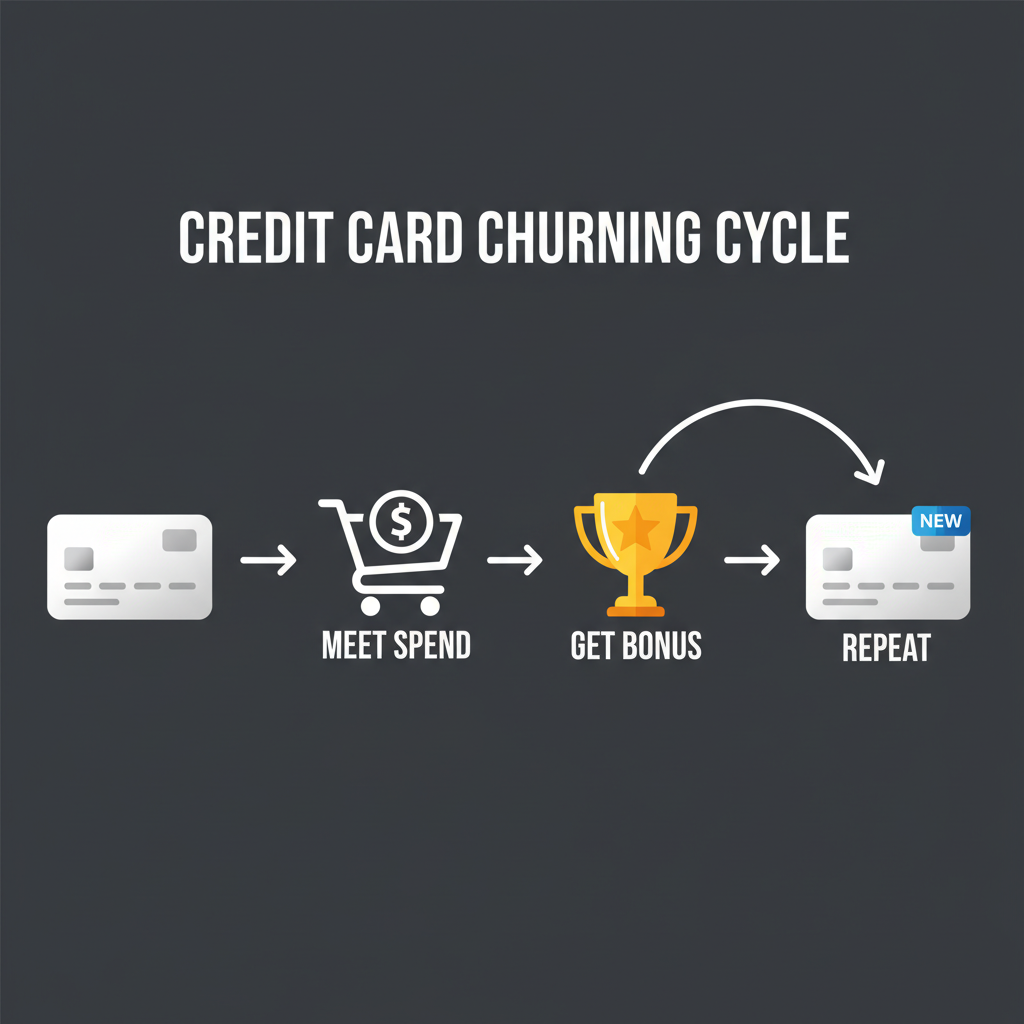
Before you even think about applying for a new card, you need to understand the playbook. At its core, credit card churning is the practice of repeatedly opening new credit card accounts to collect valuable sign-up bonuses (SUBs). These bonuses are the jackpot—they can be worth hundreds, sometimes thousands, of dollars in cash back, points, or airline miles.
The basic loop looks like this:
- Identify a Killer Offer: You find a card with a massive sign-up bonus, like ‘Earn 60,000 points after you spend $4,000 in the first 3 months.’
- Apply and Get Approved: You apply for the card, leveraging your good credit score.
- Meet the Minimum Spend: This is the critical part. You must spend the required amount (e.g., $4,000) within the specified timeframe. The key is to do this with your normal, planned spending—not by buying stuff you don’t need. Think groceries, gas, utilities, rent… not a shopping spree.
- Collect the Bonus: Once you hit the spend, the bonus points or cash back are deposited into your account. Cha-ching.
- Evaluate and Move On: After you’ve milked the bonus, you decide what to do with the card. You might keep it if it has great long-term benefits, downgrade it to a no-annual-fee version, or, after a year, close it. Then, you rinse and repeat with a new card.
It sounds simple, but the devil is in the details. This isn’t about spending more; it’s about being hyper-strategic with the money you were already going to spend. It requires discipline, organization, and a rock-solid budget. If you carry a balance, even for one month, the interest you pay will likely wipe out the value of any bonus you earned. This game is for people who pay their balance in full, every single month. No exceptions.
The Payday: Realistic Earning Potential

So, what’s the actual take-home from all this effort? It’s not unlimited, and it’s definitely not passive income. The value you get depends entirely on your spending habits, your credit score, and how much complexity you can handle. Let’s break down a realistic first year for a dedicated churner with good credit and about $2,500 in monthly expenses they can put on a card.
A Sample First-Year Churning Plan
This example assumes you can meet the minimum spend for each card without manufacturing spend or buying things you don’t need.
| Card (Example) | Sign-Up Bonus | Minimum Spend Required | Estimated Value | Notes |
|---|---|---|---|---|
| Chase Sapphire Preferred® | 60,000 points | $4,000 in 3 months | $750+ | Points are worth 1.25 cents each when redeemed for travel through Chase, or can be transferred to partners. |
| Capital One Venture Rewards | 75,000 miles | $4,000 in 3 months | $750 | Miles can be used to cover any travel purchase at 1 cent per mile. |
| American Express® Gold Card | 60,000 points | $4,000 in 3 months | $600 – $1,200 | Value depends heavily on transfer partners. Highly variable but potentially lucrative. |
| Citi Premier® Card | 60,000 points | $4,000 in 3 months | $600+ | Flexible points with a good range of transfer partners. |
In this scenario, over 12 months, you could potentially rack up bonuses worth over $2,700. That’s a serious haul. However, you also have to subtract the annual fees (after the first year, typically). For these four cards, that could be around $500 per year combined. So your net gain is closer to $2,200 for the first year, plus any ongoing rewards from your spending.
The Real Cost: This doesn’t account for your time. Researching cards, tracking spending, managing due dates, and redeeming points can easily take 5-10 hours per month. If you value your time at $20/hour, that’s $1,200 – $2,400 worth of your time per year. Suddenly, that $2,200 profit looks a lot more like a real job with an hourly wage.
The Dark Side: The 7 Deadly Sins of Churning

This is the chapter the gurus skip. Churning is like walking a tightrope. One wrong move, and the whole thing can come crashing down, leaving you in a worse position than when you started. Here are the traps you must avoid at all costs.
- The Credit Score Plunge: Every time you apply for a new card, it results in a ‘hard inquiry’ on your credit report, which can temporarily dip your score by a few points. Opening many new accounts in a short time also lowers the average age of your credit history, another factor in your score. While proponents say the score recovers, a series of hard inquiries can be a red flag for lenders if you’re planning to apply for a major loan like a mortgage in the near future.
- The Organizational Nightmare: Juggling 4, 5, or 10+ credit cards is not for the faint of heart. You have to track minimum spend deadlines, payment due dates, annual fee dates, and various card-specific rules (like the Chase 5/24 rule). One missed payment can result in a massive interest charge and a late fee, wiping out your bonus and damaging your credit score.
- The Overspending Quicksand: This is the single biggest danger. The need to meet a $4,000 minimum spend in 3 months can subconsciously pressure you into buying things you don’t need. You justify it by saying, ‘It’s for the bonus!’ But if you spend an extra $500 on junk to get a $750 bonus, you’ve only really gained $250 while acquiring clutter. Worse, if you can’t pay it off, you’re now in debt.
- The Annual Fee Death Spiral: Many top-tier rewards cards come with hefty annual fees, often waived for the first year. A common churner strategy is to cancel the card before the second year’s fee hits. But if you forget, you’re suddenly on the hook for a $95, $250, or even $695 fee.
- The Tax Man Cometh: Generally, credit card rewards earned from spending are considered rebates and aren’t taxable. However, the IRS has sometimes viewed sign-up bonuses that don’t require spending (like bank account bonuses) as taxable income. The rules can be murky, and it adds a layer of complexity you need to be aware of.
- Getting Blacklisted by Banks: Banks are not stupid. They are businesses, and they lose money on churners. They have implemented rules to stop this behavior. The most famous is the ‘Chase 5/24 Rule,’ where Chase will automatically deny you for most of their cards if you’ve opened 5 or more personal credit cards from *any* bank in the last 24 months. Other banks have similar, unpublished rules. Get too aggressive, and you could be shut down and have your hard-earned points forfeited.
- The Point Devaluation Bomb: The 100,000 points you have today might not be worth the same next year. Airlines and hotels can devalue their points overnight by increasing the number of points needed for a flight or a room. Hoarding points is a losing game; you need to ‘earn and burn.’
Your Churning Toolkit: Apps & Strategies to Stay Sane

If you’re going to attempt this, you can’t just wing it. You need a system. Being disorganized is the fastest way to fail. Here are the tools and strategies the pros use to stay on top of the game.
- The Almighty Spreadsheet: This is your command center. Create a simple spreadsheet in Google Sheets or Excel to track every single detail: Card Name, Application Date, Approval Date, Minimum Spend Amount, Minimum Spend Deadline, Annual Fee, and Cancellation/Downgrade Date. This is non-negotiable.
- Travel Freely: This is a fantastic free app built specifically for card churners. It helps you track your cards, reminds you of annual fees, and checks your eligibility against rules like Chase 5/24. It automates a lot of the headache of the spreadsheet.
- AwardHacker: Don’t know the best way to use your 80,000 points? This website is a search engine for award travel. You plug in your origin and destination, and it tells you which airline loyalty programs offer the best deals, helping you maximize the value of your points.
- Automate Everything: Set up automatic payments for at least the minimum balance on all your cards. This is your safety net to ensure you never have a late payment, even if you forget. You should still plan to pay the full balance manually before the due date, but this protects you from disaster.
- Use a Calendar App: Set multiple reminders for key dates. Create an alert for one week before your minimum spend deadline and one month before your annual fee is due. This gives you time to act.
The Scam Warning & The Reconsideration Script

The Ultimate Scam Warning
As you dive deeper, you’ll be bombarded by ‘experts’ selling high-ticket courses. Be extremely wary. Most of the information they’re selling is available for free online through reputable blogs and forums. They prey on the idea that there’s a ‘secret’ you need to pay for. There isn’t.
Key Rule: Never pay for credit card churning information. The community is built on sharing knowledge for free. If someone is charging you for a PDF or a video course, they’re not a guru; they’re a marketer exploiting your enthusiasm. Your money is better spent meeting a minimum spend requirement.
The Reconsideration Line Script
Sometimes, even with a great credit score, your application might be denied automatically. Don’t give up. Call the bank’s ‘reconsideration line.’ You’ll speak to a human credit analyst who can override the computer’s decision. Here’s what you say:
Your Script: “Hi, my name is [Your Name] and I recently applied for the [Card Name] and received a notification that my application was pending/denied. I was hoping to speak with you to see if there was any additional information I could provide to get it approved. I’ve been a loyal customer with [Bank Name, if applicable] for [X] years and was really excited about the travel benefits of this card for my upcoming trip. I have a strong credit history and manage all my accounts responsibly. Would it be possible to review my application with you?”
This script shows you’re proactive, responsible, and have a clear reason for wanting the card. It works more often than you’d think. Be polite, be confident, and be prepared to answer questions about recent inquiries on your report.
Conclusion
So, is credit card churning worth it? The honest, no-fluff answer is: it depends entirely on you.
If you are naturally organized, have a rock-solid budget, pay your bills in full every month without fail, and enjoy the challenge of ‘beating the system,’ then yes. It can be an incredibly lucrative side hustle that enables you to travel in ways you never thought possible. It can put thousands of real dollars back in your pocket.
However, if you struggle with debt, are disorganized, or are tempted to spend money you don’t have, then you must stay away. The risks are very real. The ‘dark side’ of churning is littered with people who ended up with damaged credit and crippling debt, all because they chased a bonus they couldn’t afford.
Don’t listen to the gurus. Listen to yourself. Be honest about your habits and your discipline. This isn’t free money; it’s a reward for your financial diligence. If you have that diligence, the rewards are there for the taking. If not, the cost is far too high.
Disclaimer: I am not a financial advisor. The information provided in this article is for informational and educational purposes only. It is not intended to be a substitute for professional financial advice. You should consult with a qualified professional before making any financial decisions.