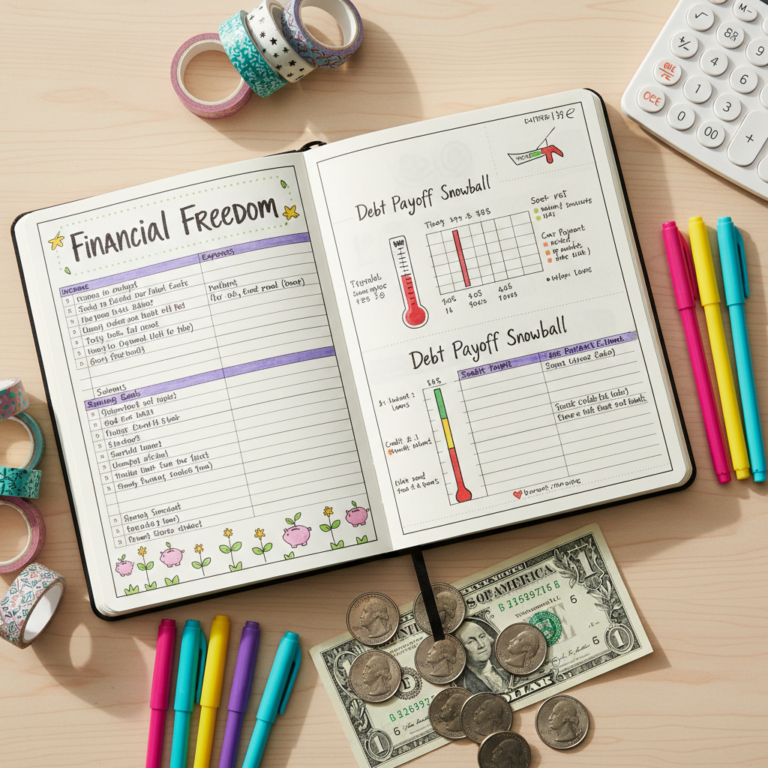

How I Tricked My Brain Into Saving: 7 ADHD Budgeting Tips For Beginners
Let’s be real: most budgeting advice is garbage. ‘Track every penny.’ ‘Cut out lattes.’ ‘Just have more willpower.’ For anyone with an ADHD brain, that’s not just unhelpful—it’s a recipe for failure and shame. Your brain isn’t broken; it’s just wired differently. It craves novelty, immediate rewards, and hates tedious, repetitive tasks. Standard budgeting is the ultimate enemy.
So, what’s the move? You stop trying to force a square peg into a round hole. You stop fighting your brain and start hacking it. This isn’t about restriction; it’s about redirection. It’s about turning the boring chore of saving money into a game you can actually win. I’m going to show you 7 battle-tested methods I used to trick my own chaotic brain into stacking cash, no soul-crushing spreadsheets required. Get ready to finally take control of your money, ADHD-style.
Hack #1: Gamify Everything – The Dopamine Drip Method

Your brain runs on dopamine. It’s the ‘feel-good’ chemical you get from a new purchase, a social media like, or beating a video game level. So, why not use that to your advantage? Instead of seeing saving as a punishment, turn it into a game where you’re the main character on a quest for financial glory.
How to Set Up the Game:
- Find Your App-ly: Use apps designed for this. Tools like Qapital or Digit are great because they use micro-savings and visual goals. Digit analyzes your spending and squirrels away small amounts you won’t miss. Qapital lets you set rules like ‘Round up every purchase to the nearest dollar and save the change’ or even ‘Save $5 every time I go to the gym.’
- Create ‘Money Quests’: Ditch the vague ‘save more’ goal. Create specific, short-term missions. For example: ‘Quest: No-Spend Weekday Challenge. Reward: $25 transferred to my ‘Vacation’ fund.’ Or ‘Side Quest: Sell one thing on Facebook Marketplace. Reward: Move that cash directly to savings.’
- Level Up Your Savings: Set milestones with real-world rewards. When you hit $100 in savings, you ‘unlock’ the ability to buy that new video game. When you hit $500, you ‘unlock’ a nice dinner out. This creates a direct link between saving (the boring part) and the reward (the dopamine hit).
The Math:
This isn’t just play money. Let’s say you set a simple rule to round up every purchase. If you make 30 transactions a month with an average round-up of $0.50, that’s $15 a month, or $180 a year, saved without even thinking. Add one ‘No Takeout Tuesday’ quest a week, saving you $20, and you’ve just added another $1,040 to your annual savings. That’s over $1,200/year from playing a game.
Hack #2: Automate It & Forget It – The ‘Out of Sight, Out of Mind’ Goldmine
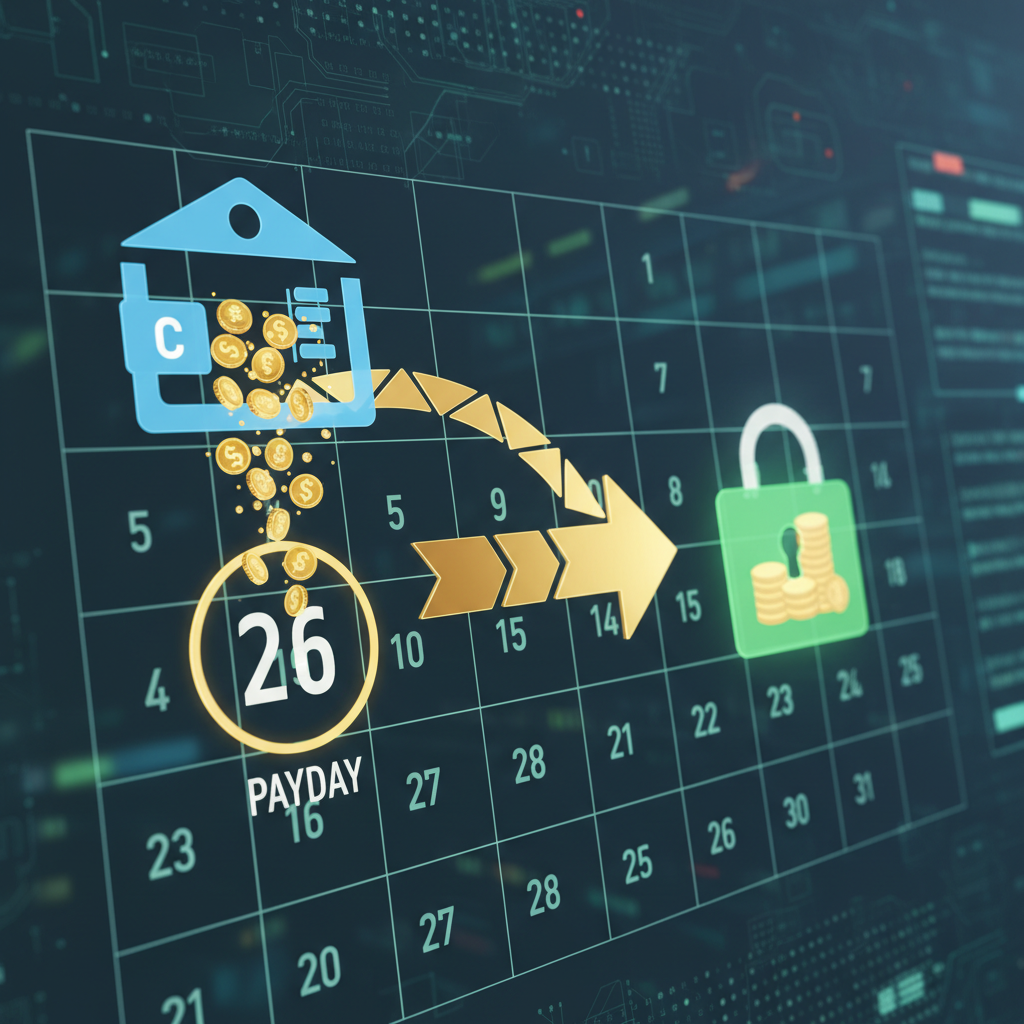
Executive dysfunction is real. The mental energy it takes to remember to manually transfer money to savings every payday is a huge barrier. Automation is your single most powerful weapon against this. The goal is to make saving happen in the background, requiring zero willpower or active decision-making from you.
How to Set It and Forget It:
- Pick Your Payday: Log into your primary checking account’s online portal. Find the section for ‘transfers’ or ‘payments.’
- Set Up a Recurring Transfer: Create a recurring transfer from your checking account to a separate high-yield savings account. Set the date for the day you get paid, or the day after. This is critical—the money is gone before you even have a chance to see it and think of ways to spend it.
- Start Small, Stay Consistent: Feeling broke? Don’t try to automate $500. Start with $20 per paycheck. You likely won’t even notice it’s gone. After a couple of months, you can bump it up to $25, then $30. The consistency is more important than the amount.
The Math:
This is the simplest, most effective wealth-building trick in the book. Automating just $25 a week feels like nothing. But over a year, that’s $1,300. If you get paid bi-weekly and automate $75 per check, you’ll have $1,950 saved in a year. You did absolutely nothing for it after the initial 5-minute setup. That’s the ultimate hack for a brain that has better things to focus on.
Hack #3: Go Analog with Cash Envelopes – The Tactile Money Trick
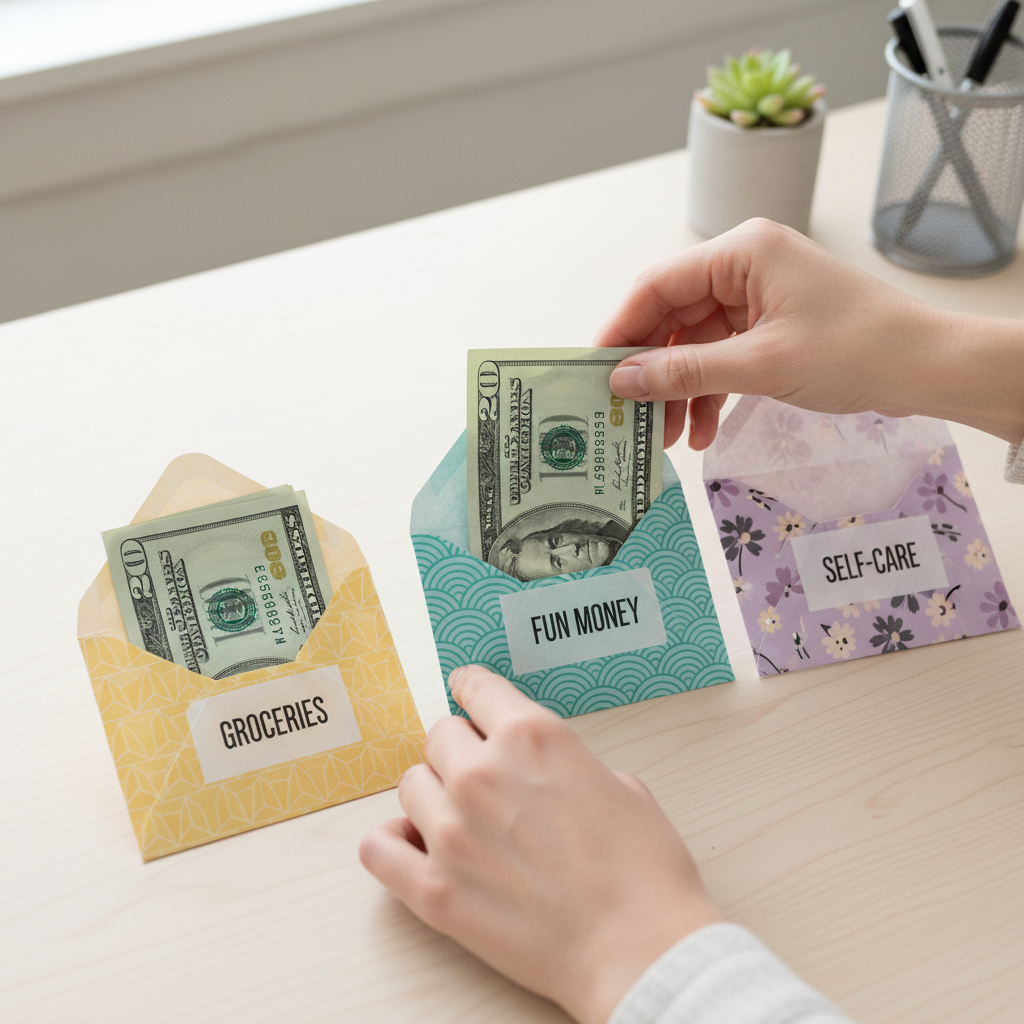
Sometimes, the digital world is the problem. Numbers on a screen are abstract and easy to ignore. Cash is real. It’s physical. When it’s gone, it’s GONE. The cash envelope system is perfect for ADHD brains because it makes your budget tangible and visual, especially for variable spending categories that get you into trouble.
How to Make It Work:
- Identify Your Black Holes: Don’t try to use envelopes for everything. Pick the 2-3 categories where you consistently overspend. Common culprits are: Groceries, Eating Out/Bars, and ‘Fun Money’ / Miscellaneous.
- Do the ‘Cash Out’: On payday, go to the bank and pull out the budgeted amount for those categories in cash. If you budget $400 for groceries for the month, pull out $400.
- Stuff ‘Em: Get some simple, different-colored envelopes and label them. Put the cash for each category into its designated envelope. When you go to the grocery store, you only take the ‘Groceries’ envelope. If you want to go out with friends, you check your ‘Fun Money’ envelope first.
When the envelope is empty, you’re done spending in that category until the next payday. No swiping a debit card and ‘dealing with it later.’ This forces you to be mindful and make real-time decisions.
| Expense Category | Monthly Budget | Method |
|---|---|---|
| Groceries | $400 | Cash in Envelope |
| Restaurants/Fun | $150 | Cash in Envelope |
| Gas | $100 | Cash in Envelope |
| Rent/Mortgage | $1200 | Auto-Pay from Checking |
| Utilities | $150 | Auto-Pay from Checking |
Hack #4: The ‘One-Category’ Budget – Slay the Overwhelm

The idea of creating a 50-category budget is enough to make anyone shut down. For an ADHD brain, it’s a non-starter. So don’t do it. Instead, adopt the ‘One-Category’ budget. It’s a hyper-focus approach that targets the single biggest leak in your financial boat.
How to Find and Fix the Leak:
- Quick Financial Autopsy: Spend 30 minutes (set a timer!) looking at your last month’s bank or credit card statement. Don’t get bogged down in details. Just look for the one category that makes you go, ‘Wow, I spent THAT much on…?’ For most people, it’s dining out, Amazon, Target, or subscription services.
- Declare Your Nemesis: Let’s say it’s Uber Eats. For the next 30 days, that is the ONLY thing you will track and manage. Forget everything else. Your entire budgeting focus is on that single expense.
- Set a Hard Rule: Create one simple, unbreakable rule for your nemesis category. For example: ‘I will only order takeout on Fridays’ or ‘I will delete all food delivery apps from my phone’ or ‘My budget for Amazon is $50 this month, and I’ll track it in my phone’s notes app.’
By focusing your limited executive function on a single target, you’re far more likely to succeed. Once you’ve conquered one category for a month or two and built a new habit, you can pick a new ‘nemesis’ to focus on.
The Math:
If your financial autopsy reveals you’re spending $500 a month on food delivery and impulse online shopping, and you cut that by just half, that’s $250 back in your pocket every month. Annually, that’s a massive $3,000 saved, all from hyper-focusing on one problem area instead of trying to fix everything at once.
Hack #5: The 24-Hour ‘Cool Down’ – Your Impulse-Buy Kryptonite

Impulse spending is a direct result of your brain screaming ‘I want the dopamine NOW!’ The best way to fight this is not with willpower, but with time. The 24-hour rule creates a mandatory buffer between the impulse and the action, allowing the logical part of your brain to catch up.
How to Enforce the Cool Down:
- For Online Shopping: See something you want? Great. Add it to the cart. Then, close the tab. Do not ‘Save for Later.’ Just put it in the cart and walk away. You are not allowed to purchase anything from an online cart until it has been there for at least 24 hours.
- For In-Store Shopping: Find an item you desperately want? Take a picture of it and the price tag. Then, leave the store. You can go back and buy it tomorrow if you still feel the same way about it.
You will be shocked at how often, 24 hours later, the intense ‘need’ for that item has completely vanished. The dopamine rush has passed, and you can now evaluate the purchase clearly. Did you really need it? Probably not.
The Script for Self-Talk: ‘I’m not saying no, I’m just saying not right now. I’m putting this in a 24-hour timeout. If I still want it tomorrow, I’ll consider how it fits into my goals.’
This simple trick has personally saved me thousands of dollars. The ‘urge’ is a chemical reaction, and like all reactions, it fades with time. You just have to give it time to fade.
Hack #6: The ‘Money Date’ with a Body Double

Body doubling is a productivity hack where you do a task alongside another person. Their quiet presence helps you stay focused and on task. This is a lifesaver for boring, anxiety-inducing administrative tasks, and nothing is more boring and anxiety-inducing than managing money.
How to Set Up Your Money Date:
- Find Your Partner: This could be your actual partner, a trusted friend, or even a family member. The key is that they are also there to work on their own ‘life admin’ stuff. They don’t even need to see your finances.
- Schedule It: Put it on the calendar like a real appointment. ‘Every Sunday at 7 PM: Money Date.’ Make it a ritual. Grab a coffee or a snack to make it more appealing.
- Set a Timed Agenda: During your 30-minute Money Date, you will:
- Review your bank account for weird charges.
- Pay any upcoming bills.
- Check the balances on your cash envelopes.
- Make your one transfer to savings (if not automated).
The shared focus creates accountability and transforms a dreaded solo chore into a shared, productive session. It short-circuits the procrastination and avoidance that often come with financial tasks. You’re less likely to get distracted and scroll social media if someone is sitting across from you.
Hack #7: Build a ‘Why’ Board – Connect Your Cash to Your Dreams
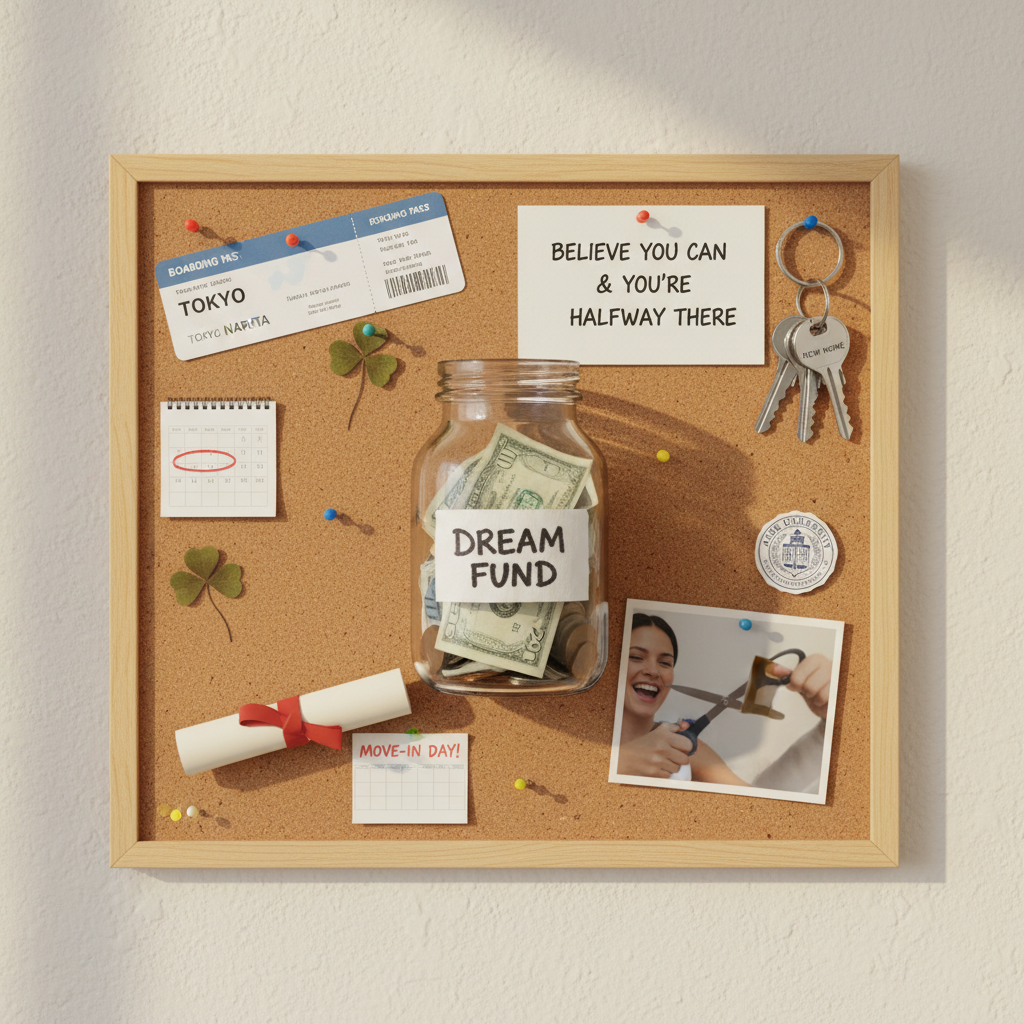
Saving money for the sake of ‘saving money’ is a terrible, unmotivating goal for an ADHD brain. It’s too abstract. You need to make your goal concrete, visual, and emotional. You need to know exactly *why* you’re saying no to that $15 lunch delivery. You’re not just ‘saving $15‘; you’re ‘buying a plane ticket to Italy.’ See the difference?
How to Build Your ‘Why’:
- Get Visual: Create a physical corkboard, a digital Pinterest board, or just a folder of images on your phone. This is your ‘Why’ Board.
- Find Your Images: What are you actually saving for? Don’t just write ‘pay off debt.’ Find a picture of a loan document with a giant red ‘PAID’ stamp on it. Don’t just say ‘buy a house.’ Find a picture of your dream kitchen or backyard. Saving for a vacation? Get high-res photos of the beach, the food, the hotel.
- Make It Visible: Put this board somewhere you will see it every single day. Make it your phone’s lock screen. Tape it to the mirror you use to get ready in the morning. Put a key image on your physical credit card.
Every time you’re faced with a spending decision, you can glance at your ‘Why’ Board. This visual cue provides an instant shot of motivation, reminding your brain of the bigger, better dopamine reward you’re working towards. It makes the short-term sacrifice feel meaningful and directly connected to a long-term win.
Conclusion
Look, the financial world wasn’t built for brains like ours. But that doesn’t mean you’re doomed to be bad with money. It just means you have to use a different playbook. Stop trying to brute-force your way through a system that makes you feel like a failure. Instead, get creative. Get strategic. Turn saving into a game, automate the boring stuff, and make your goals so real you can almost taste them.
Pick just one of these hacks to start with this week. Don’t try to do them all at once. Pick the one that sounds the most fun or the easiest to implement. The goal is progress, not perfection. You have the power to change your financial future, not by changing who you are, but by embracing how your brain works and making it work for you. You got this.
Disclaimer: I am not a financial advisor. This content is for educational and entertainment purposes only. The information provided is not intended as financial, legal, or tax advice. Please consult with a licensed professional for advice tailored to your specific situation.