


Let’s get one thing straight: most vision boards are a waste of perfectly good poster board. They’re a collection of random magazine cutouts—a mansion you’ll never live in, a sports car you’ll never drive, a watch that costs more than your rent. It’s feel-good fantasy, not a financial strategy. And if you’re here, you’re not about fantasy. You’re about building real, tangible wealth.
The secret the gurus won’t tell you is that a vision board isn’t magic. It’s a psychological tool. It works by programming your brain, specifically your Reticular Activating System (RAS), to notice opportunities that align with your goals. But if your goals are vague, your results will be vague. That’s where the financial vision board comes in. It’s not a dream board; it’s a dashboard for your wealth-building journey. Forget wishing for a million bucks. We’re about to show you how to visualize the exact, actionable steps to get there, one goal at a time.
The Groundwork: Why Most Vision Boards Fail (And How Yours Won’t)
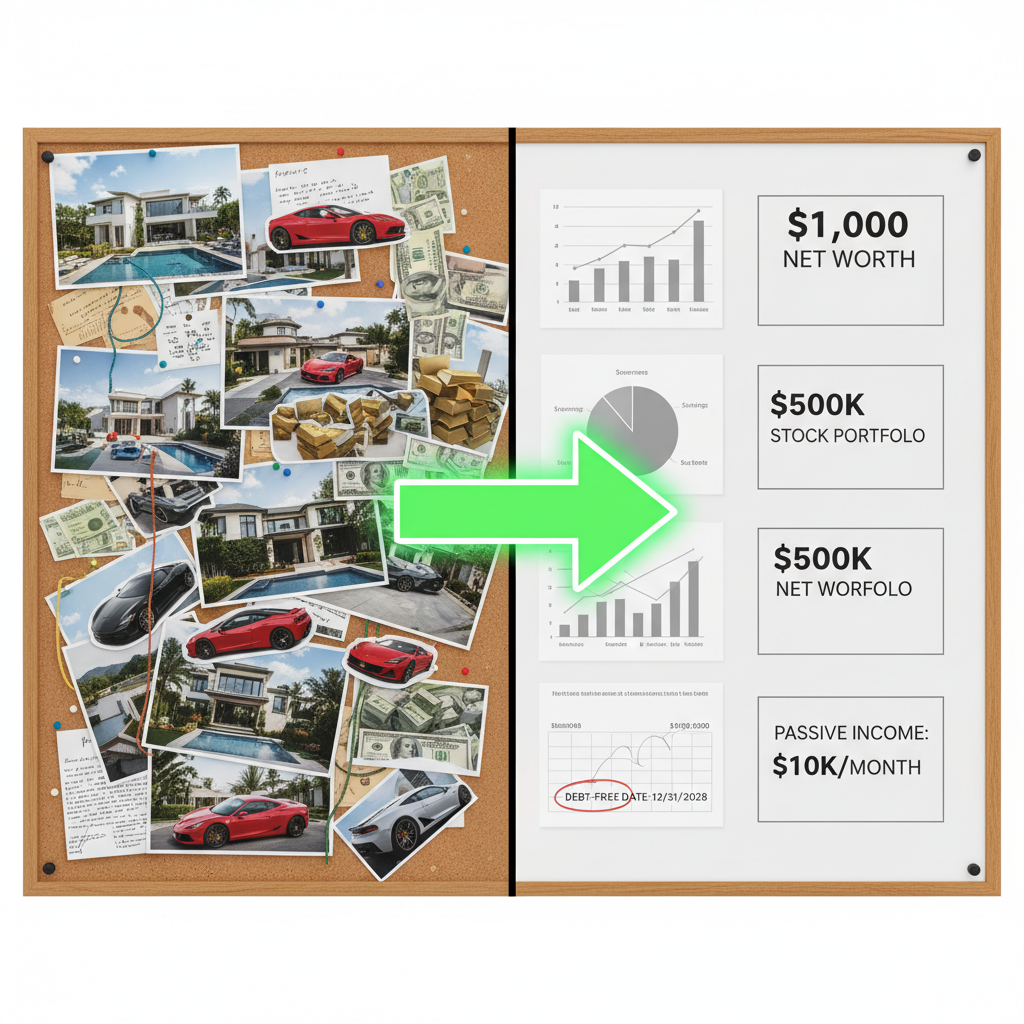
The problem with traditional vision boards is they focus on the ‘what’ without the ‘how.’ A picture of a beach is nice, but it doesn’t pay for the plane ticket. Your brain sees the disconnect and files it under ‘daydream.’ A financial vision board is different. It’s a gritty, numbers-driven roadmap that connects your desires to the cold, hard cash required to get them.
Think of it this way: a regular vision board is like looking at a travel brochure. A financial vision board is the GPS with the route programmed, the estimated time of arrival, and the toll costs clearly displayed. It forces you to get brutally honest about the numbers, which is the first step to changing them. Instead of a vague ‘be rich’ vibe, you’ll have specific, measurable targets. This isn’t about ‘manifesting’; it’s about motivating and maintaining focus on the daily grind that actually builds wealth.
10 Financial Vision Board Examples That Build Real Wealth
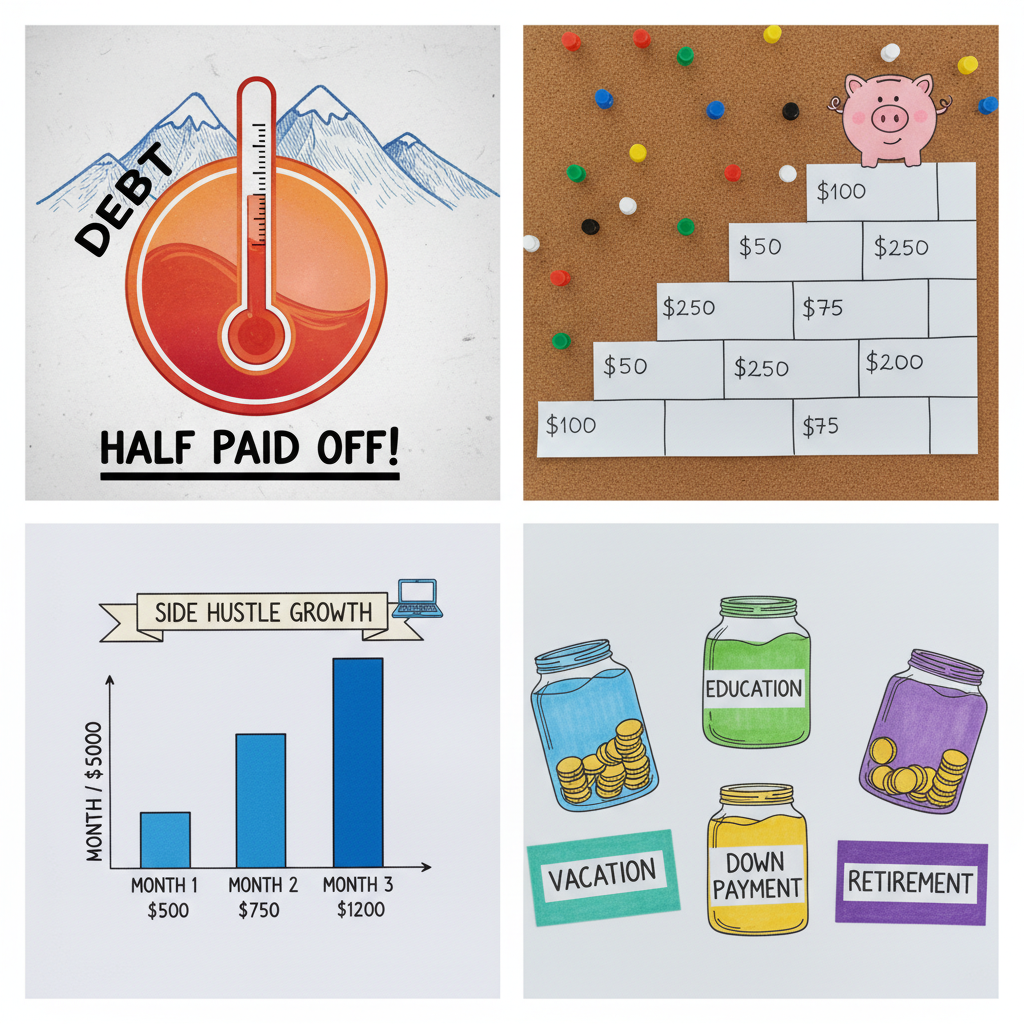
Ready to ditch the fluff? Here are 10 concrete, actionable vision board concepts designed for people who are serious about their money. Pick one, or combine a few, to create a powerful tool for your financial arsenal.
1. The Debt Payoff Thermometer
This is for everyone who feels crushed by debt. Instead of avoiding the scary numbers, you put them front and center. Draw a giant thermometer for each debt (student loan, credit card, car loan). The top is the starting balance, and the bottom is $0. Every time you make a payment, you color in a section. It turns a dreadful task into a satisfying visual victory, keeping you motivated to throw every extra dollar at that balance.
2. The Emergency Fund ‘Brick Wall’
An emergency fund is your wall against financial disaster. So, build one visually. Your goal is a 3-6 month safety net. Let’s say that’s $15,000. Your board features a big, empty wall outline. Each ‘brick’ represents a savings milestone, like $100 or $500. Every time you hit a milestone, you draw or paste in a new brick. You’re not just saving money; you’re visually building a fortress of financial security.
3. The Side Hustle Income Tracker
Want to make an extra $1,000 a month? Visualize it. Create a bar graph on your board with the ultimate goal at the top. Each month, you fill in the bar to show how much you actually earned from your side hustle. This isn’t just a tracker; it’s a motivator. Seeing the bar grow pushes you to take that extra delivery, list another item, or pitch one more client.
4. The ‘Kill Your Subscriptions’ Graveyard
We all bleed money through forgotten subscriptions. This board celebrates cutting them off. Create a ‘graveyard’ section on your board. Every time you cancel a recurring charge (streaming service, gym you don’t use, software trial), you paste its logo in the graveyard with the monthly savings written next to it. The math is powerful: ‘Netflix: $15.49. Spotify: $10.99. Gym: $40. Total Saved: $785.76/year!’
5. The Sinking Funds Jars
Sinking funds are the secret weapon of savvy savers. These are mini-savings accounts for specific, predictable future expenses. Instead of being surprised by a $600 car repair bill, you plan for it. On your board, draw or paste pictures of several jars labeled ‘Car Maintenance,’ ‘Vacation,’ ‘Holiday Gifts,’ etc. Inside each jar, you can add paper ‘coins’ or color it in as you allocate money to each fund. It gamifies saving for the boring stuff.
6. The ‘Net Worth’ Mountain Climb
Net worth is your ultimate financial scorecard. It’s what you own minus what you owe. Draw a huge mountain on your board. The peak is your long-term net worth goal (e.g., $1,000,000). Along the path up the mountain, create base camps with smaller, achievable milestones: $10,000, $50,000, $100,000. Move a little hiker pin up the mountain as your net worth grows. This shifts your focus from just income to overall financial health.
7. The ‘401k Match’ Money Machine
If your employer offers a 401k match, it’s literally free money. Visualize this! Create a simple diagram of a machine. One input slot is labeled ‘My Contribution: $250/month.’ The other is ‘Company Match: $250/month.’ The output is a pile of cash labeled ‘Total Investment: $500/month.’ It’s a stark, daily reminder of the power of doubling your money without any extra effort.
8. The ‘House Down Payment’ Puzzle
Saving for a down payment feels impossible. Break it down. Find a picture of your dream house and print it out. Cut it into 20, 50, or 100 puzzle pieces. Let’s say your down payment goal is $40,000 and you use 40 pieces. Each piece represents $1,000 saved. Every time you save another grand, you get to glue a new piece onto the board. You’re not just saving; you’re literally building your future home, piece by piece.
9. The ‘Paid in Full’ Ticker
This is for a single, major purchase you’re saving for, like a used car or new furniture, that you want to buy with cash. Put a big picture of the item on your board. Next to it, create a ‘Loan Balance’ ticker that starts at the full price (e.g., $8,000). As you save, you cross out the old number and write the new, lower ‘balance.’ The goal is to get it to $0 and write ‘PAID IN FULL’ in giant red letters across it.
10. The ‘Skills to Riches’ Flowchart
Your biggest wealth-building tool is your ability to earn. This board connects learning to earning. Create a flowchart. It starts with a skill you want to learn (e.g., ‘Google Ads Certification’). An arrow points to the cost and time (‘$0, 20 hours’). The next arrow points to the action (‘Update Resume, Apply for Marketing Jobs’). The final box shows the payoff (‘Potential Salary Increase: +$10,000/year‘). It visualizes the direct ROI of investing in yourself.
The Blueprint: How to Build Your Money-Making Vision Board
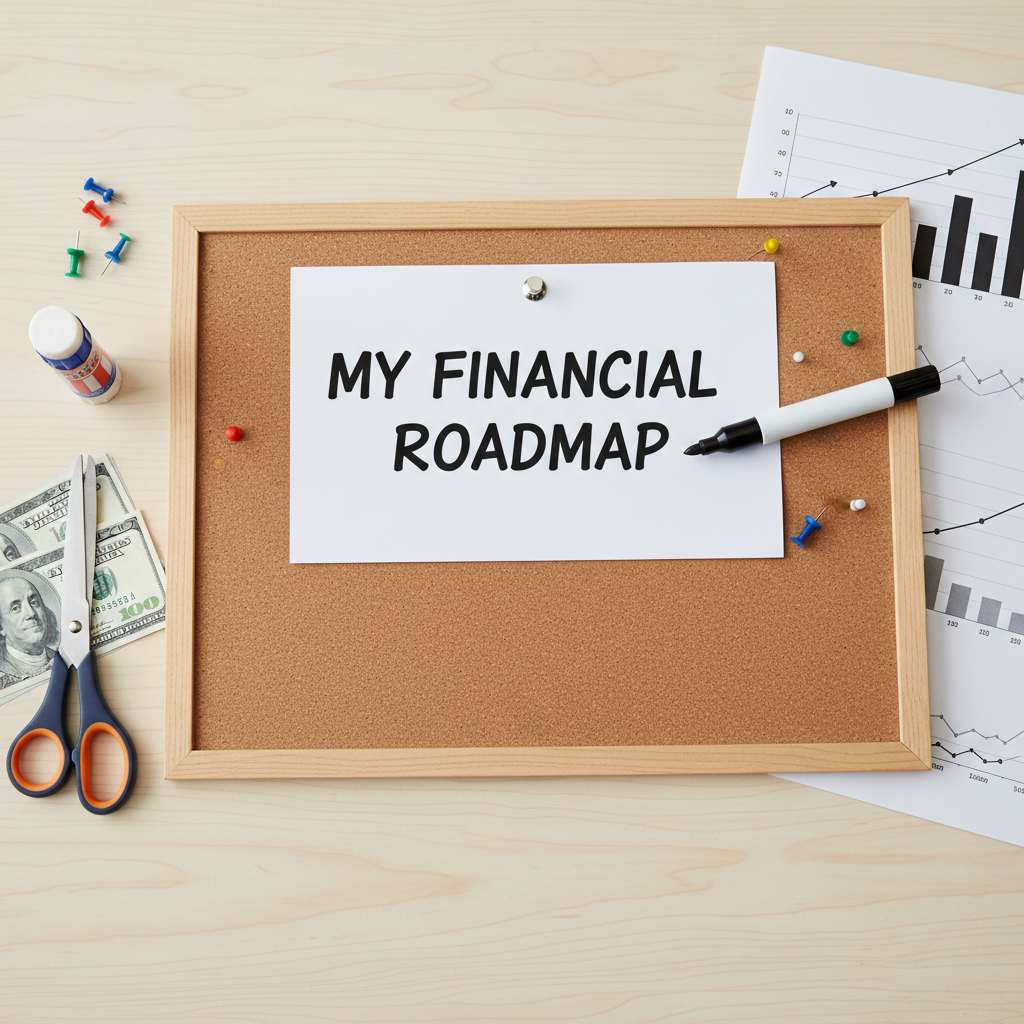
Alright, you’ve got the concepts. Now it’s time to build. No artistic skill required—just a commitment to your financial future. Follow these steps to create a board that actually works.
- Define Your ‘Why’: Before you cut a single picture, get brutally honest. What are your top 1-3 financial goals right now? Not in ten years, but right now. Is it killing that $5,000 credit card debt? Saving a $6,000 emergency fund? Getting specific is non-negotiable.
- Gather Your Intel: This is where the work comes in. Find the real numbers. Log into your accounts. How much debt do you actually have, down to the penny? What’s the average cost of a house in your target neighborhood? A goal without a number is just a wish.
- Choose Your Medium: You have options. A physical corkboard or poster board is tangible and powerful. You can touch it and update it by hand. Digital boards using apps like Pinterest or Canva are great if you’re low on space or prefer a clean, digital look. The best tool is the one you’ll actually use and look at every day.
- Source Your Visuals: Go beyond magazines. The most powerful images are the ones personal to you. Print out your actual debt statement and slap a big red ‘X’ on it. Take a screenshot of your savings account as it grows. Create your own charts and graphs. Use numbers, dollar signs, and powerful words that resonate with you.
- Make it Action-Oriented: This is the final, crucial step. For every single goal on your board, add a picture or a phrase that represents the action required. Next to your side hustle goal, add a picture of a laptop or your product. Next to your debt thermometer, add a picture of someone packing their lunch for work. This connects the dream to the daily grind.
The Reality Check: Avoiding The Visualization Traps

A vision board is a powerful tool, but it’s not a magic wand. The street-smart hustler knows the difference and avoids the common traps that turn a tool into a toy.
Trap 1: The ‘Sit and Wait’ Mindset
Putting a picture of a $100,000 savings account on your board will not make money appear in it. The board is the map; you are the driver. You still have to do the work: the budgeting, the saving, the negotiating, the side-hustling. The board’s job is to remind you where you’re going when you feel like quitting.
Trap 2: Comparison Overload
Your board should be a reflection of YOUR goals, not Instagram’s. Don’t put someone else’s life on your board. If your goal is a reliable, paid-off Honda that gives you peace of mind, don’t pin a picture of a Lamborghini that would give you a heart attack over the insurance bill. Authenticity is key. Your goals, your life, your board.
Trap 3: Forgetting to Update
Your financial vision board is a living document, not a museum piece. As you crush your goals, celebrate them! Then, take them down and replace them with new, bigger ones. Paid off that credit card? Awesome. Take the thermometer down and put up a ‘Max Out Roth IRA’ tracker. This shows you’re making progress and keeps you from getting complacent.
Scam Warning: Anyone selling you a ‘manifestation course’ that promises wealth without work is selling you expensive hot air. Your vision board works when YOU work. The power isn’t in the board; it’s in the focus and action it inspires in you.
Conclusion
Forget everything you thought you knew about vision boards. The game has changed. This isn’t about cutting out pictures of yachts and hoping for the best. It’s about creating a tactical, visual dashboard for your financial life. It’s about turning vague dreams into specific, numbered, and actionable targets.
Your financial vision board is your personal drill sergeant, your cheerleader, and your roadmap all rolled into one. It’s the daily reminder of what you’re fighting for. So grab a board, get honest about your numbers, and start building a visual representation of the wealth you are going to earn. Stop dreaming. Start doing.


Makenzie is the founder and lead writer at MoneyHackTips.com — a personal finance blog dedicated to delivering street-smart financial wisdom for real people on real budgets. With 300+ published articles covering everything from debt management to investing fundamentals, Makenzie’s mission is to make every dollar work harder. When not writing about money hacks, Makenzie is testing frugal living strategies, optimizing side hustles, and helping readers build financial freedom from scratch.