

The 72-Hour Hack: How This Simple Rule Cured My Shopping Addiction
Let’s be real. You work hard for your money. So why does it feel like it vanishes into thin air, spent on things you didn’t even know you wanted yesterday? You’re caught in the trap: the endless scroll, the targeted ads, the ‘limited time offer’ that triggers that panic-buy impulse. It feels like a weakness, but it’s not. It’s a game, and it’s rigged against you. Marketers spend billions to short-circuit your rational brain and hit that ‘buy now’ button on pure emotion.
I was there. My closet was full of ‘bargains’ I never wore and my shelves were cluttered with gadgets I used once. I was trading my financial future for a temporary dopamine hit. Then I discovered a stupidly simple rule that changed everything. It’s not a complicated budget or a soul-crushing spending freeze. It’s the 72-Hour Hack. This single rule is your secret weapon to flip the script, take back control, and stop being a puppet for retail giants. It’s time to stop managing your debt and start building your empire. This guide will show you how.
The Rule That Breaks the Spell: Unpacking the 72-Hour Hack

So what is this magic bullet? It’s almost insultingly simple: Before you buy any non-essential item, you must wait 72 hours. That’s it. Three days. No exceptions for flash sales. No excuses for ‘it’s the last one’. You see it. You want it. You wait.
This isn’t about punishing yourself. It’s about giving your brain a fighting chance. Here’s the street-smart psychology behind why it works:
- It Kills the Emotional High: Impulse buys are driven by emotion, not logic. You’re stressed, bored, or feeling insecure, and that shiny new thing promises a quick fix—a hit of dopamine. The 72-hour waiting period acts as a cooling-off period. It lets that initial emotional wave crash and recede, leaving your logical brain to clean up the mess and ask the real questions.
- It Exposes Marketing Gimmicks: Retailers create a sense of urgency on purpose. ’24-Hour Flash Sale!’ or ‘Only 2 Left in Stock!’ are designed to make you panic. They want you to feel like you’ll miss out. The 72-hour rule calls their bluff. 99% of the time, the item will still be there, or a similar (or better) one will exist. You realize that manufactured urgency is a lie.
- It Redefines ‘Need’ vs. ‘Want’: When you have to wait, you’re forced to truly consider the item’s place in your life. After one day, the intense ‘want’ might fade a little. By day three, you might forget about it entirely or realize you already have something that serves the same purpose. It forces you to consciously evaluate if this purchase adds genuine value or if it’s just another piece of clutter.
Think of it like a quarantine for your purchases. You identify a potential purchase, isolate it on a list, and observe it for 72 hours. Most of the time, you’ll find the ‘want’ was contagious but not fatal. You’ll simply choose to let it go, no willpower required, because the desire has naturally died. You’re no longer reacting; you’re responding. That’s power.
The Cold, Hard Math: What Your Impulse Buys Are *Really* Costing You

Talking about ‘saving money’ can feel abstract. Let’s put some real numbers on it. Let’s look at the small, seemingly harmless purchases that bleed you dry over time. This isn’t about shaming you for buying a coffee; it’s about showing you the raw financial power you’re giving away without a second thought.
We’re going to analyze a few common impulse-buy categories. Look at this table and see where your money is *really* going. This isn’t just cash; it’s your freedom, your goals, your ticket out of the rat race.
| Impulse Buy Category | Typical Weekly Cost | Annual Cost | What That Money Could Be Instead |
|---|---|---|---|
| Designer Coffees & Lunches Out | $75 (5x $15) | $3,900 | A high-end laptop for your side hustle or a killer vacation. |
| ‘On Sale’ Fast Fashion Items | $50 | $2,600 | Maxing out your Roth IRA contribution for the year. |
| Subscription Boxes You Forget | $40 | $480 | A solid emergency fund starter or a weekend getaway. |
| Digital Goods (Apps, Skins, E-books) | $20 | $1,040 | Paying off a chunk of high-interest credit card debt. |
| TOTAL LEAKAGE | $185/week | $9,620/year | A serious down payment on a car or a life-changing investment. |
When you see that a $185 weekly habit turns into nearly $10,000 a year, the game changes. Suddenly, skipping that ‘deal’ doesn’t feel like deprivation. It feels like you’re choosing to buy your freedom instead. Every time you enforce the 72-hour rule and walk away, you’re not losing an item; you’re gaining cold, hard cash that you can point directly at your biggest goals. You’re paying yourself first, for real.
Your 72-Hour Gauntlet: A Step-by-Step Action Plan
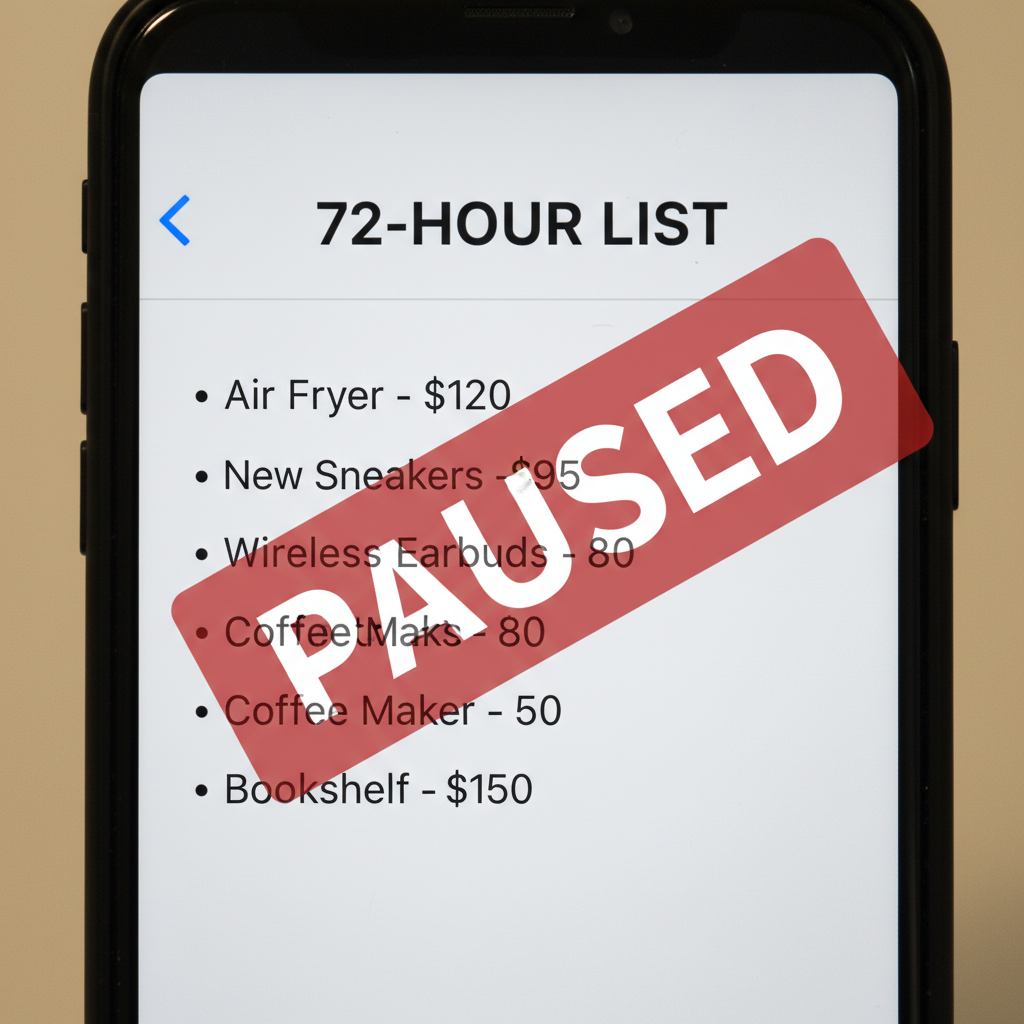
Knowing the rule is one thing; living it is another. You need a system. This isn’t about flimsy willpower; it’s about building a bulletproof process that makes the right choice the easy choice. Follow these steps to master the 72-Hour Hack.
- Step 1: The Capture. The moment you feel the urge to buy something non-essential online or in a store, STOP. Do not put it in your cart. Instead, open a dedicated note on your phone, a physical notebook, or use a wishlist app. Write down the item, the price, and where you found it. This simple act of writing it down instead of clicking ‘buy’ is your first victory. You’ve captured the impulse without surrendering to it.
- Step 2: Start the Clock. As soon as you log the item, the 72-hour countdown begins. You can even set a reminder on your phone for three days from now. Label it: ‘Decision time for [Item Name]’. This formalizes the process and holds you accountable.
- Step 3: The Interrogation. During the 72-hour waiting period, your job is to be a ruthless detective. Ask yourself these questions about the item on your list:
- Do I already own something that does the same job?
- Where will I store this? Do I have the space?
- Is this a genuine need or just a fleeting want fueled by an ad/influencer?
- What else could I do with this $50, $100, or $500? (Think debt, savings, investments).
- Can I find this cheaper elsewhere, secondhand, or borrow it from someone?
- Step 4: The Verdict. When your 72-hour reminder goes off, it’s time to make a decision. Look at the item on your list. How do you feel about it now? Has the urgency vanished? Does it still seem as critical as it did three days ago? Most of the time, the desire will have evaporated. You can simply delete it from the list—another win. If you still genuinely believe it will add significant value to your life after the interrogation, then you have permission to buy it. It’s now a conscious, deliberate purchase, not an impulse. You’re in control.
Bulletproof Your Wallet: Tools & Tricks to Support the Hack

The 72-Hour Hack is your core strategy, but a good general needs the right gear. You’re fighting against billion-dollar marketing departments; it’s time to arm yourself with some tech and tactics to level the playing field.
Digital Defenses
- Wishlist Apps: Instead of using the shopping cart as a ‘maybe’ list, use a dedicated tool. Apps like Notion, Trello, or even the basic notes app on your phone are perfect. Create a board or note called ’72-Hour Quarantine’ and dump all your shopping temptations there.
- Unsubscribe Aggressively: Your inbox is a battlefield. Every marketing email is a landmine designed to trigger an impulse. Go on an unsubscribe rampage. Use services like Unroll.Me to bulk unsubscribe from retail newsletters. A quiet inbox is a safe wallet.
- Delete Payment Info: Go into your browser settings and your favorite shopping sites and delete your saved credit card information. Forcing yourself to get up and physically get your card adds a crucial layer of friction. That small delay is often enough to make you pause and ask, ‘Do I really need this?’
Mental Fortitude
- Give Your Savings a Job: Don’t just ‘save money’. Create a specific, exciting goal for the cash you’re reclaiming. Call it your ‘Get a Passport Fund’, ‘Pay Off My Car Fund’, or my personal favorite, the ‘Escape Fund’. When you have to choose between a random gadget and funding your escape from a job you hate, the choice becomes crystal clear.
- Identify Your Triggers: Are you most vulnerable to shopping when you’re bored on a Tuesday night? Or stressed after a bad day at work? Identify your personal spending triggers and have a non-spending alternative ready. If boredom is the trigger, have a go-to podcast or a book ready. If it’s stress, go for a walk or call a friend. Replace the habit, don’t just resist it.
Key Rule: Make buying harder and saving easier. Every piece of friction you add to the buying process is a win. Every dollar you automatically transfer to your ‘Freedom Fund’ is a step in the right direction.
Excuses, Meet Reality: Dodging Common Pitfalls

Your brain is tricky. It’s been conditioned to want instant gratification, and it will come up with some very convincing excuses to bypass the 72-hour rule. Here’s how you shut down the most common ones before they even take root.
Excuse #1: ‘But it’s on sale! It’s such a good deal!’
Reality Check: Spending money you weren’t planning to spend is not saving money. A 50% off deal on a $200 item you don’t need is still $100 out of your pocket. Marketers create sales to induce FOMO (Fear Of Missing Out). Trust this: there will *always* be another sale. Always. The only thing you’re missing out on is the opportunity to keep your cash.
Excuse #2: ‘What if it sells out?’
Reality Check: This is the scarcity tactic, and it’s one of the oldest tricks in the book. Unless you’re buying a one-of-a-kind antique, chances are you can find the item or a near-identical version elsewhere. And even if it does sell out, so what? Will your life be materially worse without it? Probably not. The anxiety of scarcity is manufactured to make you act irrationally.
Excuse #3: ‘I had a hard day, I deserve a treat.’
Reality Check: You absolutely deserve a reward for your hard work, but you’ve been conditioned to believe that ‘treats’ must be purchased. This is a dangerous link to break. Redefine what a ‘treat’ is. It could be an hour to read a book guilt-free, a long bath, a walk in the park, or cooking a nice meal with groceries you already have. Treating yourself shouldn’t involve going into debt or sabotaging your financial goals.
Excuse #4: ‘It’s just $10, it’s not a big deal.’
Reality Check: Refer back to the math. Those ‘small’ purchases are the financial termites that silently eat away at the foundation of your wealth. A $10 purchase three times a week is $1,560 a year. That’s not a small deal. That’s a plane ticket, a new computer, or a significant chunk of your emergency fund. Respect the small numbers, and the big numbers will take care of themselves.
Overcoming these excuses is about shifting your mindset from a short-term consumer to a long-term architect of your own life. Every time you sidestep one of these mental traps, you strengthen your self-discipline and get one step closer to your real goals.
Conclusion
The 72-Hour Hack isn’t just another budgeting tip. It’s a fundamental shift in your relationship with money and consumer culture. It’s the pause button that lets you step out of the endless cycle of want, buy, regret. By putting a simple three-day buffer between impulse and action, you reclaim the most valuable asset you have: conscious choice.
You will be shocked at how many ‘must-have’ items become ‘don’t-need’ after 72 hours of perspective. You’ll see your savings account grow not through painful sacrifice, but through mindful decisions. This isn’t about never buying anything nice again. It’s about ensuring that every dollar you spend is a deliberate vote for the life you actually want, not the one advertisers are selling you.
Your challenge starts now. The next time you feel that pull to click ‘Add to Cart’, don’t fight it. Capture it. Put it on your list and start the clock. This is your first step to proving that you control your money, not the other way around. You got this.