
Get Ripped at Home: The No-Equipment Calisthenics Routine
Listen up. You’ve seen the ads, the influencers, the massive gyms that look more like nightclubs. They’re all selling you the same story: to get in shape, you need to open your wallet. Wide. They want your monthly membership fee, your money for overpriced supplements, and your cash for trendy activewear. It’s a hustle, and you’re the target. But here’s the real talk: the most powerful piece of fitness equipment you’ll ever own is the one you already have—your own body.
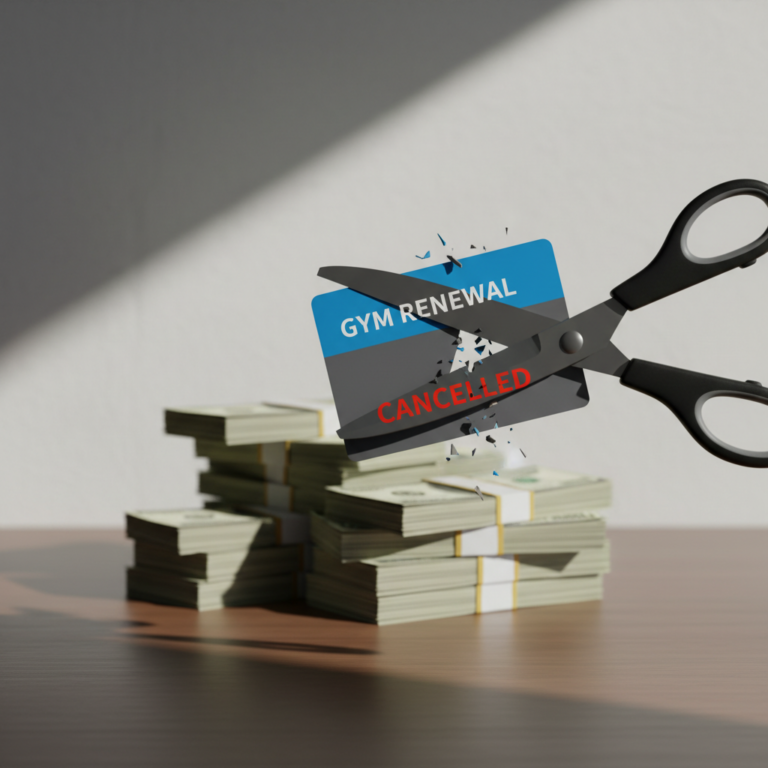
This isn’t just another workout plan. This is a financial strategy. This is your escape route from the recurring monthly charge that bleeds your bank account dry. We’re talking about building raw, functional strength using nothing but gravity and grit. It’s about reclaiming your power, both physical and financial. You’re a hustler, a saver, someone who understands the value of a dollar. So why would you pay someone else for the privilege of lifting heavy things when you can become stronger than ever for free? It’s time to stop renting your fitness and start owning it. Let’s get to work.
Why Your Wallet Hates Your Gym Membership
The Real Cost of ‘Getting Fit’ the Commercial Way
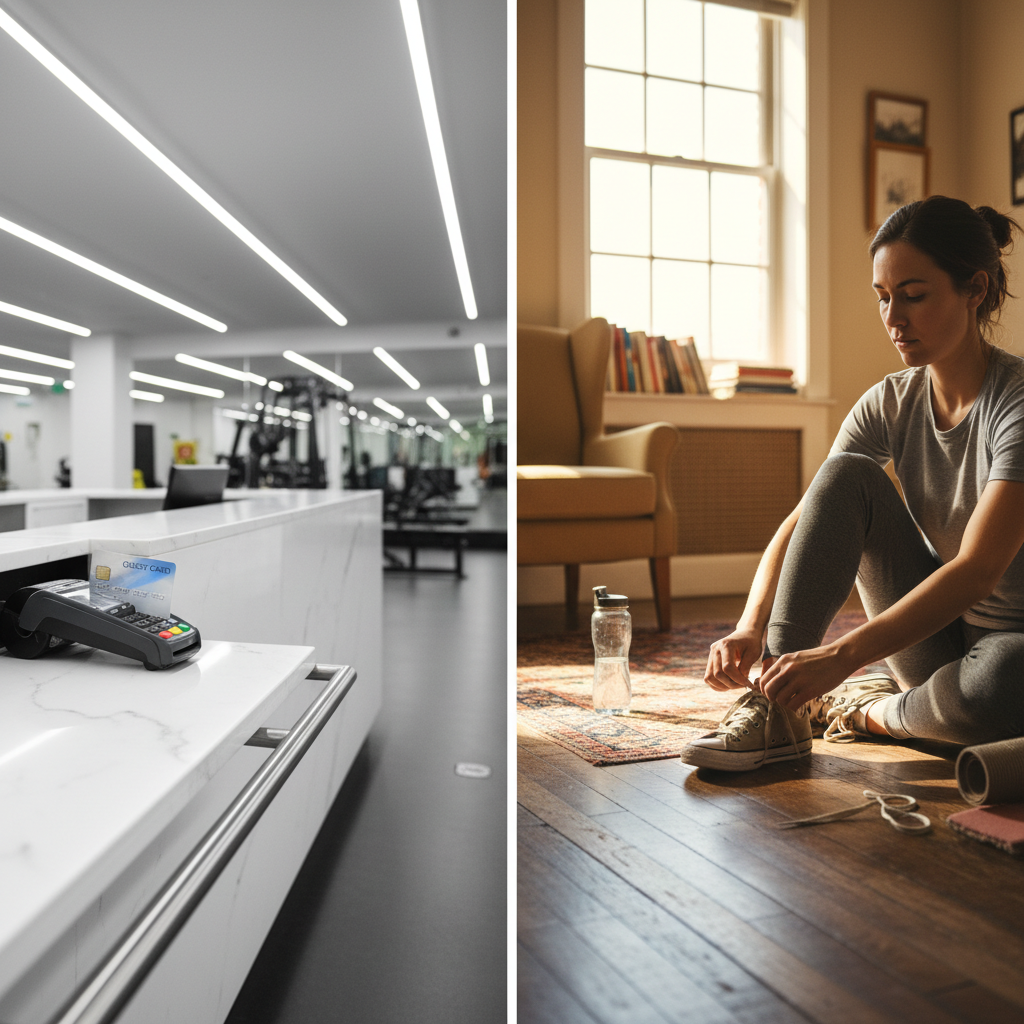
Let’s do some math. The average gym membership in the US hovers around $50-$70 a month. That sounds manageable, right? Wrong. That’s the sticker price, the bait. It’s designed to get you in the door. It doesn’t account for the hidden costs, the financial leaks that drain your resources. We’re talking about initiation fees, annual ‘maintenance’ fees, the gas money to drive there and back, and the time you lose in traffic—time you could be spending on your side hustle. Then there’s the pressure. The smoothie bar wants $9 for a post-workout shake you could make for $1.50 at home. The pro shop pushes $80 leggings. It’s a system designed to extract maximum cash from you.
Calisthenics, on the other hand, has an initiation fee of zero. The annual fee is zero. The commute is the time it takes you to walk from your bedroom to your living room. The only thing it costs is effort, and that pays dividends in both your health and your bank account. Every dollar you don’t give to a corporate gym is a dollar you can invest, save, or use to pay down debt. This isn’t just about saving a few bucks; it’s about a fundamental mindset shift. You are the asset. Your body is the gym. The world is your playground.
Cost Breakdown: Home Calisthenics vs. The Average Gym
| Expense Category | Average Gym Membership (Annual Cost) | At-Home Calisthenics (Annual Cost) |
|---|---|---|
| Membership Fee | $600 – $840 (@ $50-$70/mo) | $0 |
| Initiation/Annual Fees | $50 – $100 | $0 |
| Gas/Transportation | $120 – $240 (est.) | $0 |
| Gear & Apparel Pressure | $100+ | $0 (Wear what you own) |
| Overpriced Shakes/Snacks | $150+ | $0 (You control your kitchen) |
| TOTAL ANNUAL COST | $1,020 – $1,430+ | $0 |
Seeing it in black and white is a gut punch, isn’t it? You could be pocketing over $1,000 a year. That’s seed money for a new side hustle, a big chunk of an emergency fund, or a serious boost to your investment portfolio. The choice is a no-brainer.
The Blueprint: Mastering the Core Four Movements
Forget Complicated Machines. Master These.
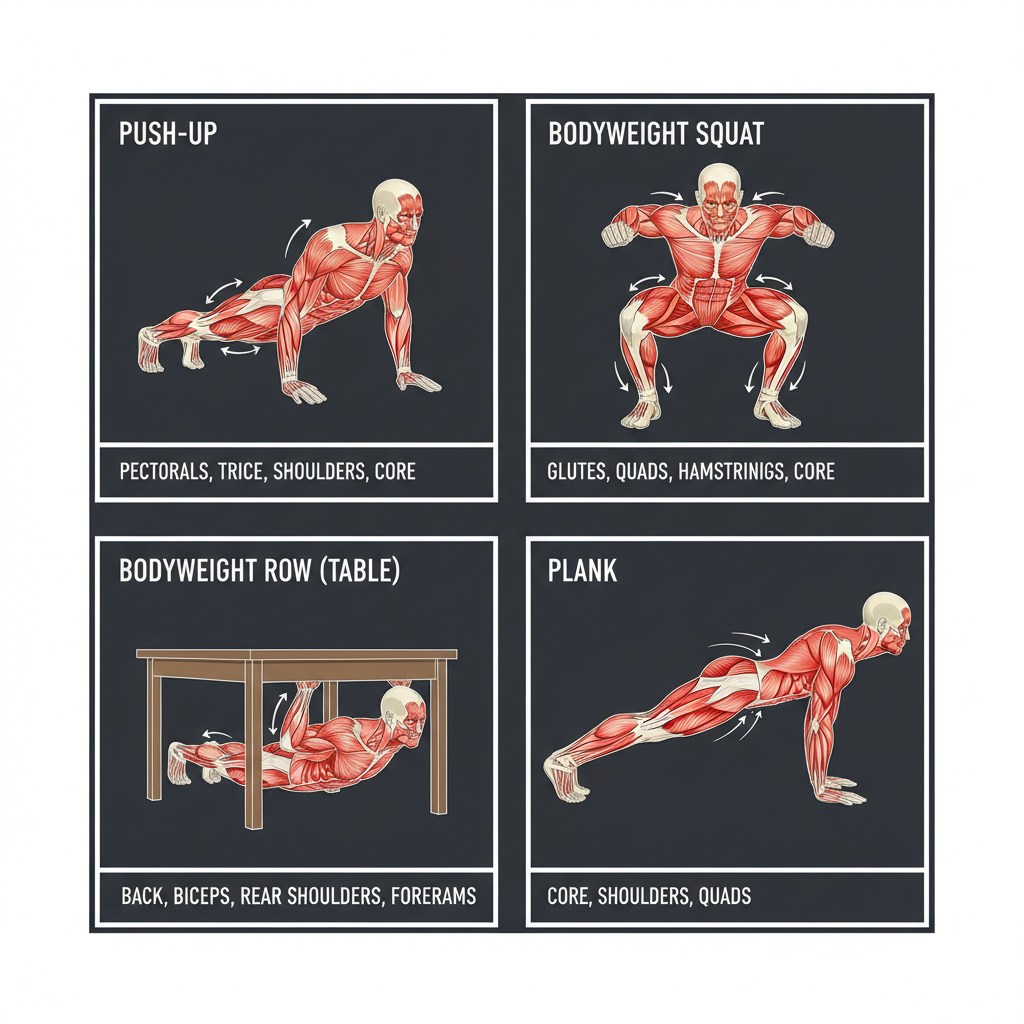
Your journey to a ripped physique and a fatter wallet is built on a foundation of four key movements. That’s it. No fluff, no complex routines designed to confuse you. Just pure, unadulterated strength-building. Focus on mastering the form first. An ugly rep doesn’t count. It just leads to injury. We’re building, not breaking.
The Golden Rule: Form Over Reps. Always. An ego-driven, sloppy push-up is worthless. A controlled, perfect-form push-up is priceless. Check your ego at the door.
1. The Push-Up: The Ultimate Upper Body Press
This isn’t just a chest exercise. A proper push-up forges your chest, shoulders, triceps, and core. It’s a moving plank.
- Get into a high plank position. Your hands should be directly under your shoulders, your body a straight line from your head to your heels. No sagging hips or piking up.
- Engage your core. Squeeze your glutes and abs like you’re about to take a punch. This stabilizes your entire body.
- Lower your body in one controlled motion. Keep your elbows tucked in at about a 45-degree angle to your body, not flared out to the sides.
- Go down until your chest is just an inch or two from the floor.
- Explode back up to the starting position, pressing through the palms of your hands. That’s one rep.
2. The Bodyweight Squat: The Foundation of Strength
If you want powerful legs and a rock-solid core, the squat is non-negotiable. It’s the most functional movement pattern there is.
- Stand with your feet slightly wider than shoulder-width apart, toes pointing slightly outward.
- Keep your chest up and your back straight. Look forward, not down.
- Initiate the movement by pushing your hips back, as if you’re about to sit in a chair that’s too far behind you.
- Lower yourself until your thighs are parallel to the floor, or as low as you can comfortably go while maintaining good form.
- Keep your weight on your heels, not your toes. You should be able to wiggle your toes at the bottom of the squat.
- Drive through your heels to return to the starting position, squeezing your glutes at the top.
3. The Pull-Up (and its variations): The King of Back Builders
“But I don’t have a pull-up bar!” No excuses. You can use a sturdy doorframe, a tree branch, or playground monkey bars. If none of those work, we start with rows.
- For Pull-Ups: Grab the bar with an overhand grip, slightly wider than your shoulders. Hang with your arms fully extended.
- Engage your back muscles (your lats). Think about pulling your shoulder blades down and back.
- Pull yourself up until your chin is over the bar. Avoid swinging or using momentum.
- Lower yourself back down in a controlled manner. A slow negative is just as important as the pull up.
- No-Bar Alternative (Bodyweight Rows): Get under a sturdy table. Grab the edge with both hands. With your body straight and heels on the floor, pull your chest up to the table’s edge. This works the same muscles.
4. The Plank & Leg Raise: Forging a Core of Steel
Forget endless crunches. A strong core is about stability. The plank and leg raises are your tools.
- Plank: Hold the top of a push-up position, or rest on your forearms. Your body must be a rigid straight line. Hold it. If it feels easy, you’re doing it wrong. Squeeze every muscle.
- Lying Leg Raises: Lie on your back, hands under your lower back for support. Keeping your legs straight, raise them until they’re perpendicular to the floor. Lower them slowly, stopping just before they touch the ground. Feel the burn in your lower abs.
Level Up: The No-Cost Progression Plan
Stagnation is the Enemy. Progress is the Goal.
Getting strong is a process. You can’t just do 10 push-ups forever and expect to look like a superhero. The secret to continuous growth is progressive overload. In a gym, that means adding more weight. At home, it means getting smarter and manipulating leverage, time, and intensity. This is how you keep getting stronger without spending a single cent.
Techniques for Infinite Progression:
- Increase Volume: The simplest method. If you did 3 sets of 8 squats last week, aim for 3 sets of 9 this week. Add one rep, one set. Small, consistent wins lead to massive gains.
- Decrease Rest Time: Shave 5-10 seconds off your rest periods between sets. This increases the metabolic demand and builds endurance alongside strength. If you rested 60 seconds, try 50.
- Time Under Tension (TUT): This is a game-changer. Slow down your reps. Take 3 full seconds to lower yourself in a push-up, and 3 full seconds to push back up. This makes every rep exponentially harder and builds serious muscle control.
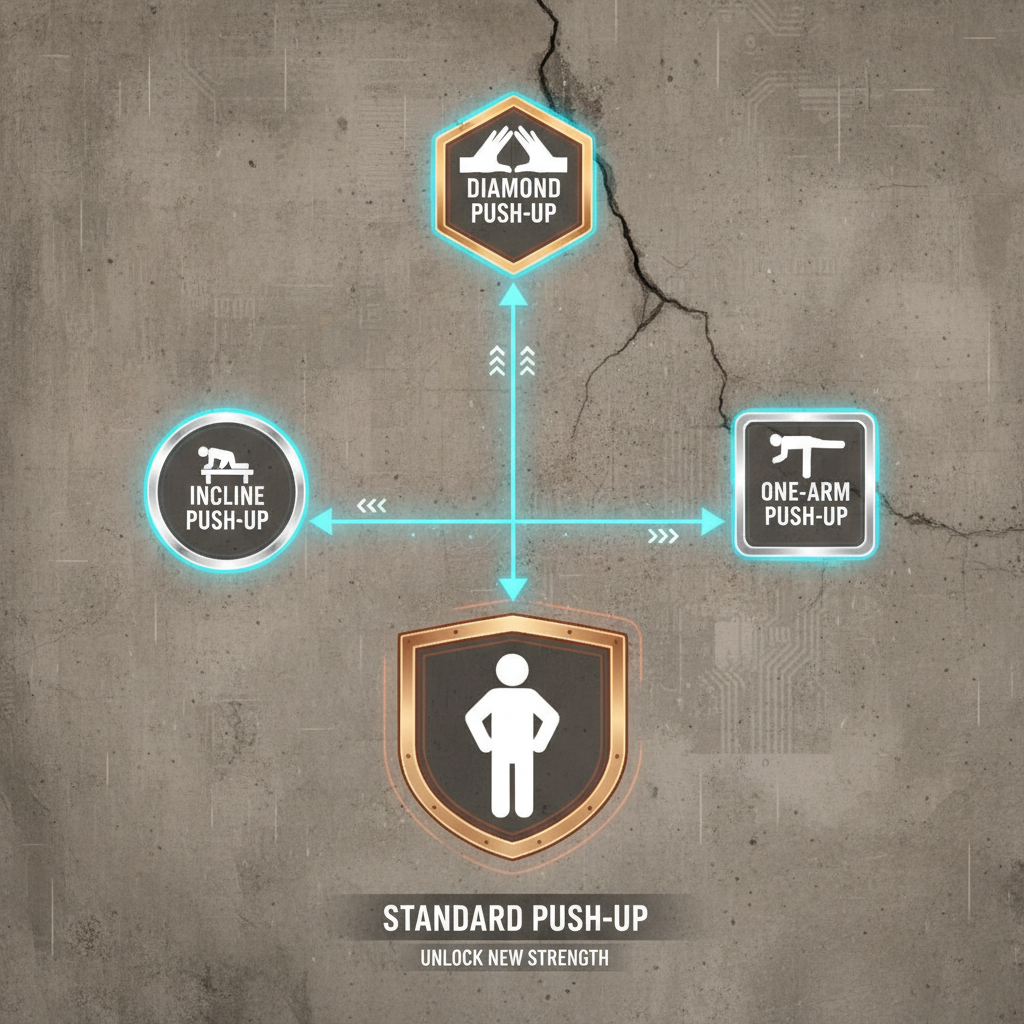
- Change the Leverage: This is where you get creative and unlock elite-level strength. By shifting your body’s position, you can make an exercise dramatically harder.
Progression Examples:
- Push-ups: Standard Push-up -> Incline Push-up (feet on a chair) -> Diamond Push-up (hands together) -> Archer Push-up (shifting weight to one side).
- Squats: Bodyweight Squat -> Pause Squat (hold at the bottom for 3 seconds) -> Jump Squat -> Pistol Squat (one-legged squat).
- Rows/Pull-ups: Table Row -> Inverted Row (feet elevated) -> Negative Pull-ups (jump to the top, lower slowly) -> Full Pull-up.
Your body is an adaptation machine. Give it a reason to adapt, and it will. The key is to consistently challenge it just beyond its current capacity. That’s the hustle.
The Grind: Your 3-Day-a-Week Workout Schedule
Stop Thinking. Start Doing. Here’s the Plan.
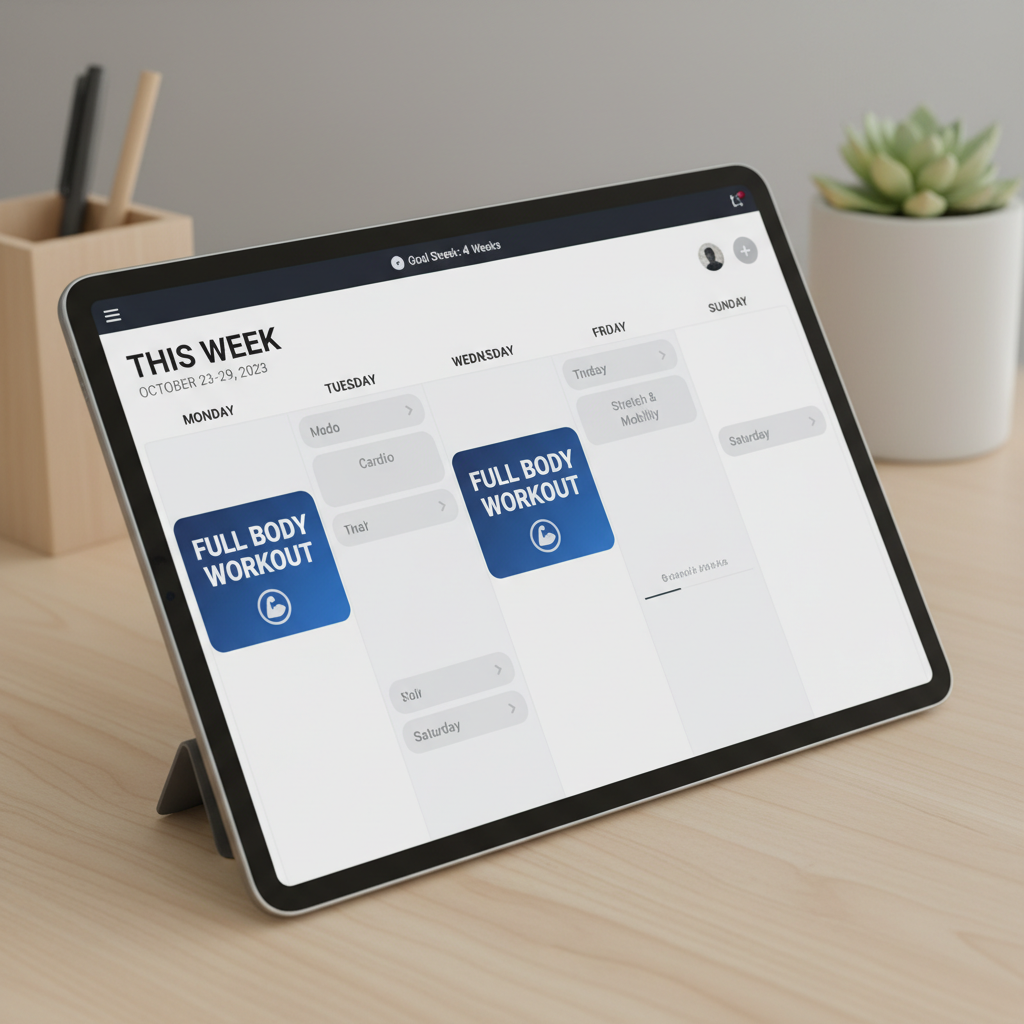
Consistency beats intensity every single time. You don’t need to destroy yourself every day. You need a sustainable plan you can stick to week after week. Here is a simple, brutally effective full-body routine. Perform this workout 3 times a week on non-consecutive days (e.g., Monday, Wednesday, Friday). This gives your body time to recover and grow stronger.
The Rule of Recovery: Your muscles don’t grow in the gym; they grow when you rest. Prioritize sleep and listen to your body. More is not always better. Smart is better.
The Weekly Workout Blueprint
- Warm-up (5 minutes): Don’t skip this. Do some light cardio (jumping jacks, high knees) and dynamic stretches (arm circles, leg swings) to get your blood flowing and joints ready.
- The Main Workout: Perform the following exercises as a circuit. Complete one set of each exercise before moving to the next. After completing all exercises, that’s one round. Rest for 60-90 seconds and repeat for a total of 3-4 rounds.
- Cool-down (5 minutes): Static stretching. Hold each stretch for 20-30 seconds. This helps with flexibility and recovery.
| Exercise | Reps/Time | Focus |
|---|---|---|
| Bodyweight Squats | 15-20 reps | Controlled descent, explosive ascent. |
| Push-Ups | As Many Reps As Possible (AMRAP) with good form | Full range of motion. Chest to floor. |
| Plank | Hold for 30-60 seconds | Keep body rigid. No sagging hips. |
| Bodyweight Rows (or Pull-ups) | 8-12 reps (or AMRAP for pull-ups) | Squeeze your shoulder blades together. |
| Lying Leg Raises | 15-20 reps | Slow and controlled. Don’t use momentum. |
Your goal is to improve each week. Maybe you get one more push-up. Maybe you hold the plank for 5 more seconds. Document your progress in a notebook. This tangible proof of your hard work is the ultimate motivation.
Fueling the Hustle: Nutrition Without the ‘Broke Tax’

You Can’t Out-Train a Bad Diet. But You Don’t Need to Go Broke Eating Right.
The fitness industry wants you to believe you need expensive powders, miracle supplements, and exotic superfoods to build muscle. It’s another lie designed to drain your bank account. Real food builds real strength. The principles are simple: get enough protein to rebuild muscle, complex carbs for energy, and healthy fats for hormone function. Here’s how to do it on a shoestring budget.
The Frugal Muscle-Builder’s Shopping List:
- Protein Powerhouses: Eggs (the perfect food), chicken thighs (cheaper and tastier than breast), canned tuna, lentils, beans, and plain Greek yogurt.
- Energy Sources: Rolled oats, brown rice, potatoes, sweet potatoes, and whole-wheat pasta. Buy these in bulk to save even more.
- Vitamins & Minerals: Focus on seasonal vegetables and fruits. Spinach, broccoli, carrots, bananas, and apples are cheap, nutrient-dense options year-round. Frozen veggies are just as nutritious and often cheaper than fresh.
- Hydration: Water. It’s free from the tap. You don’t need $5 electrolyte drinks. Drink water throughout the day, especially before, during, and after your workouts.
Scam Warning: Fat Burners & Miracle Pills. If a supplement promises rapid, effortless results, it’s a scam. They are unregulated, overpriced caffeine pills at best, and dangerous at worst. The only things that burn fat are a caloric deficit and hard work. Save your money.
Cook your own meals. Meal prepping on a Sunday afternoon can save you hundreds of dollars and countless hours during the week. It ensures you have a healthy, budget-friendly meal ready to go, so you’re not tempted by expensive takeout after a long day. Your body and your wallet will thank you.
Conclusion
There you have it. The complete, no-BS guide to building a powerful physique without spending a dime. We’ve shown you that the gym isn’t a temple of fitness; it’s a business. And you can choose to opt out. You have the blueprint, the exercises, the progression plan, and the nutritional strategy. The only missing ingredient is your commitment.
This is about more than just six-pack abs or bigger biceps. It’s about taking control. It’s about proving to yourself that you can achieve incredible things with the resources you already have. The discipline you build in your living room will translate to every other area of your life—your career, your side hustles, your finances. You’re not just building muscle; you’re building resilience, confidence, and freedom. So, what are you waiting for? The excuses are gone. The path is clear. Stop making payments. Start making progress.