


Listen up. That massive tax refund you get every spring isn’t a bonus. It’s not free money from the government. It’s an admission that you let the IRS hold onto your hard-earned cash all year long, completely interest-free. Think about it: you wouldn’t let your landlord hold an extra $200 a month just to give it back to you at the end of the year, would you? Of course not. So why are you letting the government do it?
Giving the IRS an interest-free loan is a classic financial fumble. It means you had less money in your pocket every single month to pay down debt, invest in your side hustle, or just breathe a little easier. We’re here to stop that. The key to unlocking this cash is a simple, often-ignored document: the Form W-4. It’s not just another piece of HR paperwork; it’s the control panel for your paycheck. By making a few smart adjustments, you can stop overpaying your taxes and start putting that money back where it belongs—in your bank account, right now.
Why Your Big Tax Refund is a Financial Fail

Let’s get one thing straight: a big tax refund is a sign of poor cash flow management. It feels good for a moment, like finding a $20 bill in an old coat. But that ‘found money’ was always yours. The average tax refund is around $3,000. If you got that much back, it means you overpaid your taxes by $250 every single month.
What could you have done with an extra $250 a month? That’s a car payment. That’s a significant chunk of a credit card bill with a nasty interest rate. It’s seed money for the side hustle you’ve been dreaming about. Instead, that money was sitting in the U.S. Treasury’s bank account, earning you exactly zero. This is called opportunity cost—the potential gain you lost by not having access to your own money.
The Math Doesn’t Lie
Let’s say you took that $250 each month and put it into a high-yield savings account (HYSA) earning a modest 4% APY. At the end of the year, you’d have your $3,000 plus about $65 in interest. It’s not a fortune, but it’s $65 more than the IRS gave you. If you used it to pay down a credit card with an 18% APR, you would have saved yourself hundreds in interest charges. By overpaying your taxes, you are literally paying to let the government borrow your money. It’s time to flip the script.
The goal isn’t to get a huge refund or to owe a massive amount. The street-smart sweet spot is to owe a very small amount or get a tiny refund (think under $500). This proves you played the game with maximum efficiency, keeping your money working for you all year long.
Decoding the W-4: Your Paycheck Power Tool

The Form W-4, officially the ‘Employee’s Withholding Certificate’, looks intimidating. It’s got steps, worksheets, and official-sounding jargon. But don’t let it scare you. It’s your direct line of communication to your employer’s payroll system, telling them exactly how much to set aside for taxes from each check. The form was redesigned a few years ago to be more straightforward, moving away from the old system of ‘allowances’. Now, it’s based on real dollar amounts, which gives you more precise control.
Let’s break down the only parts that matter for most people:
- Step 1: Personal Info. Easy. Name, address, filing status (Single, Married Filing Jointly, etc.). Get this right. Your filing status has a huge impact on your tax brackets.
- Step 2: Multiple Jobs or Spouse Works. This is CRITICAL for anyone in a two-income household or juggling multiple gigs. If you and your spouse both work, and you both just check ‘Married Filing Jointly’ on your W-4s without doing this step, you are almost guaranteed to under-withhold and get a nasty tax bill. The form gives you three options here, but the most accurate one is using the IRS’s online estimator.
- Step 3: Claim Dependents. This is where you get credit for your kids or other dependents. You multiply the number of qualifying children under 17 by $2,000 and the number of other dependents by $500. This directly reduces your withholding.
- Step 4: Other Adjustments. This is the secret weapon for fine-tuning your paycheck.
The Power of Step 4
This section lets you manually adjust your withholding for things outside your main job.
- (a) Other Income: Got a side hustle? Rental income? This is where you can tell your employer to withhold more to cover the taxes on that income so you don’t have to mess with quarterly estimated payments.
- (b) Deductions: If you expect to have large deductions (like mortgage interest, state and local taxes, big charitable donations) beyond the standard deduction, you can use the worksheet to claim them here. This will reduce your withholding.
- (c) Extra Withholding: The ultimate manual override. Want to have an extra $50 taken out of each check just to be safe? Put it here. This is how you can dial in your withholding with surgical precision.
Forget trying to do the complex worksheets by hand. Your best move is to use the free, official tool the IRS provides.
The Step-by-Step Playbook to Adjust Your Withholding
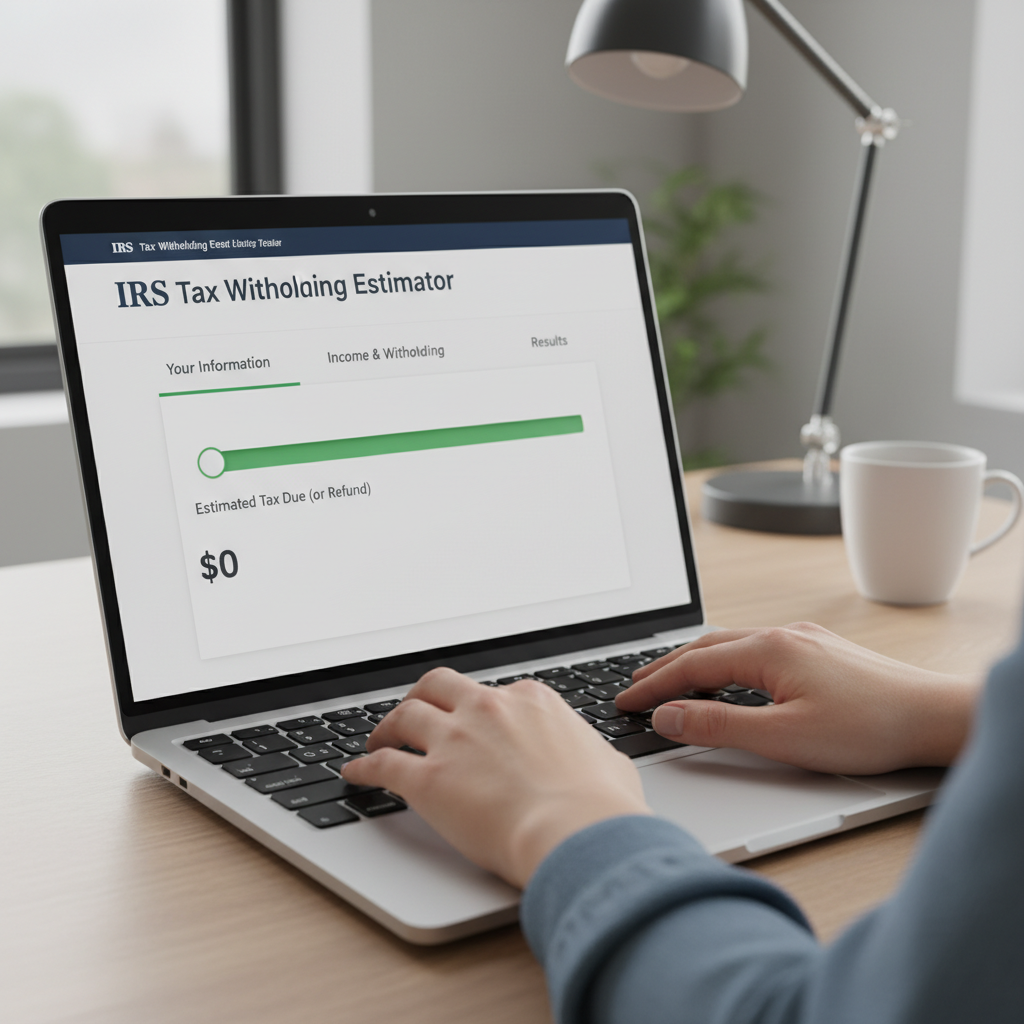
Ready to take control? It’s easier than you think. Set aside 20 minutes, grab a coffee, and let’s reclaim your cash. This isn’t rocket science; it’s a simple process of giving the right information to the right tool.
- Gather Your Intel: You’ll need your most recent pay stubs for yourself (and your spouse, if applicable). You’ll also want a copy of last year’s tax return. This will give you a good baseline for your income and deductions.
- Go to the Source: Open up your web browser and search for the ‘IRS Tax Withholding Estimator.’ Make sure you are on the official IRS.gov website. Do not use any third-party sites that ask for your Social Security number or other sensitive info. The official IRS tool is anonymous and secure.
- Plug in Your Numbers: The estimator will walk you through a series of questions. It’ll ask about your filing status, number of dependents, your salary, how much you’ve paid in federal taxes so far this year, and any other income or tax credits you expect. Be as accurate as possible for the best results.
- Analyze the Results: Once you’ve entered everything, the magic happens. The estimator will tell you your projected tax liability for the year and, most importantly, whether you’re on track for a refund or to owe money. It will then give you a recommendation on how to fill out a new W-4 to get as close to a $0 balance as possible. It might tell you to claim a specific dollar amount in Step 3 or enter a specific amount for extra withholding in Step 4(c).
- Execute the Plan: Get a new Form W-4. Most companies have this available on their internal employee portal. If not, just ask HR for one. Fill it out EXACTLY as the IRS estimator recommended. Don’t second-guess it.
- Submit and Verify: Turn in the new form to your payroll department. The changes should take effect within one or two pay cycles. When you get your next paycheck, look at the federal tax withholding line item. You should see a difference. Enjoy that extra cash!
Real-World Math: How Much Cash Are We Talking?
This all sounds good in theory, but what does it mean for your actual bank account? Let’s look at some concrete examples. These are simplified scenarios, but they show the powerful impact of a properly adjusted W-4.
| Scenario | Old Monthly Take-Home (Big Refund) | New Monthly Take-Home (Optimized) | Extra Cash Per Month | Annual Extra Cash |
|---|---|---|---|---|
| Single Filer, $60k Salary | $3,650 | $3,850 | $200 | $2,400 |
| Married, 1 Income, 2 Kids, $90k Salary | $5,700 | $5,975 | $275 | $3,300 |
| Dual Income, No Kids, $140k Combined | $8,200 | $8,550 | $350 | $4,200 |
Look at those numbers. We’re talking about hundreds of dollars every single month. That $275 for the family could cover groceries for two weeks. The $200 for the single filer could wipe out a student loan payment. The $350 for the dual-income couple could be funneled directly into an investment account. This isn’t chump change. This is money that can fundamentally change your monthly budget, reduce financial stress, and accelerate your wealth-building goals.
When to Re-Check Your W-4 (Don’t Set It and Forget It)
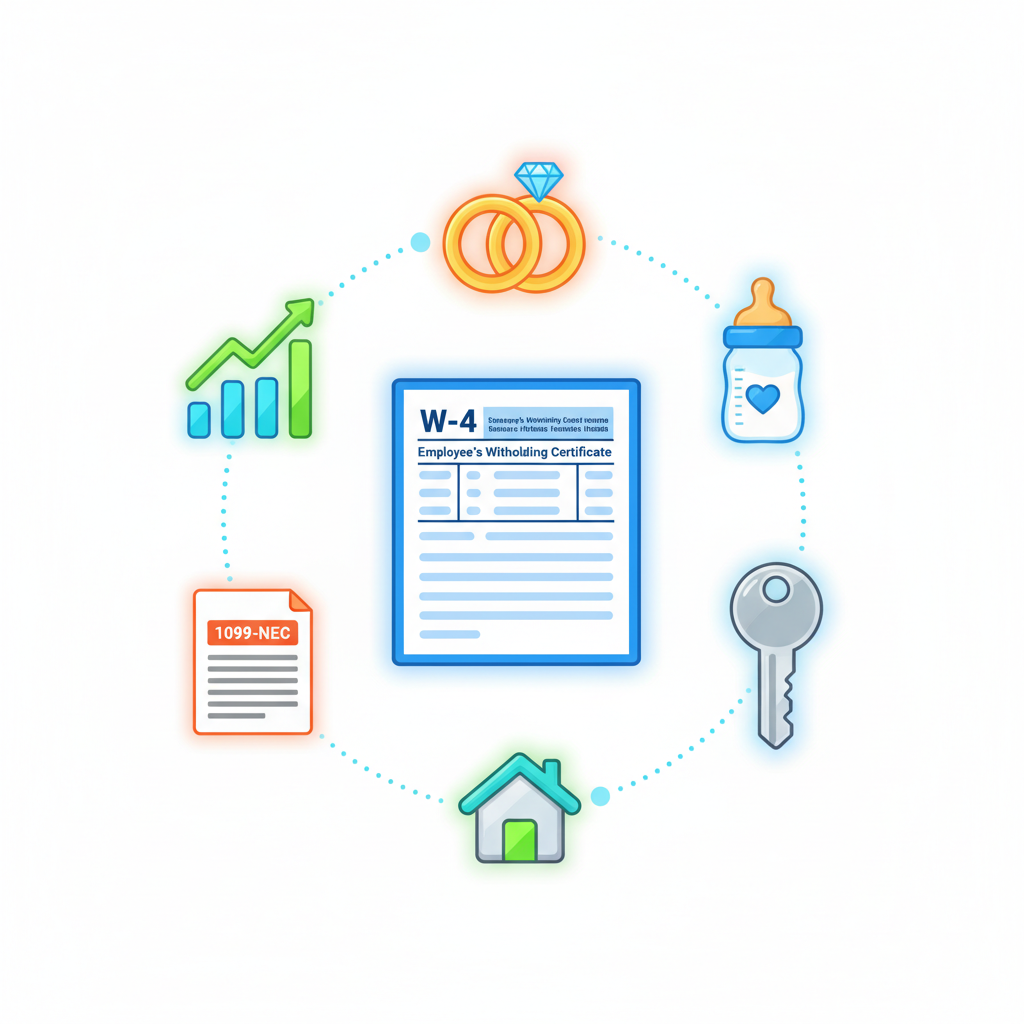
Your W-4 isn’t a one-and-done task. Life changes, and so does your tax situation. You should plan to give your W-4 a quick check-up at the beginning of every year, but you absolutely MUST revisit it if you experience any major life event. Treating your W-4 as a static document is how you end up with surprise tax bills or massive refunds again.
Here are the top reasons to immediately run your numbers through the IRS estimator again:
- You Get Married or Divorced: Your filing status changes, which dramatically impacts your tax liability.
- You Have a Child (or a child is no longer a dependent): Adding a dependent means more tax credits and less withholding. A child aging out means the opposite.
- You or Your Spouse Gets a New Job or a Big Raise: More income means you’ll be in a different tax situation. This is especially true if you go from a one-income to a two-income household.
- You Start a Side Hustle: This is a big one for this crowd. Your side hustle income from a 1099-NEC or other source has ZERO taxes withheld. You are responsible for that tax. You can either pay quarterly estimated taxes or, the easier way, adjust your W-4 at your W-2 day job to withhold extra to cover your side hustle tax bill.
- You Buy a House: The mortgage interest and property tax deductions might be large enough to significantly lower your tax liability, meaning you can reduce your withholding.
Think of it like a financial check-up. A quick 15-minute review after any of these events can save you from a major headache or from loaning the government your money for another year.
Conclusion
The days of celebrating a big tax refund are over. You’re smarter than that now. You know that a refund is just your own money being returned to you after a year-long, interest-free loan. By taking 20 minutes to understand and adjust your Form W-4, you’re not just filling out paperwork—you’re executing a financial strategy. You’re taking back control, improving your monthly cash flow, and making your money work for you instead of for the government.
So, what are you waiting for? Go find your last pay stub, fire up the IRS Tax Withholding Estimator, and give yourself a raise. Your budget, your debt, and your future self will thank you for it.
Disclaimer: I am not a financial advisor, CPA, or tax professional. This content is for educational and informational purposes only. Tax laws are complex and your individual situation is unique. Please consult with a qualified tax professional for advice tailored to your specific financial circumstances.


Makenzie is the founder and lead writer at MoneyHackTips.com — a personal finance blog dedicated to delivering street-smart financial wisdom for real people on real budgets. With 300+ published articles covering everything from debt management to investing fundamentals, Makenzie’s mission is to make every dollar work harder. When not writing about money hacks, Makenzie is testing frugal living strategies, optimizing side hustles, and helping readers build financial freedom from scratch.