

Free Money You’re Missing: Maximizing Employee Benefits Checklist For Beginners
Listen up. You’re grinding away at your job, maybe juggling a side hustle or two, and you think your paycheck is the only reward for your hard work. Wrong. Your employer is holding a bag of cash with your name on it, and it’s called your benefits package. Ignoring it is like setting a pile of $100 bills on fire every single month.
Most people just tick a few boxes during open enrollment and call it a day, completely clueless about the thousands of dollars they’re forfeiting. This isn’t some boring HR paperwork; this is a high-yield investment, a tax-slashing machine, and the easiest side hustle you’ll ever have. You don’t need more hours in the day, you just need the inside scoop.
This isn’t your parents’ stuffy financial guide. This is a no-fluff, street-smart checklist for beginners. We’re going to break down exactly where the free money is hidden and how you can claim every last cent. Get ready to give yourself a massive raise without ever having to ask for one.
The Mindset Shift: Your Benefits Are Your Secret Paycheck
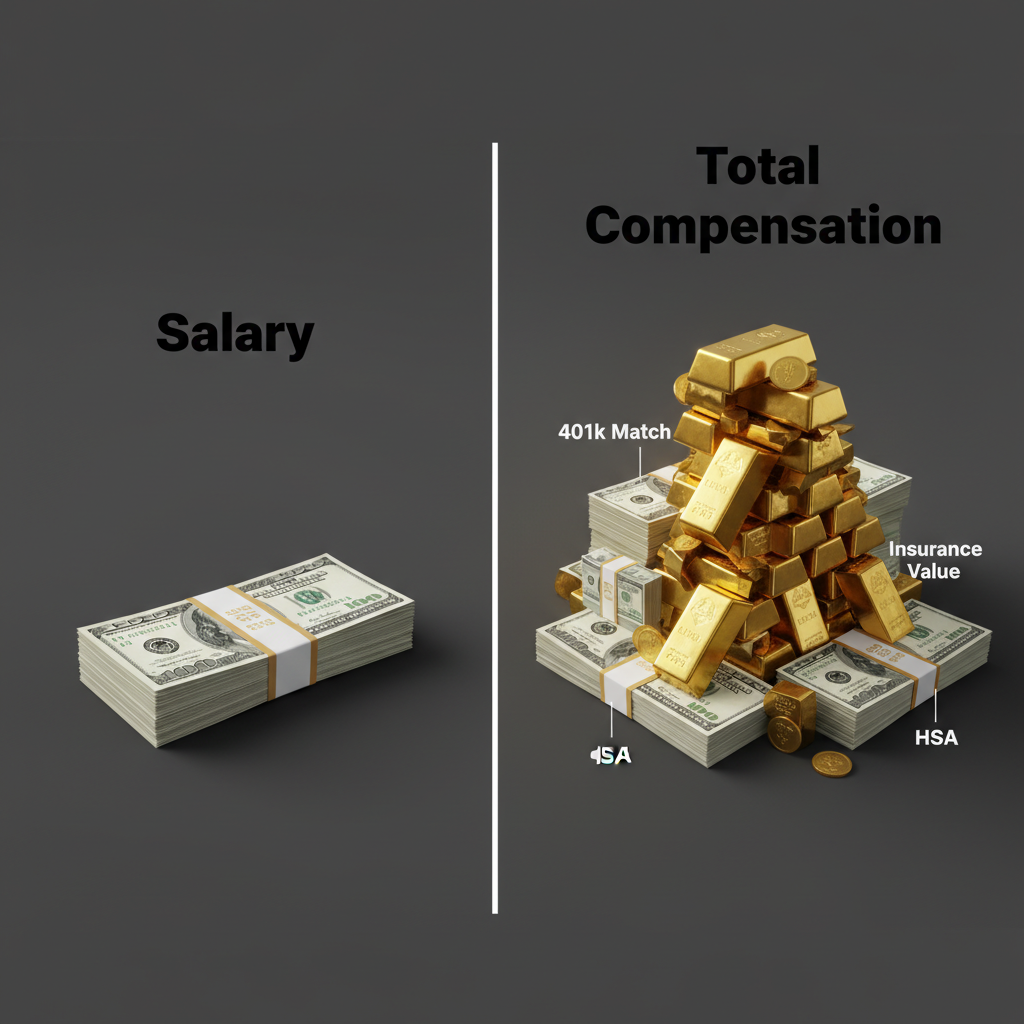
First things first, we need to rewire your brain. Stop thinking of your salary as your total pay. The real number you need to care about is your Total Compensation. This includes your salary, any bonuses, and the dollar value of every single benefit your company offers—health insurance, retirement matching, wellness stipends, you name it.
Think of it like this: A job offering $60,000 with a $5,000 401(k) match and a $3,000 HSA contribution is actually a $68,000 a year gig. A job offering $62,000 with no match is leaving you poorer. The hustler’s mindset is about seeing the whole picture and playing the game to win.
Your annual benefits enrollment isn’t a chore; it’s your annual strategy session to maximize your income. It’s the one time a year you can give yourself a guaranteed, tax-advantaged raise. Don’t sleep on it. Your future self, rolling in dough, will thank you.
The Easiest Money You’ll Ever Make: The 401(k) Match

If you ignore everything else in this guide, burn this one rule into your memory: Contribute enough to get your full employer 401(k) match. Not doing this is, without exaggeration, rejecting a 100% return on your investment. There is nowhere else on planet Earth you will find a guaranteed 100% return. It’s free. Money.
How it works is simple: Your company says, “For every dollar you put into your retirement account, up to a certain percentage of your salary, we’ll put a dollar in too.” The most common match is 100% of your contributions up to 6% of your salary.
The Math Doesn’t Lie
Let’s say you earn $50,000 a year, and your company offers a 100% match up to 6%. To get the full match, you need to contribute 6% of your salary.
| Your Action | The Result (Annual) |
|---|---|
| You contribute 6% of $50,000 | $3,000 from your paycheck goes into your 401(k) |
| Your employer matches 100% | $3,000 in FREE MONEY is deposited by your employer |
| Total Annual Contribution | $6,000 (for the price of $3,000) |
You instantly doubled your money before it even had a chance to be invested and grow. If you don’t do this, you’re telling your boss, “Nah, you can keep that $3,000. I don’t need it.” Don’t be that person.
The Script for HR
Not sure what your match is? Send this email. No fear, just facts.
Hi [HR Manager Name],
I’m reviewing my benefits and want to ensure I’m maximizing my retirement savings. Could you please clarify two things for me?
1. What is the company’s 401(k) matching formula?
2. What is the vesting schedule for the company’s contributions?Thanks for your help!
The “vesting schedule” is key. It’s the time you have to work at the company to be able to keep their matching funds if you leave. Know the rules of the game.
The Triple-Tax-Advantaged Cheat Code: Health Savings Account (HSA)

Okay, hustlers, this is the next level. If your company offers a High-Deductible Health Plan (HDHP), it likely comes with access to a Health Savings Account (HSA). People see “health” and think it’s just for doctor bills. Big mistake. An HSA is one of the most powerful wealth-building tools in existence, even better than a 401(k) or Roth IRA.
Why? It’s the only account with a triple tax advantage:
- Tax-Deductible Contributions: The money you put in is pre-tax, lowering your taxable income for the year. (Instant savings!)
- Tax-Free Growth: You can invest the money in your HSA, and it grows completely tax-free. (Like a Roth IRA.)
- Tax-Free Withdrawals: You can take money out for qualified medical expenses anytime, completely tax-free. (The knockout punch.)
Unlike a Flexible Spending Account (FSA), the money in your HSA is yours forever. It doesn’t expire. It rolls over year after year, and you take it with you when you leave your job. Many savvy people max out their HSA, pay for minor medical bills out-of-pocket, and let their HSA balance grow into a massive, tax-free retirement fund for future healthcare costs.
HSA Math: The Tax Shield
Let’s say you’re in the 22% federal tax bracket and contribute the 2024 individual max of $4,150 to your HSA.
- Immediate Tax Savings: $4,150 x 22% = $913. That’s $913 you just kept away from the taxman this year alone.
- Employer Contribution: Many employers kick in free money to your HSA just for opening one, often $500 to $1,000. More free cash!
Using an HSA is like getting a 20-30% discount on all your medical expenses, while also building a secret, tax-free investment account. It’s a no-brainer if you’re eligible.
Use It or Lose It: The Flexible Spending Account (FSA) Hustle
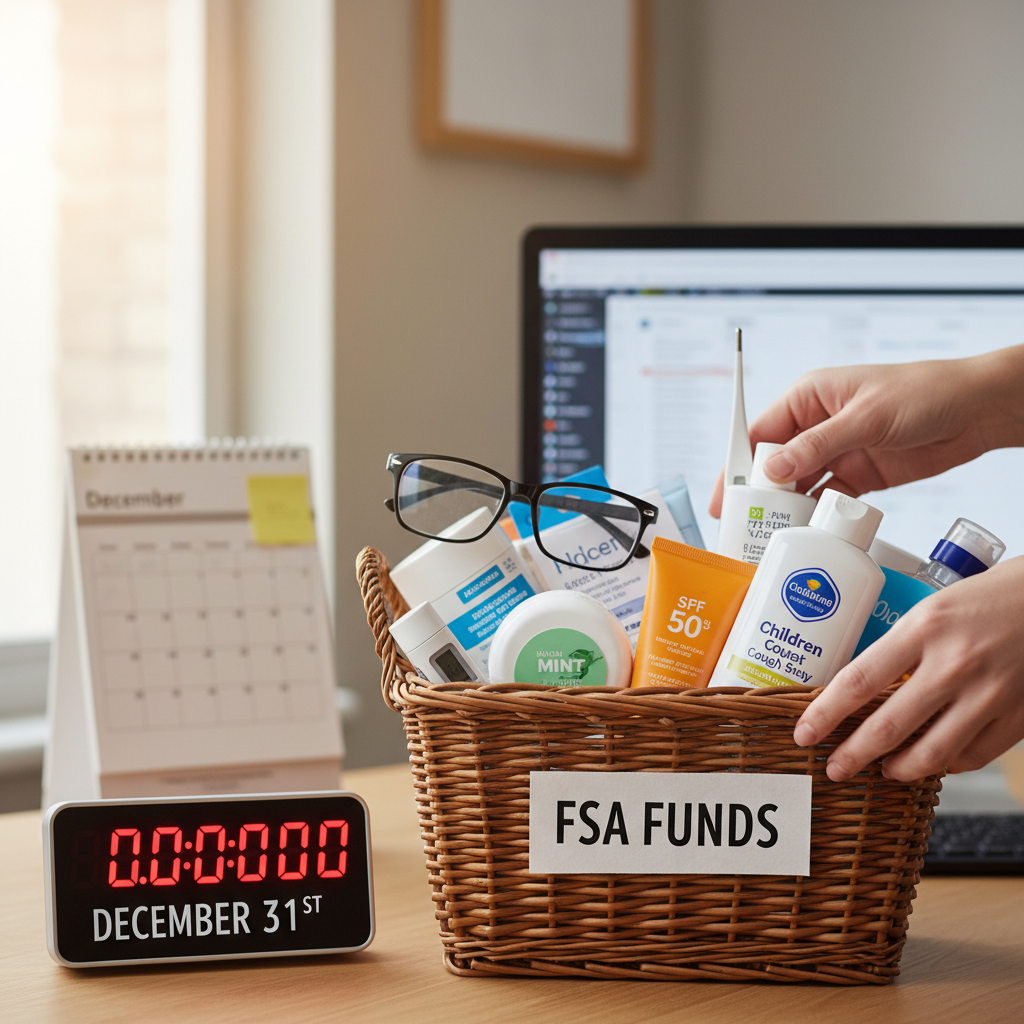
If you don’t have access to an HSA, you’ll likely have the option of a Flexible Spending Account (FSA). Think of it as the HSA’s more rigid cousin. You still contribute pre-tax money, saving you a bundle on taxes, but it comes with a critical rule: it’s use-it-or-lose-it.
This is where you need a strategy. The FSA is perfect for predictable expenses you know you’ll have in the coming year. Don’t just guess a number. Sit down and calculate it.
Common FSA-Eligible Expenses:
- Doctor visit co-pays and deductibles
- Prescription medications
- Dental work (cleanings, fillings, braces)
- Eye exams, glasses, and contact lenses
- Sunscreen (SPF 15+) and first-aid supplies
- Dependent care (daycare for your kids)
The game here is precision. Add up your expected costs for the year and contribute that exact amount. If you know you need $800 worth of dental work and your kid needs $200 in new glasses, contribute $1,000. By using pre-tax dollars, you’re essentially getting a 20-30% discount on those essential costs. Just make sure you have a plan to spend every dollar before the deadline, which is usually December 31st or sometimes March 15th of the next year.
The Hidden Gems: Perks They Don’t Advertise Loudly

The big-ticket items are the 401(k) and health accounts, but don’t stop there. Your employee handbook is probably full of smaller perks that add up to serious cash back in your pocket. You just have to look for them. Hunt through your benefits portal for these hidden gems:
- Tuition Reimbursement: Want to level up your skills? Many companies will pay for part or all of your college courses or certifications. This can be worth $5,000+ per year.
- Wellness Stipend: Free money for your gym membership, workout apps, or new running shoes. This is often a few hundred dollars a year for things you’re already buying.
- Commuter Benefits: Allows you to pay for public transit or parking with pre-tax dollars. It’s another easy way to get a discount on a regular expense.
- Employee Stock Purchase Plan (ESPP): This lets you buy company stock at a discount, usually 10-15%. You can often sell it immediately for a quick, low-risk profit. It’s a slightly more advanced hustle, but can be very lucrative.
- Cell Phone Bill Reimbursement: If you use your personal phone for work, many companies will pay a portion of your monthly bill. That’s an easy $50 a month back in your pocket.
- Legal Services: Need to create a will or get advice? Many plans offer free or heavily discounted access to lawyers.
Take an hour, grab a coffee, and read every single page of your benefits guide. You’ll be shocked at what you find. Each one of these is a budget line item you can now get for free or at a steep discount.
The Final Boss: Scam Warnings & Red Flags

Now that you’re ready to dive in, a word of caution. Not all benefits are created equal, and some have traps for the unwary. Keep your street smarts about you.
Red Flag #1: High-Fee 401(k) Plans
Your 401(k) isn’t totally free. The investment funds inside have fees, called “expense ratios.” A good, low-cost index fund might have a fee of 0.05%. A bad one could have a fee of 1.5% or more. That difference can cost you tens or even hundreds of thousands of dollars over your career. Look for low-cost index funds (like an S&P 500 fund) within your plan options.
Red Flag #2: The “On-Site Financial Advisor”
Some companies bring in “advisors” to help you sign up. Be skeptical. Many of these are not true fiduciaries (legally obligated to act in your best interest); they are salespeople who get commissions for putting you into high-fee products. Get your advice from a neutral third party.
Red Flag #3: Ignoring the Vesting Schedule
We mentioned this before, but it’s critical. If your company’s 401(k) match has a 3-year “cliff vesting” schedule, you must stay for 3 full years to keep their contributions. If you leave after 2 years and 11 months, you walk away with $0 of their money. Know your date!
Key Rule: Always read the fine print. Your benefits are a business transaction. Understand the terms before you sign, just like any other contract. Protect your money.
Conclusion
You now have the playbook. Your employee benefits package is not a passive document; it’s an active income stream waiting to be tapped. By getting your full 401(k) match, maxing out an HSA, strategically using an FSA, and hunting down hidden perks, you are giving yourself a raise that could easily be worth 10-20% of your salary.
This is the ultimate frugal hack. It doesn’t require clipping coupons or giving up lattes. It just requires one afternoon of focused effort each year to make decisions that will pay you back for decades. Take control. Open your benefits portal, book a meeting with HR if you need to, and go claim the free money that is rightfully yours.
Disclaimer: I am not a financial advisor. The information provided in this article is for informational and educational purposes only. It is not intended to be a substitute for professional financial advice. You should consult with a qualified financial professional before making any financial decisions.