

Let’s be real. You’ve tried budgeting before. You downloaded the app, printed the spreadsheet, and bought the fancy planner. For a week, you were a financial rockstar. Then life happened. The system was too rigid, too confusing, or just plain boring. You ended up with more guilt than savings. Sound familiar? That’s the old way. It’s time to wise up and get a secret weapon the big-shot finance gurus don’t want you to know about: Artificial Intelligence.
I’m talking about using a tool you probably already mess around with—ChatGPT—to build a budget that actually works for your life. This isn’t about complicated formulas or restrictive rules. This is about having a conversation with a super-smart assistant that can organize your financial chaos, spot money leaks you never knew you had, and even brainstorm ways to make more cash. Forget everything you think you know about budgeting. We’re about to turn your finances into a game you can finally win.
Why Your Old Budget Failed (And Why AI is Your New Secret Weapon)

The reason most budgets crash and burn isn’t because you lack discipline. It’s because they’re built on a foundation of failure. They’re one-size-fits-all solutions for unique financial lives. It’s like trying to wear someone else’s shoes—uncomfortable and destined to trip you up.
The Old Guard: Why Traditional Budgets Suck
- They’re Rigid: Got an unexpected car repair or a friend’s wedding? A static spreadsheet doesn’t care. It just shows you a big, fat red number, making you feel like you’ve failed.
- They’re Judgmental: Budgeting apps love to send you push notifications shaming you for that $6 latte. They don’t understand context, nuance, or the fact that you needed that caffeine to function.
- They’re Time-Consuming: Manually entering every single receipt and categorizing every transaction is a part-time job nobody wants. After a few weeks, the effort outweighs the reward, and you quit.
- They Lack Insight: A spreadsheet can tell you what you spent, but it can’t tell you why or offer creative solutions. It’s just a data dump with zero intelligence.
Now, enter your new financial co-pilot. ChatGPT flips the script entirely. It’s not a rigid set of rules; it’s a dynamic, conversational partner. Think of it less like an accountant and more like a street-smart friend who’s a whiz with numbers. It’s available 24/7, costs nothing, and won’t judge you for your spending habits. It’s here to analyze, strategize, and empower you to make smarter moves with your money.
The Game Plan: Prompting ChatGPT Like a Pro

Garbage in, garbage out. This rule is gospel when dealing with AI. To get a killer budget, you need to feed ChatGPT the right information. Don’t just ask, “Fix my finances.” That’s like walking into a doctor’s office and saying, “I’m sick.” You need to provide specifics. The more detail you give, the more personalized and powerful the output will be.
Step 1: Gather Your Financial Intel
Before you type a single word, pull together your numbers. You don’t need to be perfect, just thorough. Grab your last 1-2 months of statements and list out the following:
- Monthly Take-Home Pay: This is your net income after taxes and deductions. If your income is variable, use an average of the last 3 months.
- Fixed Expenses: These are the bills that are the same every month. Think rent/mortgage, car payments, insurance, internet, and phone bills.
- Variable Expenses: This is everything else. Food, gas, entertainment, shopping, utilities that fluctuate. Don’t judge, just list them. Group them into rough categories like ‘Groceries’, ‘Dining Out’, ‘Subscriptions’, ‘Gas’, etc.
- Debt Payments: List all your minimum monthly payments for credit cards, student loans, and personal loans. Include the total balance and interest rate for each—this is crucial for strategy later.
- Savings Goals: What are you working towards? A $1,000 emergency fund? A $5,000 down payment? Be specific.
Step 2: The Master Prompt Formula
Now it’s time to put it all together. You’re going to give the AI a role, provide your data, and state your goal. Use a structure like this for maximum impact. Copy and paste this into ChatGPT and fill in your details.
Act as a personal finance expert and budget coach. Your goal is to help me create a simple, realistic monthly budget that I can actually stick to. You must be encouraging but direct. I want to use the 50/30/20 budgeting rule as a starting point. Here is my financial data:
Monthly Take-Home Income: [Your total monthly net income, e.g., $3,500]
Fixed Expenses:
– Rent/Mortgage: [e.g., $1,200]
– Car Payment: [e.g., $300]
– Car Insurance: [e.g., $120]
– Internet: [e.g., $60]
– Phone Bill: [e.g., $80]Variable Expenses (Last Month’s Total):
– Groceries: [e.g., $450]
– Gas: [e.g., $150]
– Dining Out/Bars: [e.g., $350]
– Subscriptions (Netflix, Spotify, etc.): [e.g., $45]
– Shopping: [e.g., $200]
– Personal Care: [e.g., $50]Debts:
– Credit Card 1: $2,500 balance at 21% APR, $75 minimum payment
– Student Loan: $15,000 balance at 5.5% APR, $200 minimum paymentFinancial Goal: My primary goal is to build a $1,000 emergency fund as quickly as possible.
Based on this information, please do the following:
1. Create a detailed 50/30/20 budget for me in a table format, categorizing my spending into Needs, Wants, and Savings.
2. Show me where I am over or under the recommended percentages.
3. Provide 3 actionable, specific recommendations to help me align my budget with my goal of building an emergency fund.
Step-by-Step: Analyzing Your AI-Powered Budget
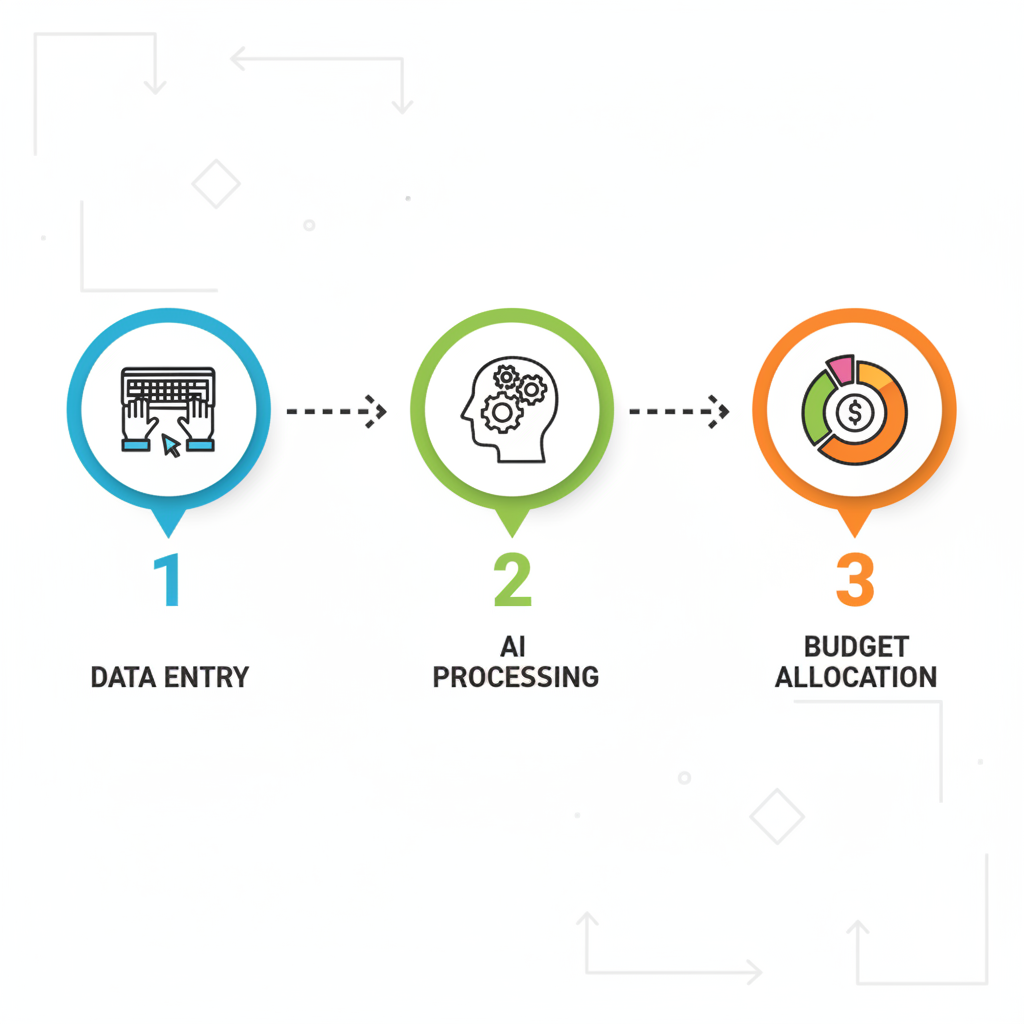
Once you hit ‘Enter’ on that master prompt, ChatGPT will spit out a structured plan in seconds. This is where the magic happens. It’s not just a list of numbers; it’s a clear snapshot of your financial life. Now, you need to know how to read it and use it.
The AI will likely give you something that looks like this, which is a starting point for your new financial reality.
| Category | Budget Rule | Recommended Spend | Actual Spend | Difference |
|---|---|---|---|---|
| NEEDS (50%) | Your income x 0.50 | $1,750 | $2,360 | -$610 |
| WANTS (30%) | Your income x 0.30 | $1,050 | $645 | +$405 |
| SAVINGS/DEBT (20%) | Your income x 0.20 | $700 | $275 | -$425 |
Seeing your finances laid out like this is a gut-check moment. The ‘Difference’ column is your roadmap. The red numbers aren’t failures; they’re opportunities. The AI has just flagged exactly where your money is going and where you have leverage.
- Review the Categories: Does the AI’s breakdown make sense? It might put ‘Groceries’ under Needs, but if you know half of that is fancy snacks and expensive cuts of meat, you can mentally shift some of that cost to the ‘Wants’ category. This is your budget; you make the rules.
- Analyze the Recommendations: ChatGPT will give you suggestions. They might be things like, “Your ‘Dining Out’ spending is high for your income. Reducing it by $150/month would free up significant cash for your emergency fund.” or “Consider calling your internet provider to negotiate a lower rate.” These are not commands; they are strategic options.
- Start a Conversation (Refine and Iterate): This is the best part. You can talk back to it. Use follow-up prompts to dig deeper. Try these:
- “My ‘Needs’ category is way too high. Can you analyze my fixed expenses and suggest which one has the most potential for reduction?”
- “Show me the financial impact of reducing my ‘Dining Out’ budget by $150 and putting that money towards my high-interest credit card instead. How much faster would I pay it off?”
- “Let’s try a different budget model. Re-calculate this using a zero-based budget instead of 50/30/20.”
You are now in a dynamic strategy session with your financial co-pilot. You’re not just looking at numbers; you’re stress-testing scenarios and building a plan that feels aggressive but achievable.
The AI Advantage: Uncovering Hidden Savings and Side Hustle Gold

A basic budget is just the beginning. The real power of using AI is its ability to think outside the box and connect dots you might miss. It’s time to push your AI co-pilot beyond simple categorization and into the realm of a true financial hacker.
Uncovering ‘Subscription Creep’ and Money Leaks
You probably have small, recurring charges bleeding your account dry. We’re talking about free trials that expired, services you forgot you signed up for, or apps you no longer use. The AI is perfect for hunting these down. Give it a list of your subscriptions and use this prompt:
“Analyze this list of monthly subscriptions. Identify any redundancies (e.g., multiple music streaming services) and calculate the total annual cost of each. Which 3 would you recommend I cut to save money fast? Show me the total annual savings.”
Seeing that your $14.99/month subscription is actually costing you $179.88/year is a powerful motivator. This isn’t about deprivation; it’s about intentional spending.
| Common Money Leak | Monthly Cost | Annual Cost (The Real Damage) |
|---|---|---|
| Unused Gym Membership | $40 | $480 |
| Premium Streaming Bundle | $25 | $300 |
| Daily Gourmet Coffee | $5/day (avg. 20 days/mo) | $1,200 |
| Lunch Delivery Fees | $7/order (avg. 2x/week) | $672 |
Brainstorming Your Next Side Hustle
Is your budget still too tight even after cutting costs? Then you don’t have a spending problem; you have an income problem. It’s time to make more money. ChatGPT is an incredible engine for generating personalized side hustle ideas that go beyond the generic “drive for Uber” advice.
“Based on my budget, I need to make an extra $500 per month to reach my goals. I have the following skills: [e.g., I’m great at organizing, I can write well, I know how to use Canva]. I have about 10 hours per week to dedicate to a side hustle and I have a reliable car and laptop. Please suggest 5 realistic side hustle ideas for me, including a potential hourly rate and a simple first step to get my first client.”
This prompt gives the AI the constraints (time, money goal) and assets (skills, tools) it needs to give you truly viable options. It might suggest becoming a virtual assistant for small businesses, offering resume writing services on Fiverr, or starting a local home organization service. It connects your skills to a market need, which is the core of any successful hustle.
Keeping It Real: The Human Touch AI Can’t Replace

Let’s get one thing straight: ChatGPT is an insanely powerful tool, but it’s not a magic money tree. It’s your co-pilot, not the pilot. The person in the driver’s seat of your financial life is, and always will be, YOU. The AI can give you the map, but you have to drive the car.
Discipline is Still Your Job
The AI can create the most perfect budget known to man, but it can’t stop you from impulse buying that thing you saw on Instagram. It can’t drag you to the grocery store with a list, and it can’t automatically transfer money into your savings account (yet). The execution, the daily choices, the discipline—that’s all on you. The AI provides the clarity; you provide the commitment.
Your ‘Why’ is More Powerful Than Any Algorithm
An AI doesn’t have dreams. It doesn’t know the feeling of relief that a fully funded emergency fund will bring you. It doesn’t understand your desire to travel, buy a home, or quit a job you hate. Your personal, emotional ‘why’ is the fuel that will keep you going when you’re tempted to splurge. Write your goals down. Look at them daily. The AI handles the ‘how’; you have to remember the ‘why’.
Security Warning: Protect Your Data
This is non-negotiable. While it’s fine to provide ChatGPT with numbers and categories, NEVER give it sensitive personal information. Do not input your full name, address, bank account numbers, social security number, or credit card numbers. Keep your inputs anonymous and general. Think of it as sharing a financial problem, not your personal identity. You are in charge of your data security.
Ultimately, the partnership works like this: The AI takes the raw, messy data of your finances and turns it into a clear, actionable strategy. Your job is to take that strategy, infuse it with your own goals and discipline, and execute it in the real world. It’s the perfect blend of high-tech logic and high-touch human ambition.
Conclusion
You no longer have an excuse. The argument that budgeting is too hard, too complicated, or too time-consuming is officially dead. With a tool as powerful and accessible as ChatGPT, you have a free, world-class financial analyst at your fingertips. You can build a budget in minutes, identify money leaks you’ve been blind to for years, and even brainstorm your way to a higher income.
This isn’t just about saving a few bucks. This is about taking back control. It’s about shifting from a place of financial anxiety to a position of power. The technology is here. The strategy is simple. The only thing left is for you to take action. So open up that chat window, gather your numbers, and start a conversation that could change your financial future. You’ve got this.
Disclaimer: I am not a financial advisor, and this article is for informational and educational purposes only. The use of AI for financial planning is a tool and should not be considered a substitute for professional financial advice. Please consult with a qualified financial professional before making any significant financial decisions.


Makenzie is the founder and lead writer at MoneyHackTips.com — a personal finance blog dedicated to delivering street-smart financial wisdom for real people on real budgets. With 300+ published articles covering everything from debt management to investing fundamentals, Makenzie’s mission is to make every dollar work harder. When not writing about money hacks, Makenzie is testing frugal living strategies, optimizing side hustles, and helping readers build financial freedom from scratch.