

Alright, let’s have some real talk. You work hard for your money. You hustle, you budget, you clip coupons, and you look for every angle to get ahead. So why are you letting your bank treat your checking account like a free storage locker? That account, the one you use for everything from direct deposits to paying your rent, is probably earning you a pathetic 0.01% interest. That’s not a typo. Your bank is using your cash to make a fortune in loans and investments, and they’re giving you practically nothing in return. It’s the financial equivalent of a slap in the face.
But what if I told you that you could be earning 5% or more on that same money? The cash you use for groceries, bills, and your daily coffee run could be generating passive income around the clock. This isn’t some risky investment scheme; it’s about switching from a dumb account to a smart one. We’re talking about high-yield checking and savings accounts—the ultimate frugal hack that puts your money back to work for you. Forget leaving money on the table. It’s time to own the whole damn table.
Why Your Bank Account Is Secretly Costing You Money

You think your checking account is free, right? No monthly fee, maybe. But it’s costing you big time in a way that’s much sneakier: opportunity cost. Every dollar sitting in a near-zero interest account is a dollar that’s not growing. It’s lazy money, and in an economy where prices are always going up, money that isn’t growing is actually shrinking. It’s losing purchasing power every single day.
Let’s break it down. When you deposit your paycheck, your big brick-and-mortar bank doesn’t just let it sit in a vault. They take your $5,000, bundle it with everyone else’s money, and lend it out for mortgages, car loans, and business loans at rates like 7%, 8%, or even higher. They’re making a killing off your cash. In return, they might give you $0.50 for the entire year. That’s not even enough to buy a pack of gum. You are funding their profits for free.
The Inflation Grift
Worse yet, inflation is constantly eating away at your savings. If inflation is at 3% for the year, and your money is earning 0.01%, you’ve effectively lost 2.99% of your money’s value. Your $5,000 now buys what $4,850.50 bought last year. You did nothing wrong, but you’re poorer. A standard checking account is a guaranteed way to lose money over time. It’s a system designed to benefit the bank, not you. Recognizing this is the first step to taking back control.
The Fix: Meet the Accounts That Actually Pay You

So what’s the solution? You move your money where it’s treated with respect. Enter the High-Yield Savings Account (HYSA) and its lesser-known but equally powerful cousin, the High-Yield Checking Account.
These accounts are the real deal. They are typically offered by online-only banks. Because these banks don’t have to pay for thousands of physical branches and tellers, they pass those massive savings on to you in the form of sky-high interest rates. We’re talking rates that are often 100 times higher than the national average.
Busting the Myths
People get sketched out by online banks, so let’s clear the air:
- “Is my money safe?” Absolutely. As long as the bank is FDIC insured, your money is protected by the federal government up to $250,000 per depositor. It’s the same insurance the big guys have. No difference.
- “Is it a pain to get my money?” Not at all. These accounts come with top-notch mobile apps, debit cards, free ATM access (many even reimburse other banks’ ATM fees), and easy electronic transfers. You can move money to and from your other accounts in a day or two.
- “What’s the difference between high-yield savings and checking?” A HYSA is perfect for your emergency fund or big savings goals (like a down payment or a car). It’s designed for money you don’t need to touch every day. A high-yield checking account is for your active money—your direct deposits and bill payments. It lets your working capital earn its keep instead of just sitting there.
Key Rule: Your emergency fund should be liquid and safe. A HYSA is the perfect home for it—it’s FDIC insured and earns a massive return compared to a traditional account, but it’s not locked into a risky investment.
The Cold, Hard Numbers: What 5% APY Actually Looks Like
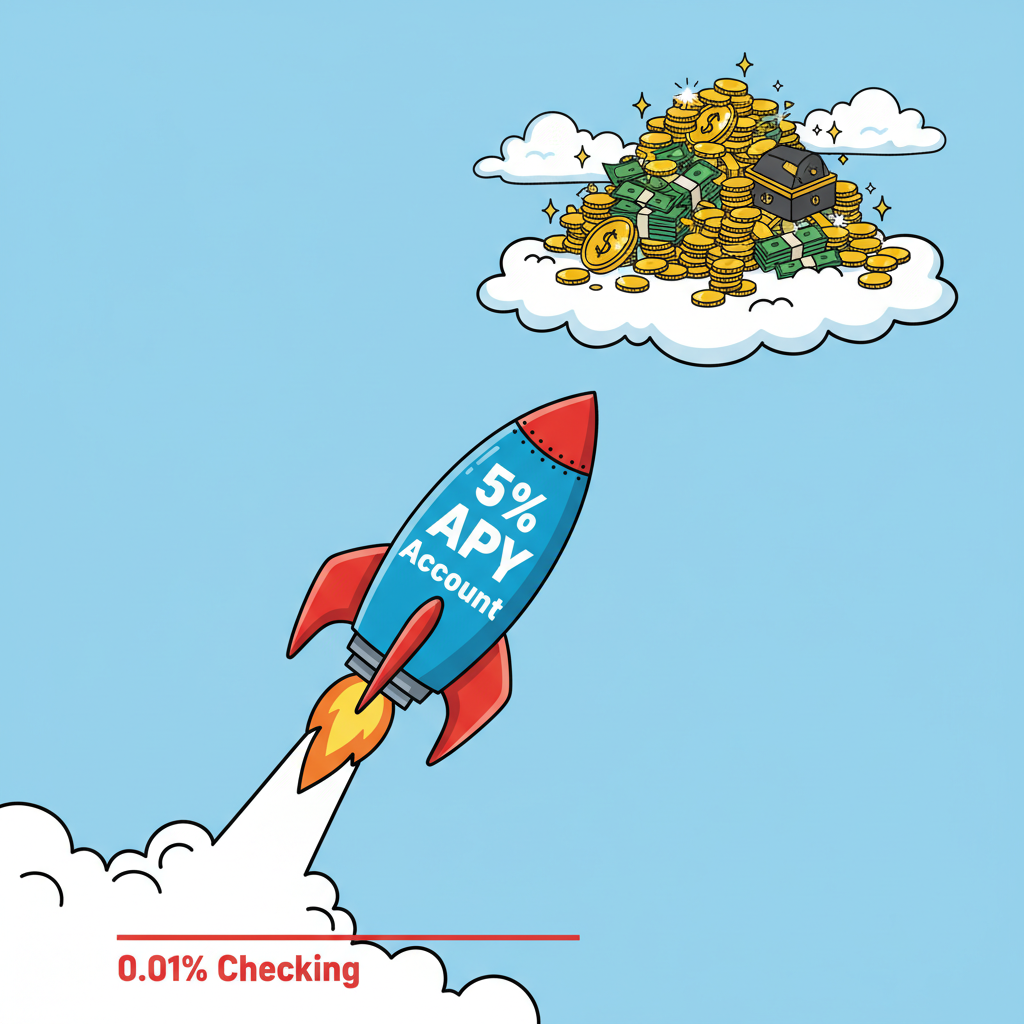
Talk is cheap. Let’s look at the math, because the numbers don’t lie. This is where you see just how much money you’re leaving on the table by sticking with a traditional bank. We’ll compare a standard checking account earning a pitiful 0.01% APY with a high-yield account pulling in a solid 5.00% APY.
The real magic here is compounding interest. In simple terms, it’s your money making money. You earn interest on your initial deposit, and then you start earning interest on that interest. It’s a snowball effect that turns your cash into a passive income powerhouse over time.
| Initial Deposit | Annual Earnings @ 0.01% APY | Annual Earnings @ 5.00% APY | 5-Year Earnings @ 5.00% APY (Compounded) |
|---|---|---|---|
| $1,000 | $0.10 | $50.00 | $276.28 |
| $5,000 | $0.50 | $250.00 | $1,381.41 |
| $10,000 | $1.00 | $500.00 | $2,762.82 |
| $20,000 | $2.00 | $1,000.00 | $5,525.63 |
Look at those numbers. With $10,000, you go from earning a single dollar a year to earning $500. Over five years, that’s over $2,700 in pure, passive profit for doing absolutely nothing but choosing a smarter bank account. This isn’t chump change; it’s a vacation, a paid-off credit card, or a serious boost to your investment portfolio. This is how you make your money work as hard as you do.
Read the Fine Print: The ‘Gotchas’ of High-Yield Accounts
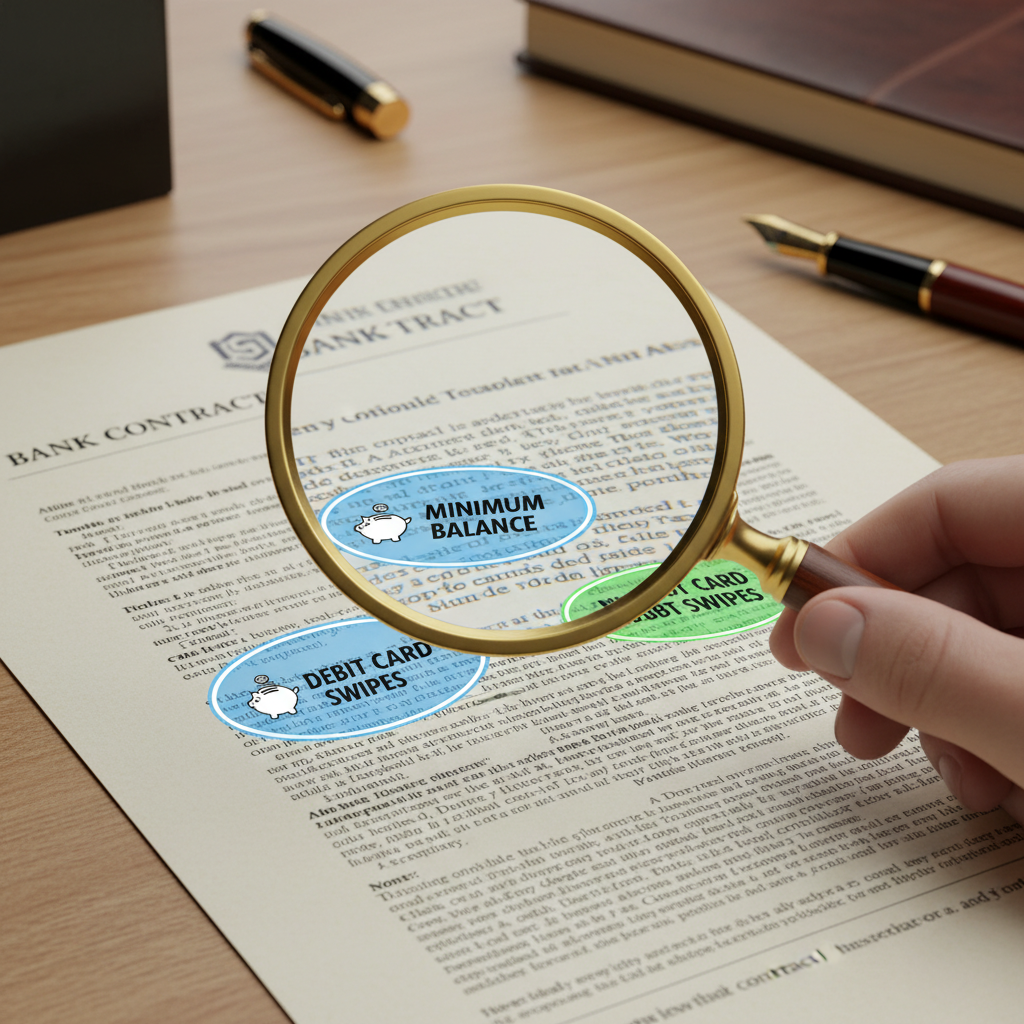
Okay, a 5% return on a checking account sounds too good to be true, right? It’s not, but there are sometimes hoops you have to jump through. These banks are willing to pay you, but you have to be a customer they want—someone who actively uses their account. Here’s what to watch for:
- Direct Deposit Requirements: Many high-yield checking accounts require you to have a certain amount, like $500 or more, direct-deposited into the account each month. This is easy to meet if you just switch your paycheck over.
- Debit Card Transaction Minimums: This is a common one. You might need to make 10-15 debit card purchases per month to qualify for the high interest rate. The purchases don’t have to be big—your morning coffee counts. Just be aware of this so you don’t fall short and get a lower rate.
- Minimum Balance: While many HYSAs have no minimum, some might require you to keep a certain amount in the account to avoid fees or earn the top-tier interest rate. Always check this before signing up.
- Variable Rates: This is crucial. The 5% APY isn’t locked in forever. It’s a variable rate that can—and will—change based on what the Federal Reserve does. When the Fed raises rates, your account’s APY will likely go up. When they cut rates, it will go down. But even when rates drop, they will almost certainly still demolish what your brick-and-mortar bank offers.
Scam Warning: Be wary of any offer that promises a guaranteed, fixed rate that’s astronomically high on a checking or savings account. Legitimate high-yield accounts have variable rates. Stick to well-known, FDIC-insured online banks you can find on reputable comparison sites like NerdWallet or Bankrate.
Your 15-Minute Money Upgrade: A Step-by-Step Guide
Ready to stop losing money and start earning it? Good. Making the switch is faster and easier than you think. You can do this on your lunch break. Here’s the game plan:
- Research & Compare (5 Minutes): Don’t just jump on the first ad you see. Go to a financial comparison website. Look for the highest APY combined with requirements you can actually meet. If you don’t use a debit card often, an account with a swipe minimum isn’t for you. Find the one that fits your lifestyle.
- Gather Your Docs (1 Minute): You’ll need your driver’s license or other government ID and your Social Security number. Have them ready.
- Apply Online (5 Minutes): The online applications are slick and fast. You’ll fill out your basic information, and approval is often instant.
- Fund Your New Account (2 Minutes): The easiest way is to link your old, crusty bank account. You’ll enter your old account and routing number, and you can initiate a transfer to fund your new, high-yield powerhouse. Start with a small amount if you want to test it out, then move the rest.
- Update Your Automations (2 Minutes): This is the most important step. Don’t forget it. Once your new account is funded, grab the new account and routing number. Go to your employer’s HR portal and switch your direct deposit. Go to your bill-paying apps (utilities, car payment, credit cards) and update your payment info. This ensures a seamless transition and prevents you from missing payments.
That’s it. In about 15 minutes, you’ve given yourself a raise. You’ve turned a lazy asset into a passive income stream. It is one of the highest-impact financial moves you can make with the least amount of effort.
Conclusion
For years, big banks have relied on us being too busy or too intimidated to move our money. They’ve made billions by paying us next to nothing for our loyalty. That era is over. In today’s world, with powerful online tools at our fingertips, letting your cash rot in a zero-interest account is a choice—a choice to leave free money on the table.
Making the switch to a high-yield checking or savings account is more than just a smart financial decision; it’s an act of empowerment. It’s you, the side hustler, the budget-conscious shopper, the frugal enthusiast, taking control and demanding that your money works for you, not for some bank’s shareholders. Stop letting them get rich off your hard work. Take the 15 minutes. Make the switch. Start getting paid what you’re worth.
Disclaimer: I am not a financial advisor and this article is for informational and educational purposes only. The content provided is not intended to be a substitute for professional financial advice. Always consult with a qualified professional before making any financial decisions. Interest rates are variable and subject to change.


Makenzie is the founder and lead writer at MoneyHackTips.com — a personal finance blog dedicated to delivering street-smart financial wisdom for real people on real budgets. With 300+ published articles covering everything from debt management to investing fundamentals, Makenzie’s mission is to make every dollar work harder. When not writing about money hacks, Makenzie is testing frugal living strategies, optimizing side hustles, and helping readers build financial freedom from scratch.